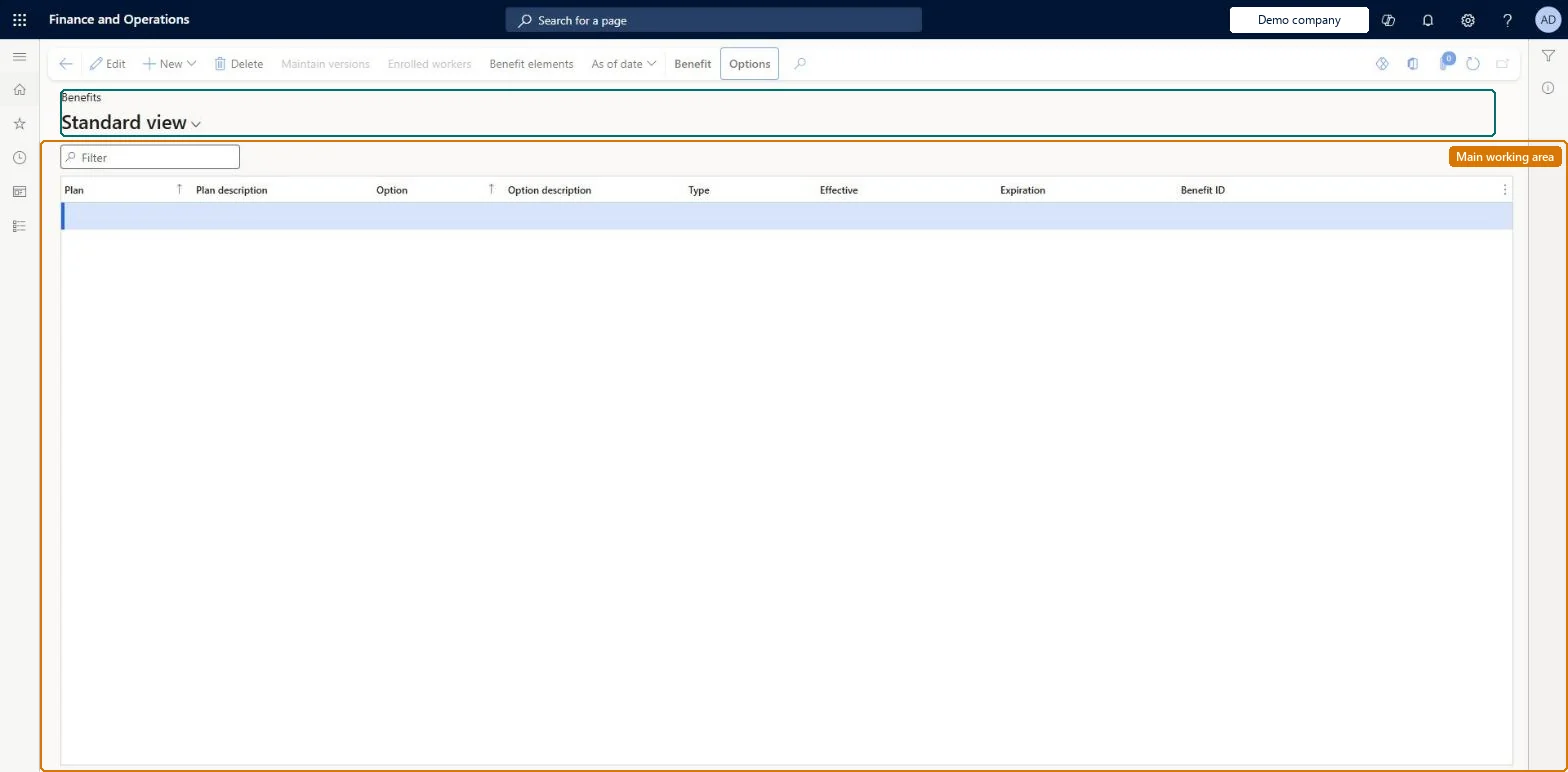
Use this page to create benefits from benefit plans and options, set the dates they are available, and decide how eligibility is determined, for example by assigning an eligibility rule type.
Compensation and benefits manager, Human resource assistant, Human resource manager and 3 more roles
Business process
Develop people strategy
Menu item
HcmBenefitList
Main table
HcmBenefit
Data entity
HcmBenefitEntity
Setup steps
1 on this page
Show what matters for
SETUP GUIDEHow to set it up8 sections. Choose a role to highlight what matters to you.
Everyone
1What it is and why
What it is
A list and details page where you keep the benefits your organisation offers, each one a combination of a benefit plan and a coverage option that workers can enrol in.
What you do here
Use this page to create benefits from benefit plans and options, set the dates they are available, and decide how eligibility is determined, for example by assigning an eligibility rule type.
Example
For example, BEAT creates the benefit Medical PPO with the option Employee only, effective 1 January 2027, with Eligibility set to Rule based and the rule type Full-time; an open enrollment event for 120 employees finds the 95 full-time employees eligible, and only they can be enrolled.
The page in Dynamics 365. page title tab to open what to set or check
About the examples: Examples and screenshots in this guide use BEAT, a demo company in a Dynamics 365 test environment. Use your own company's codes and values instead of copying them.
Setup steps on this page
Set up Benefits
Use this page to create benefits from benefit plans and options, set the dates they are available, and decide how eligibility is determined, for example by assigning an eligibility rule type.
Steps from Microsoft
Go to Human resources > Benefits > Benefits.
Find and select the benefit you want, and open it.
Expand the Eligibility rules section.
Select Edit.
In the Eligibility field, select the eligibility method.
In the Rule type field, select the rule type you created earlier.
Together these identify the benefit: the benefit type, the provider's plan, and the coverage option.Microsoft Learn
Medical / Medical PPO / Employee only
Effective / Expiration
The date range when the benefit is available to workers.Microsoft Learn
1/1/2027 to Never
Eligibility
How eligible workers are found: all workers, rule based, or bypassing the eligibility process.Microsoft Learn
Rule based
Rule type
The eligibility rule type assigned to the benefit when eligibility is rule based.Microsoft Learn
Full-time
Eligibility overrides
Workers listed here are eligible for the benefit regardless of the usual eligibility criteria.Microsoft Learn
Julia Funderburk, 1/1/2027 to 12/31/2027
Common errors and fixes
Message
What to do
A worker can't be enrolled in the benefit
With Rule based or All workers are eligible, the worker must be in a processed eligibility event first. Process an event that includes the worker, or add an eligibility override whose dates cover the coverage start date. Microsoft Learn
Nothing is deducted or contributed for the benefit, and the Payroll FastTab is missing
The plan's Payroll impact is None. Set Payroll impact on the plan on Benefit elements to what the plan really does, then fill the Payroll FastTab of the benefit. Microsoft Learn
The page opens read-only and Edit isn't available
Benefits management is turned on, which makes the legacy Benefits pages read-only. It can be turned off only in a Sandbox environment; in Production keep working in the Benefits management workspace. Microsoft Learn
Test checklist
Create a benefit from a plan and option with Effective and Expiration dates.
Set Eligibility to Rule based and select a Rule type.
Create an eligibility event from the benefit, add workers, and select Process.
Select Show results and check eligible and ineligible workers match the rule.
Enroll an eligible worker and check the Payroll values default from the benefit on the worker's benefit.
Rule based eligibility for most benefits; All workers are eligible only for benefits everyone gets (for example parking); Bypass eligibility process only for garnishments and tax levies.Learn says Rule based is the method used for most benefits. All workers are eligible still limits enrollment to processed eligibility events, while Bypass eligibility process lets anyone be enrolled at any time.
This page is part of the legacy Benefits workspace. Turning on Benefits management in Feature management makes it read-only, and in a Production environment Benefits management can't be turned off again; Microsoft recommends enabling and testing it in a Sandbox first. Benefits are kept by the Compensation and benefits manager and the Payroll administrator; HR managers and assistants, recruiters and payroll managers read them.
Shared: benefits are not per company. Data management lists the Benefit entity as shared, so every legal entity uses the same benefits; payroll accounting is set per legal entity on the plan. Checked in Dynamics 365
Can it be undone
Hard to reverse: Mass benefit expiration changes the expiration date of the benefit and the coverage end dates of every enrolled worker together. Mass extension can push dates out again, but the enrollments themselves were changed.
If you change it later
The Payroll FastTab values of a benefit are the defaults copied to each worker's Maintain benefits page at enrollment, and the eligibility method decides who can enroll: Bypass eligibility process lets any worker be enrolled at any time, while All workers are eligible and Rule based need a processed eligibility event first. Microsoft Learn
Technical architect
6Technical
Menu item
HcmBenefitListChecked in Dynamics 365
Form
HcmBenefitChecked in Dynamics 365
Table
HcmBenefitShown as “BENEFIT” in Record infoKey field: BenefitIdChecked in Dynamics 365
Data entities
HcmBenefitEntityBenefit Checked in Dynamics 365
Who can open it
PrivilegesMaintain benefits HcmBenefitInquiryMaintainView a list of benefits HcmBenefitInquiryViewAccess benefits workspace HcmBenefitWorkspaceDutiesInquire into benefits process HcmBenefitInquireEnable benefits process HcmBenefitProcessEnableAccess benefits workspace HcmBenefitWorkspaceMaintain worker master HcmWorkerMaintainInquire into payroll master data PayrollMasterDataInquireSet up payroll master data PayrollMasterDataMaintainInquire into payroll position and worker setup PayrollPositionWorkerSetupInquireSet up payroll positions and workers PayrollPositionWorkerSetupMaintain6 security rolesCompensation and benefits manager HcmCompensationAndBenefitsManagerHuman resource assistant HcmHumanResourceAssistantHuman resource manager HcmHumanResourceManagerPayroll administrator HcmPayrollAdministratorPayroll manager HcmPayrollManagerRecruiter HcmRecruiterChecked in Dynamics 365
Roles to set it up and use it
To set it up or change itCompensation and benefits manager HcmCompensationAndBenefitsManagerPayroll administrator HcmPayrollAdministratorTo use itHuman resource manager HcmHumanResourceManagerHuman resource assistant HcmHumanResourceAssistantRecruiter HcmRecruiterPayroll manager HcmPayrollManagerGive people one of these roles. On this system, 6 roles can open this page.Checked in Dynamics 365
Actions on the page
Benefit(Action Pane without tabs): New, Delete, Maintain versions, Enrolled workers, Benefit elements, As of dateChecked in Dynamics 365
Developer
7Developer
Open it by URL
https://<your-environment>/?mi=HcmBenefitList
Integrate with
HcmBenefitEntity data entity Checked in Dynamics 365
Data migration
HcmBenefitEntity Benefit: the plan and option combinations workers enroll in. Shared by all companies.Load order: Benefit types, plans, options and benefits aren't in a default Data management template (the Legacy benefits template starts with eligibility). Build a data project that loads Benefit type, Benefit plan and Benefit option before Benefit, then load the Legacy benefits template for eligibility events and coverage groups.Load first: HcmBenefitTypeEntity, HcmBenefitPlanEntity, HcmBenefitOptionEntityMicrosoft Learn