Compensation and benefits manager, Human resource assistant, Human resource manager and 3 more roles
Business process
Define benefit offerings
Menu item
HcmBenefitEligibilityPolicyListPage
Main table
SysPolicy
Data entity
None for this page's own settings
Setup steps
1 on this page
Show what matters for
PAGE GUIDEWhat the page does and how to use it8 sections. Choose a role to highlight what matters to you.
Everyone
1What it is and why
What it is
A setup page where you maintain benefit eligibility policies, each a collection of eligibility rules that applies to one or more legal entities.
What you do here
Use this page to choose the organisations a policy covers and to create the policy rules, with effective dates and conditions, for each rule type.
Example
For example, BEAT's policy covers the legal entities BEAT and BEUS; the rule effective 1 January 2027 has the condition Where position description equals Sales Manager, so the 4 sales managers are eligible for the mobile phone benefit and the other 136 workers aren't.
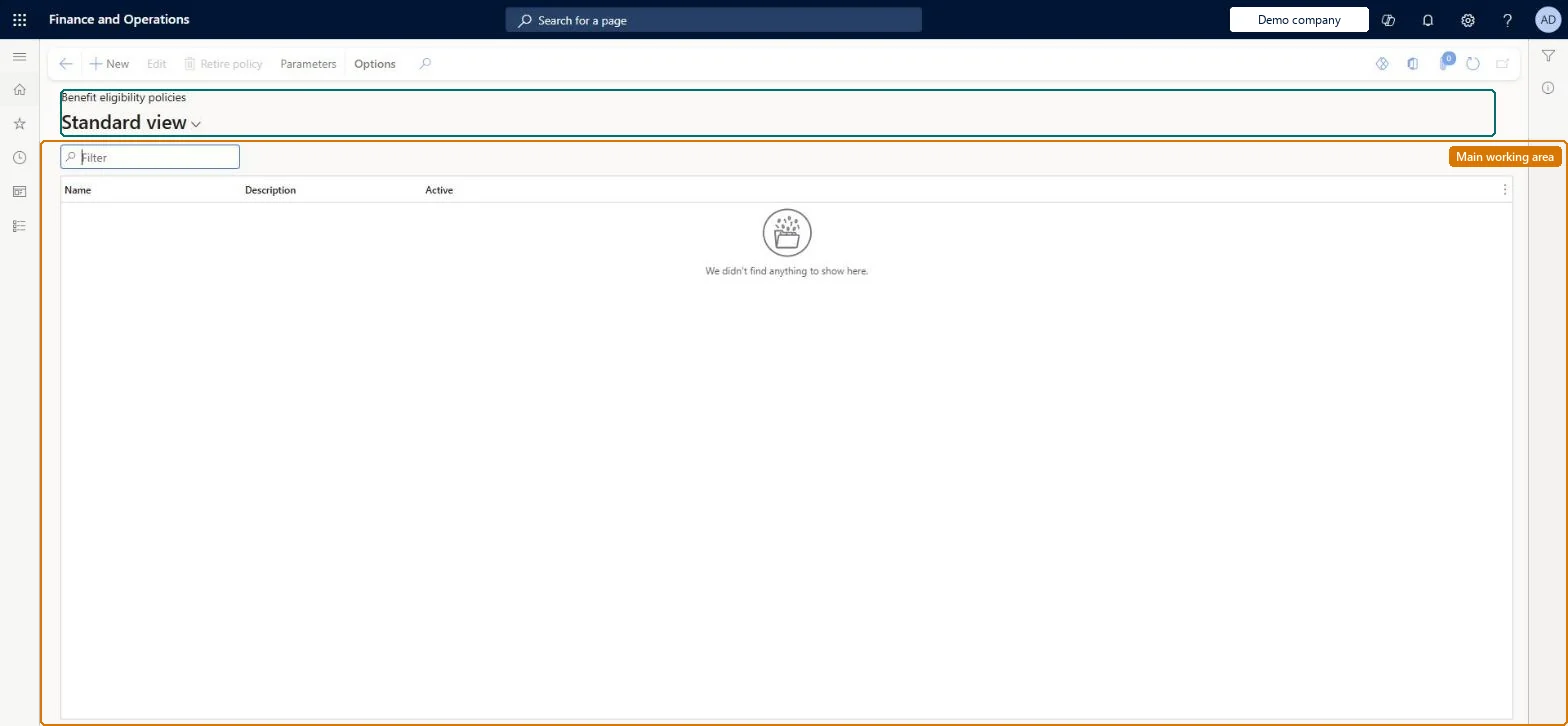
The page in Dynamics 365. page title tab to open what to set or check
About the examples: Examples and screenshots in this guide use BEAT, a demo company in a Dynamics 365 test environment. Use your own company's codes and values instead of copying them.
Setup steps on this page
Keep dated eligibility rules in one policy
Hold the eligibility conditions for each rule type in a benefit eligibility policy that covers the right legal entities.
Steps from Microsoft
Go to Human resources > Benefits > Eligibility > Benefit eligibility policies.
Select an existing benefit policy and open it.
In the Policy organizations section, add or remove the organisations to include in the policy.
In the Policy rules section, find the policy rule type you created and select Create policy rule.
In the Effective date field, enter the date when the rule becomes effective.
If needed, add a where clause in the Add condition field.
Where clauses that limit which workers the rule finds.Microsoft Learn
Where position description equals Sales Manager
Common errors and fixes
Message
What to do
A policy rule is ignored for workers in one legal entity
The legal entity isn't in the policy's Policy organizations. Add it, then process the eligibility event again. Microsoft Learn
A changed rule already applies to an event for an earlier coverage date
Policy rules are date effective. Instead of editing today's rule, create a new rule with a later effective date so the change takes effect on that date. Microsoft Learn
The page opens read-only and Edit isn't available
Benefits management is turned on, which makes the legacy Benefits pages read-only. It can be turned off only in a Sandbox environment; in Production keep working in the Benefits management workspace. Microsoft Learn
Test checklist
Open a policy and check Policy organizations includes the legal entities that should use it.
Create a policy rule with an effective date and a condition, for example position description equals Sales Manager.
Process an eligibility event with a coverage start date after the effective date and check a Sales Manager is eligible and others aren't.
Create a future-dated rule and check the current results are unchanged until that date.
One benefit eligibility policy per group of legal entities that share the same rules, with one policy rule per rule type; schedule each change as a new rule with a later effective date.Learn's policies are a collection of rules for one or more legal entities, and setting effective dates lets future changes take effect without returning to the policy.
This page is part of the legacy Benefits workspace. Turning on Benefits management in Feature management makes it read-only, and in a Production environment Benefits management can't be turned off again; Microsoft recommends enabling and testing it in a Sandbox first. Benefits are kept by the Compensation and benefits manager and the Payroll administrator; HR managers and assistants, recruiters and payroll managers read them.
Shared: the policy record is not per company (Data management lists the Policies entity as shared). Which legal entities a policy applies to is set in its Policy organizations. Checked in Dynamics 365
Can it be undone
Reversible: Policy rules are date-effective, so you can schedule a future change with a new effective date instead of overwriting today's rule. Organizations can be added to or removed from a policy. Microsoft Learn
If you change it later
Because policy rules are date-effective, you can schedule future rule changes so they take effect on their own dates without revisiting the policy. Microsoft Learn
Technical architect
6Technical
Menu item
HcmBenefitEligibilityPolicyListPageChecked in Dynamics 365
Form
SysPolicyListPageChecked in Dynamics 365
Table
SysPolicyShown as “POLICY” in Record infoKey field: NameChecked in Dynamics 365
Data entities
SysPolicyEntityPolicies (The policy header only. The entity holds policies of every type (purchasing policies load through it too), so filter on the benefit eligibility policy; the rules and their conditions are kept per rule type.) Microsoft data model SysPolicyInternalOrganizationAssignmentEntityPolicy organization assignments (The Policy organizations: the legal entities the policy applies to.) Microsoft data model
Who can open it
PrivilegesMaintain benefit setup HcmBenefitElementSetupMaintainView benefit setup HcmBenefitElementSetupViewDutiesInquire into benefits process HcmBenefitInquireEnable benefits process HcmBenefitProcessEnableMaintain worker master HcmWorkerMaintainInquire into payroll master data PayrollMasterDataInquireSet up payroll master data PayrollMasterDataMaintainSet up payroll positions and workers PayrollPositionWorkerSetupMaintain6 security rolesCompensation and benefits manager HcmCompensationAndBenefitsManagerHuman resource assistant HcmHumanResourceAssistantHuman resource manager HcmHumanResourceManagerPayroll administrator HcmPayrollAdministratorPayroll manager HcmPayrollManagerRecruiter HcmRecruiterChecked in Dynamics 365
Roles to set it up and use it
To set it up or change itCompensation and benefits manager HcmCompensationAndBenefitsManagerPayroll administrator HcmPayrollAdministratorTo use itHuman resource manager HcmHumanResourceManagerHuman resource assistant HcmHumanResourceAssistantRecruiter HcmRecruiterPayroll manager HcmPayrollManagerGive people one of these roles. On this system, 6 roles can open this page.Checked in Dynamics 365
Actions on the page
(Action Pane without tabs): Edit, Retire policy, ParametersChecked in Dynamics 365
SysPolicyEntity Policies: the policy header. Shared by all companies; it also carries policies of other types, such as purchasing policies.SysPolicyInternalOrganizationAssignmentEntity Policy organization assignments: the legal entities the policy applies to.Load order: Load the benefit eligibility policy rule types first, then the policy, then its organization assignments. Check each policy rule, its effective date and its condition on the page after the load.Load first: HcmBenefitEligibilityPolicyRuleTypeEntityMicrosoft Learn