Marketing manager, Information technology manager, Sales manager
Business process
Maintain contacts and accounts
Menu item
smmEmailGroups
Main table
smmEmailGroups
Data entity
smmEmailGroupEntity
Setup steps
1 on this page
Show what matters for
SETUP GUIDEHow to set it up8 sections. Choose a role to highlight what matters to you.
Everyone
1What it is and why
What it is
A setup page where you create email groups and add or remove their members: contacts, workers and sales units.
What you do here
Use this page to group contacts, workers and sales units so that a document can be emailed to the whole group.
Example
BEAT creates the email group DEALERS-EU in category PRICELIST and adds 64 dealer contacts and the sales unit EU-SALES. A campaign's 210 targets can also be turned into a new email group from the campaign.
The page in Dynamics 365. page title tab to open what to set or check
About the examples: Examples and screenshots in this guide use BEAT, a demo company in a Dynamics 365 test environment. Use your own company's codes and values instead of copying them.
Step by step, with screenshots
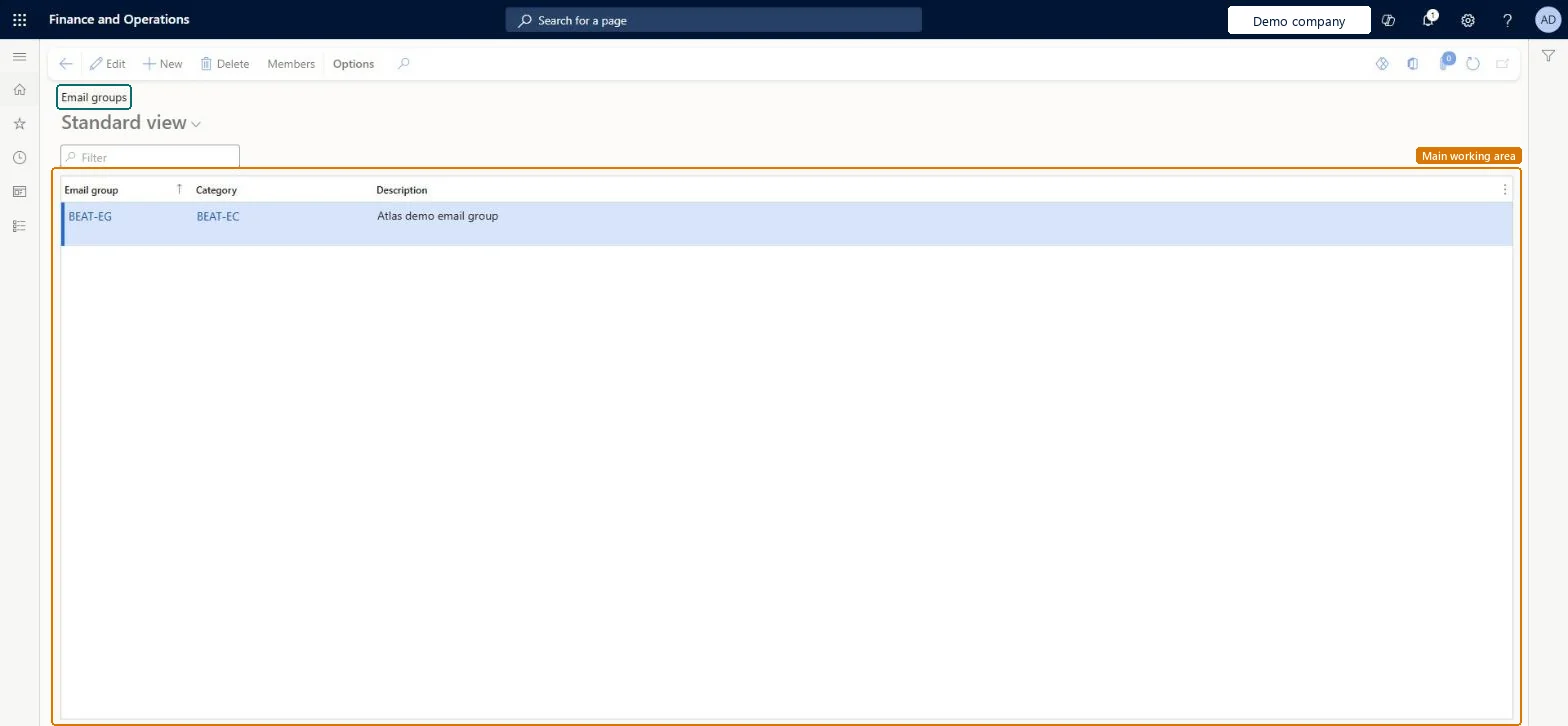
Set up Email groups1 screen
Use this page to group contacts, workers and sales units so that a document can be emailed to the whole group.
Screen 1
Create an email group
Go to Sales and marketing > Setup > Mailings > Email groups
Make sure the email category exists (Sales and marketing > Setup > Mailings > Email categories)
Select New
Enter the email group, select the category and enter a description
Select Save
Use Members to add the contacts, workers or sales units
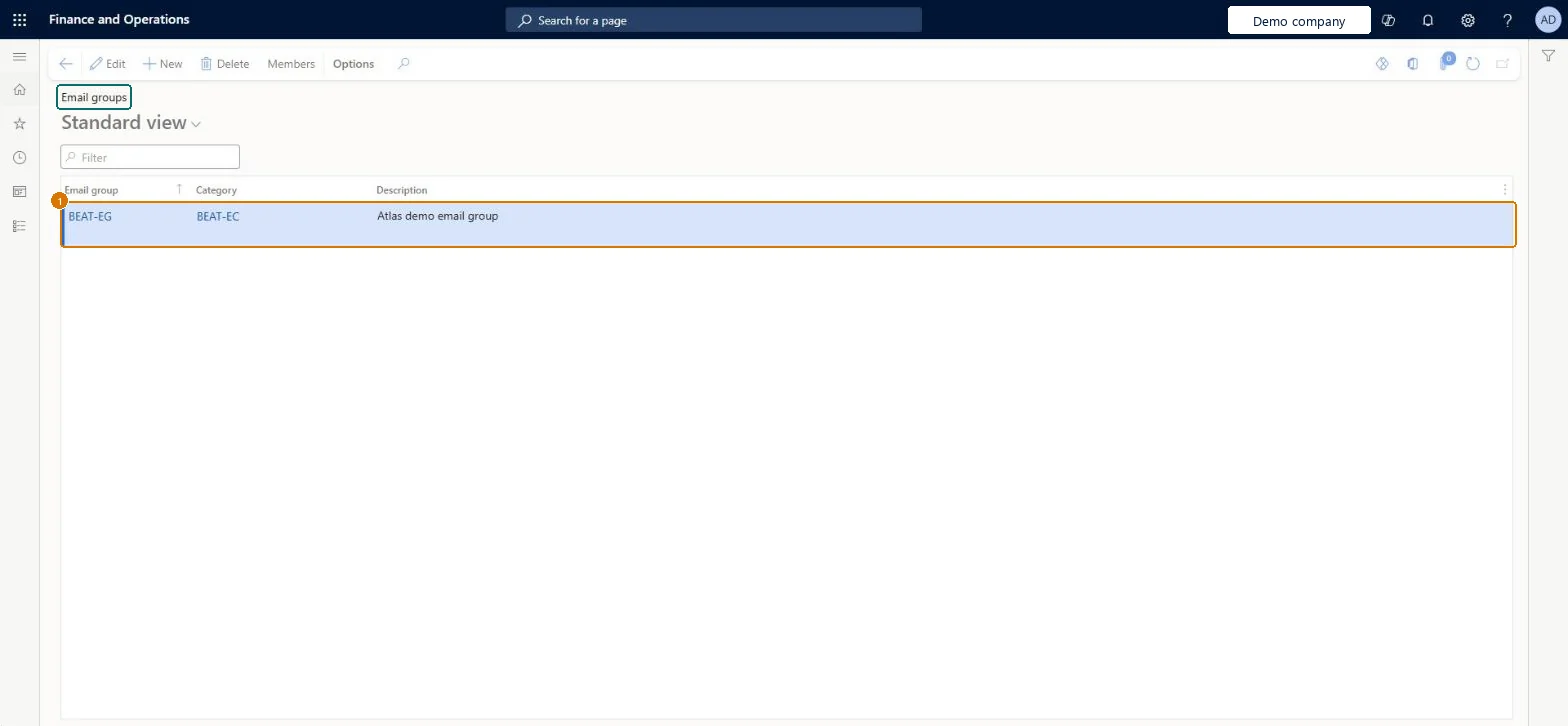
1Email group
BEAT-EG
Category
BEAT-EC
Description
Email group
Show the full screen page title tab to open what to set or check
Steps from Microsoft
Go to Sales and marketing > Setup > Mailings > Email groups.
Select New to create an email group.
In the Email group and Category fields, enter the name of the group and select an email category.
Select Members to open the email group members page.
On the Contacts, Workers and Sales units tabs, use the > button to add members to the list, and < to remove them.
A note that describes the email group.Checked in Dynamics 365
EU dealers, quarterly price list
Note
Common errors and fixes
Message
What to do
Campaign targets are missing from an email group that was created by hand.
Create the group from the campaign instead: on All campaigns, on the Targets tab, select Create e-mail group. All targets are added as members and stay on the campaign. Microsoft Learn
Test checklist
Create the email group DEALERS-EU with category PRICELIST.
Select Members and add 3 contacts and 1 sales unit.
Close and reopen Members.
Check that the E-mail members list shows 4 members.
Email groups per audience (for example DEALERS-EU), built from campaign targets where a campaign exists, and reviewed before each send.Creating the group from the campaign adds every target as a member in one step, and the group is what Email distribution sends to.
Reversible: Members can be added or removed at any time.
If you change it later
Members are added and removed on the group, so a later email to the group goes to the members at that time. Creating a group from a campaign copies the targets; it doesn't remove them from the campaign. Microsoft Learn
Technical architect
6Technical
Menu item
smmEmailGroupsChecked in Dynamics 365
Form
smmEmailGroupsChecked in Dynamics 365
Table
smmEmailGroupsShown as “Email groups” in Record infoKey field: GroupId, CategoryId, NoteChecked in Dynamics 365
PrivilegesMaintain email groups smmEmailGroupsMaintainView email groups smmEmailGroupsViewDutiesEnable the Sales and marketing process smmCRMProcessEnableInquire into Sales and marketing reference data smmCRMReferenceDataInquireEnable marketing process smmMarketingProcessEnableInquire into marketing reference data smmMarketingReferenceData3 security rolesMarketing manager CRMMarketingManagerInformation technology manager SysServerITManagerSales manager TradeSalesManagerChecked in Dynamics 365
Roles to set it up and use it
To set it up or change itSales manager TradeSalesManagerMarketing manager CRMMarketingManagerInformation technology manager SysServerITManagerGive people one of these roles. On this system, 3 roles can open this page.Checked in Dynamics 365
smmEmailGroupEntity (Email groups): loaded for each company, in Microsoft's default template 330 - Sales and marketing.Load order: Microsoft's default template 330 - Sales and marketing loads Email groups at execution unit 1, level 40, sequence 10. Lower levels load first, and entities at the same level load in sequence order.Load first: the default templates at lower levels (System setup to dependency bands 30 to 90)Microsoft Learn
Checked in a working Dynamics 365 system, version 10.0.49: the menu item, form, table and security, the page, the demo records and the values in the screenshots.
To cite this step: SM-SETUP-190, Set up Email groups. Beyond ERP Atlas Hub, 2026-11-11. https://www.beyonderp.cloud/atlas/step/SM-SETUP-190