Reconcile a bank account with Account reconciliation
Cash and bank managementBank statement reconciliation
BankAccountTableListPage
Used by
Accounts payable manager, Chief financial officer, Accounts receivable manager and 6 more roles
Business process
Reconcile bank accounts
Menu item
BankAccountTableListPage
Main table
BankAccountTable
Data entity
None for this page's own settings
Setup steps
1 on this page
Show what matters for
SETUP GUIDEHow to set it up8 sections. Choose a role to highlight what matters to you.
Everyone
1What it is and why
What it is
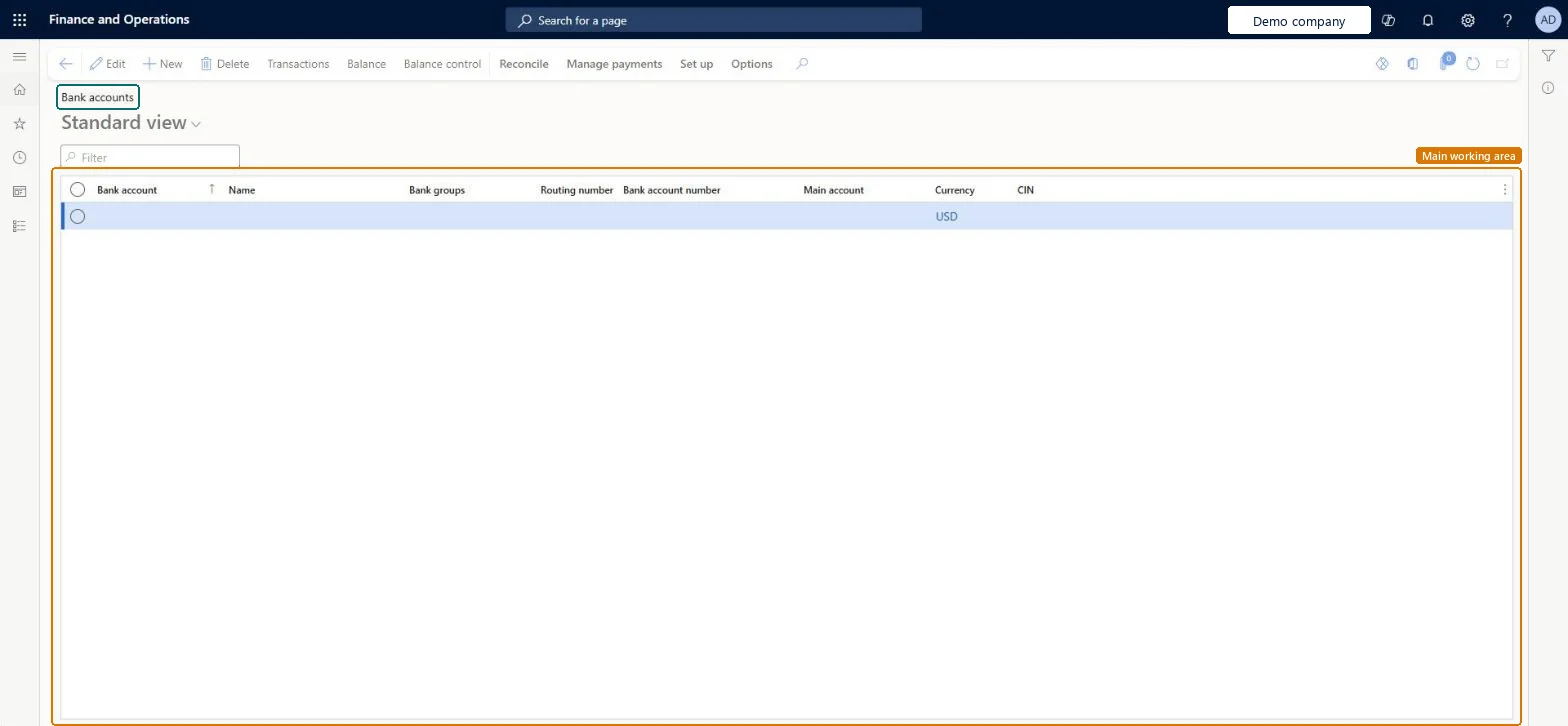
The Bank accounts list opened from the Bank statement reconciliation menu, where you start the reconciliation of a bank account that doesn't use advanced bank reconciliation.
What you do here
Use this page to reconcile a bank account with its bank statement through Reconcile > Account reconciliation, and to reach the bank statements of accounts that use advanced bank reconciliation.
Example
For example, BEAT's petty cash bank account doesn't use advanced bank reconciliation: for the March statement with an ending balance of 15,240.00 the accountant marks 37 cleared transactions, adds a 25.00 bank fee and selects Reconcile account when Unreconciled reaches 0.00.
The page in Dynamics 365. page title tab to open what to set or check
About the examples: Examples and screenshots in this guide use BEAT, a demo company in a Dynamics 365 test environment. Use your own company's codes and values instead of copying them.
Setup steps on this page
Reconcile a bank account with Account reconciliation
Reconcile bank accounts that don't use advanced bank reconciliation against each statement.
Steps from Microsoft
Go to Cash and bank management > Bank statement reconciliation > Bank accounts, select the bank account and select Reconcile > Account reconciliation.
Enter Bank statement date and Bank statement, and the statement's ending balance in Ending balance.
Select Transactions and select Cleared for each transaction on the statement, or use Mark check interval or Mark all as cleared.
Enter any difference in Correction amount, and add lines for fees and interest that are on the statement but not in Finance, with their bank transaction type.
When Unreconciled reaches zero, select Reconcile account. Accounts with Advanced bank reconciliation = Yes are reconciled on Bank reconciliation instead.
The general ledger account that the bank account posts to.Microsoft Learn
LedgerDimension
Bank groups
The bank group whose address and routing details are copied to the bank account.Microsoft Learn
BankGroupId
Prenote required
Turn on when the bank needs a prenote before it accepts electronic payments.Microsoft Learn
isBankPrenote
Prenote response days
How many days the bank takes to process a prenote.Microsoft Learn
PrenoteResponseDays
Bank account status
Whether the account is active for all transactions, inactive for new ones, or inactive for all.Microsoft Learn
BankAccountStatus
Active from
The date from which the account can be used for new transactions.Microsoft Learn
ActiveFrom
Active to
The date after which the account can't be used for new transactions.Microsoft Learn
ActiveTo
Credit limit
The credit amount that the bank offers on this account.Microsoft Learn
OverDraftLimit
Advanced bank reconciliation
Turns on electronic statement import and automatic matching for this account.Microsoft Learn
Allowed penny difference
The largest amount difference that still counts as a match during reconciliation.Microsoft Learn
BankReconAllowedPennyDifference
Statement format
The import format used to read this account's electronic bank statements.Microsoft Learn
BankStatementFormat
Clear bridged transactions during reconciliation
When on, bridged payments are cleared to the bank automatically when the reconciliation worksheet is marked as reconciled.Microsoft Learn
BankReconBridgedAutoClearing
Ending balance
The bank account balance as it appears on the bank statement.Microsoft Learn
15,240.00
Cleared
Select it for each transaction that is on the statement with the same amount; not available while a reversal is Pending cancellation.Microsoft Learn
Correction amount
The difference when the amount on the statement differs; can't be used when the transaction's fiscal period is closed.Microsoft Learn
0.03
Common errors and fixes
Message
What to do
The Cleared checkbox can't be selected for a transaction
The check or deposit slip payment has status Pending cancellation. A reviewer must post or reject the reversal on Payment reversal approvals first. Microsoft Learn
Correction amount can't be entered
The fiscal period of the transaction is closed. Add a correction line dated in an open period with the original financial dimensions and the offset main account. Microsoft Learn
Test checklist
Start Account reconciliation with the statement date and ending balance.
Mark the statement's transactions as Cleared and add a 25.00 fee line with its bank transaction type.
Check that Unreconciled is 0.00 and select Reconcile account.
Run Unreconciled bank transactions and check only the transactions not on the statement are listed.
Reconcile each statement in date order, clear only transactions on the statement and add fees and interest as lines with their bank transaction type.Reconciled transactions are locked and drop out of later reconciliations, so clearing a transaction that isn't on the statement hides a difference.
Hard to reverse: Cancel only in entry order and with Allow bank statement edit on.
If you change it later
After the reconciliation is posted, its transactions can't be changed or corrected and don't show in later reconciliations. A posted reconciliation can only be cancelled, in the order it was entered, with Allow bank statement edit on in the parameters. Microsoft Learn
Technical architect
6Technical
Menu item
BankAccountTableListPageChecked in Dynamics 365
Form
BankAccountTableChecked in Dynamics 365
Table
BankAccountTableShown as “Bank accounts” in Record infoKey field: AccountID, BankCodeType, RegistrationNum, AccountNum, BankCIN, SWIFTNo, IBAN, CompanyPaymId, DivisionPaymIdChecked in Dynamics 365
Data entities
BankAccountEntityBank accounts (The bank account and its reconciliation settings; reconciliations themselves aren't loaded.) Microsoft data model
Who can open it
PrivilegesMaintain bank accounts BankAccountTableMaintainView bank accounts BankAccountTableViewDutiesInquire into bank accounts master BankBankAccountsInquireMaintain bank accounts master BankBankAccountsMaintain9 security rolesChief financial officer CompanyChiefFinancialOfficerAccounts receivable manager CustInvoiceAccountsReceivableManagerPayroll administrator HcmPayrollAdministratorAccountant LedgerAccountantAccounting manager LedgerAccountingManagerAccounting supervisor LedgerAccountingSupervisorFinancial controller LedgerFinancialControllerTreasurer PaymTreasurerAccounts payable manager VendInvoiceAccountsPayableManagerChecked in Dynamics 365
Roles to set it up and use it
To set it up or change itTreasurer PaymTreasurerTo use itChief financial officer CompanyChiefFinancialOfficerAccounting manager LedgerAccountingManagerFinancial controller LedgerFinancialControllerAccountant LedgerAccountantAccounting supervisor LedgerAccountingSupervisorGive people one of these roles. On this system, 9 roles can open this page.Checked in Dynamics 365
Actions on the page
Reconcile: ReconcileManage payments: Deposits, Remittances, Journals, Related information, Statistics, Positive paySet up: Negotiable instruments, Layout, Methods of paymentOptions: Personalize, Page options, ShareChecked in Dynamics 365
BankAccountEntity (Bank accounts): loaded for each company, in Microsoft's default template 100 - Bank.Load order: Microsoft's default template 100 - Bank loads Bank accounts at execution unit 1, level 100, sequence 10. Lower levels load first, and entities at the same level load in sequence order.Load first: Currencies, Journal names, Bank groups, Customer charge groups, Reconciliation matching rule sets, the default templates at lower levels (System setup to dependency bands 30 to 90)Microsoft Learn
Checked in a working Dynamics 365 system, version 10.0.49: the menu item, form, table and security, the page.
To cite this step: CB-REC-010, Reconcile a bank account with Account reconciliation. Beyond ERP Atlas Hub, 2026-11-11. https://www.beyonderp.cloud/atlas/step/CB-REC-010