Process general ledger data for cost accounting in Dynamics 365 Finance
Menu item
CAMCostEntry
Main table
CAMDataCostObjectCostEntry
Data entity
CAMAggregatedCostEntryWithHierarchiesEntity
Setup steps
1 on this page
Show what matters for
SETUP GUIDEHow to set it up8 sections. Choose a role to highlight what matters to you.
Everyone
1What it is and why
What it is
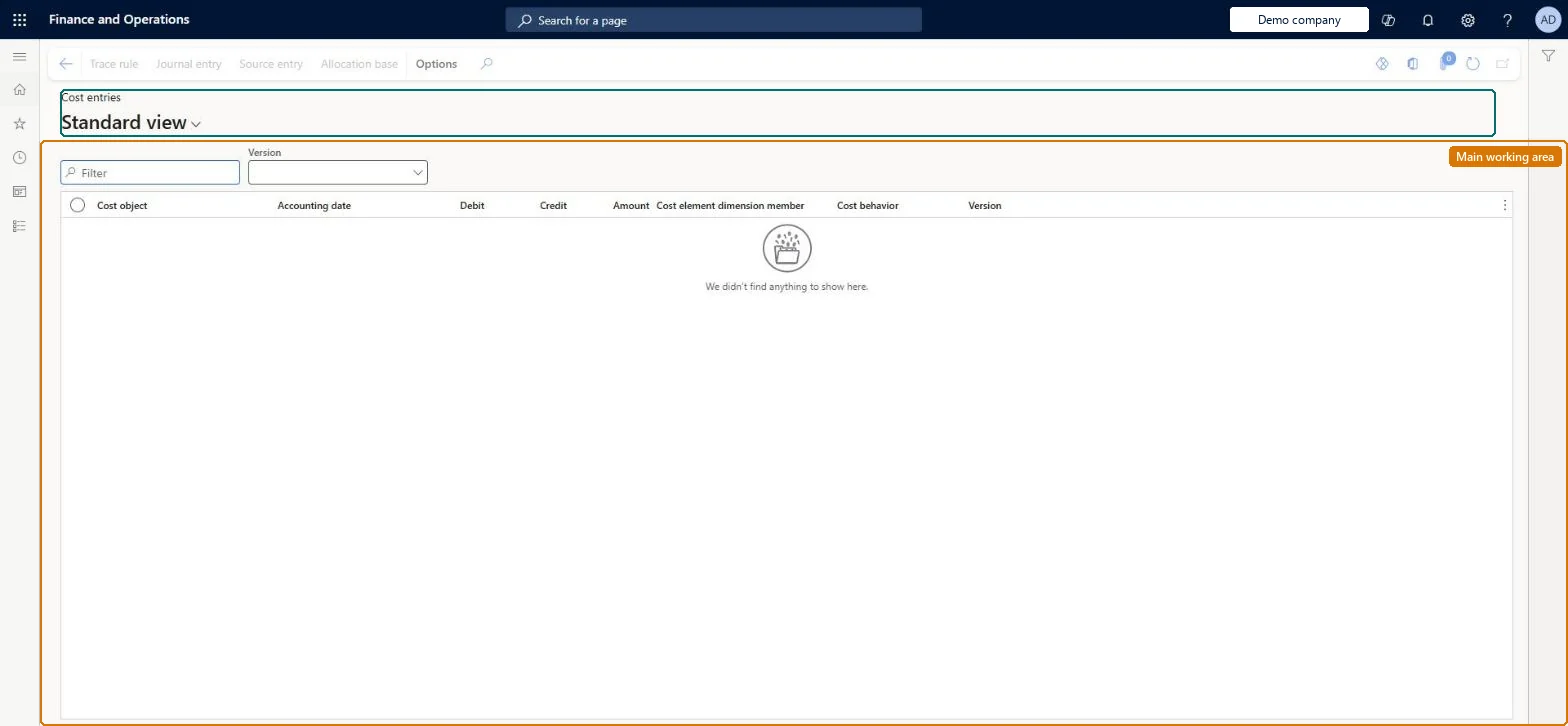
An inquiry page that lists the monetary cost entries held in a cost accounting ledger, each showing the cost object, cost element, cost behavior, amount and accounting date, whether the entry came from a data connector transfer, a cost allocation or a cost journal.
What you do here
Use this page to review the individual cost entries that source data processing, overhead calculations and cost journals have created, and to trace a cost entry back to the general ledger entry it came from.
Example
For example, if you want to understand the rent cost that your cost center must carry, you drill down to the cost entries to see how the rent was distributed.
The page in Dynamics 365. page title tab to open what to set or check
About the examples: Examples and screenshots in this guide use BEAT, a demo company in a Dynamics 365 test environment. Use your own company's codes and values instead of copying them.
Setup steps on this page
Read cost entries for one version and period
Filter cost entries so they answer one question, such as what a cost center carries after allocation.
Steps from Microsoft
Go to Cost accounting > Inquiries and reports > Cost entries.
Select the cost accounting ledger version, such as the actual version or an overhead calculation version.
Filter on Cost object, Cost element and Accounting date.
Select Trace rule to see the policy rule that created an entry.
Select Journal entry, then Source entry, to reach the transaction it came from.
Select Allocation base to see the base and magnitudes behind an allocated amount.
The cost object (for example a cost center) that the cost was posted on or allocated to.Microsoft Learn
CostObject
Cost element
The cost element (for example a main account) that categorises the cost.Microsoft Learn
Cost behavior
Whether the overhead calculation has classified the amount as fixed, variable or still unclassified.Microsoft Learn
CostBehavior
Amount
The monetary amount of the entry in the cost accounting ledger currency.Microsoft Learn
Amount
Accounting date
The date the entry is accounted for in the cost accounting ledger's fiscal calendar.Microsoft Learn
AccountingDate
Common errors and fixes
Message
What to do
Corrected source figures don't show in Cost accounting
Cost accounting keeps its own copy of the source data. Import the data again and process the source data for the period. Microsoft Learn
Processed journal shows no cost entries
Only main accounts that are cost elements produce cost entries. Check the cost element dimension's account range and the accounting dates of the source entries. Microsoft Learn
Test checklist
Filter on the actual version and one cost center for the period.
Compare the total with the cost center's balance on the general ledger for the cost element accounts.
Open an allocated entry and select Allocation base to check its magnitude.
Filter on the version first (actual, budget or one overhead calculation), then the period and the cost object; add Cost behavior when you compare fixed and variable cost.Entries from source data, from each calculation step and from cost journals sit side by side, and overhead calculation entries are dated on the period end, so the version and date filters decide the answer.
Cost accounting has four roles: Cost accounting manager (Activity licence), Cost accountant and Cost accountant clerk (Operations licence), and Cost object controller (Team members licence). Cost object controllers reach this page by drilling down from the Cost control workspace. No Feature management feature needs to be turned on for this page.
Shared: Cost accounting setup isn't kept per legal entity. It is the same from every company, and one cost accounting ledger can collect data from several legal entities. Checked in Dynamics 365
Can it be undone
Reversible: The inquiry changes no data.
If you change it later
Cost entries are a separate copy of the source data, so processing or correcting them in Cost accounting never changes the general ledger; if the source figures change you import and process the data again. Microsoft Learn
Technical architect
6Technical
Menu item
CAMCostEntryChecked in Dynamics 365
Form
CAMCostObjectCostEntryChecked in Dynamics 365
Table
CAMDataCostObjectCostEntryShown as “COST ENTRIES” in Record infoChecked in Dynamics 365
Data entities
CAMAggregatedCostEntryWithHierarchiesEntityAggregated cost entries with dimension hierarchies Microsoft data model CAMAggregatedCostEntryWithDefaultCostObjectHierarchyEntityAggregated cost entries with the default cost object hierarchy Microsoft data model
Who can open it
3 security roles. Select a role to see its duties and privileges.
RoleCost accountantCAMCostAccountant
DutyInquire into cost object entriesCAMCostObjectEntriesInquire
To use itInquire into cost object entries CAMCostObjectEntriesInquireGive people a role that holds these duties. On this system, 3 roles give access to this page.Checked in Dynamics 365
Actions on the page
(Action Pane without tabs): Trace rule, Journal entry, Source entry, Allocation baseChecked in Dynamics 365
Load order: A cost entry has no data entity in Data management, so it can't be loaded from a file or a configuration template. Cost entries are created by processing and calculation, so process the source data again in the new environment. Use the aggregated cost entry entities to read them in Excel or Power BI.Microsoft Learn
Checked in a working Dynamics 365 system, version 10.0.49: the menu item, form, table and security, the page.
To cite this step: CA-INQ-020, Read cost entries for one version and period. Beyond ERP Atlas Hub, 2026-11-11. https://www.beyonderp.cloud/atlas/step/CA-INQ-020