Accounts receivable clerk, Accounts receivable manager, Auditor and 12 more roles
Business process
Define customer payment processes in Dynamics 365 Finance
Menu item
CustPaymSched
Main table
PaymSched
Data entity
PaymentScheduleEntity
Setup steps
1 on this page
Show what matters for
SETUP GUIDEHow to set it up8 sections. Choose a role to highlight what matters to you.
Everyone
1What it is and why
What it is
A setup page for payment schedules, which split payment of an invoice into installments over set time intervals.
What you do here
Use it to define the number, amount and due dates of installments using the Total, Fixed amount, Fixed quantity or Specified allocation methods; the setup is shared with Accounts payable.
Example
A customer invoiced USD 6,000.00 pays USD 2,000.00 each month, and the invoice is not considered past due while the scheduled payments are made on time.
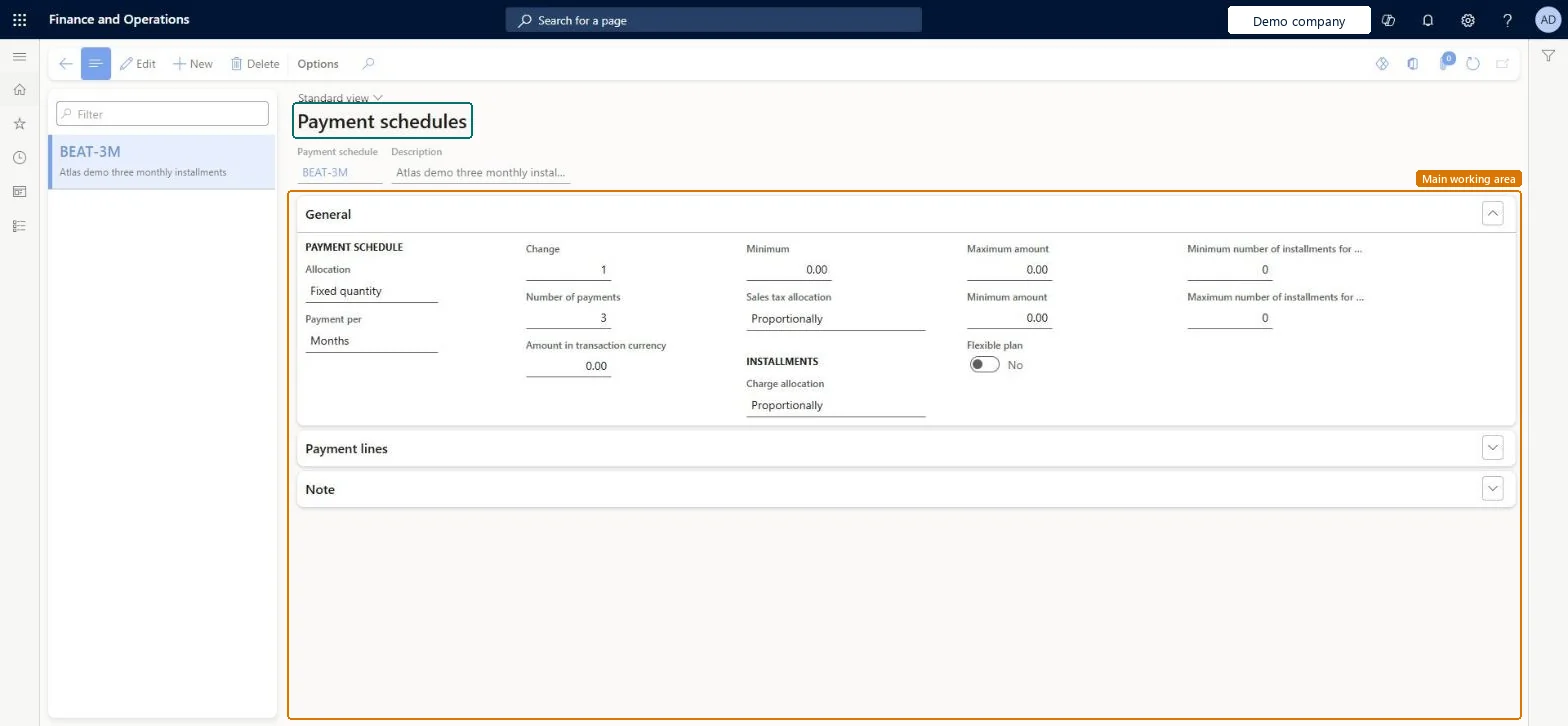
The page in Dynamics 365. page title tab to open what to set or check
About the examples: Examples and screenshots in this guide use BEAT, a demo company in a Dynamics 365 test environment. Use your own company's codes and values instead of copying them.
Step by step, with screenshots
Set up Payment schedules1 screen
Create the payment schedules used to plan installment payments from customers.
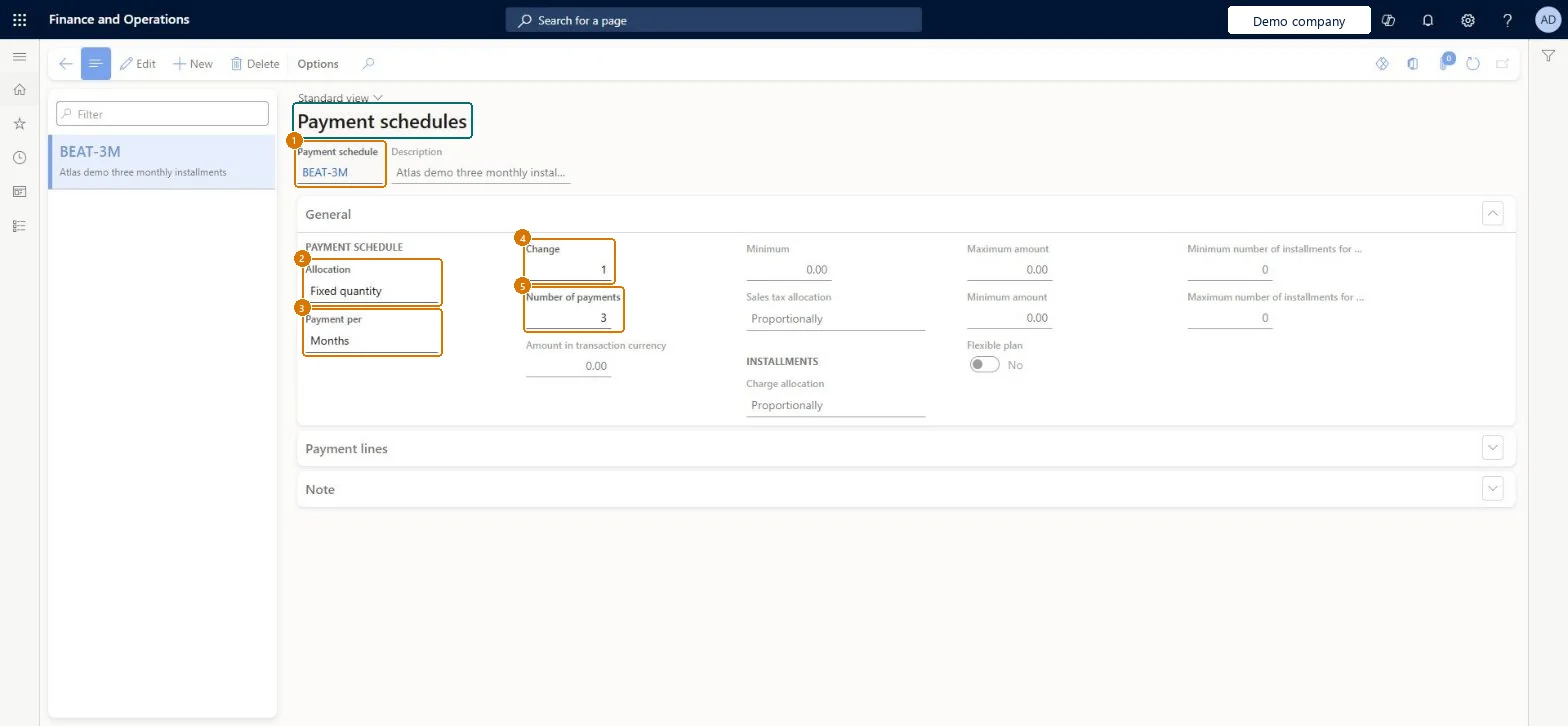
Screen 1
Create the payment schedule
Go to Accounts receivable > Payments setup > Payment schedules
Select New
Enter the code and the description
Set the allocation, the period and the number of payments
Save
1Payment schedule
BEAT-3M
2Allocation
Fixed quantity
3Payment per
Months
4Change
1
5Number of payments
3
Description
Three monthly installments
Show the full screen page title tab to open what to set or check
Steps from Microsoft
Go to Accounts receivable > Payments setup > Payment schedules.
Select the Allocation: Total, Fixed amount, Fixed quantity or Specified.
On the General FastTab, in the Payment per list, select Days, Months or Years.
In the Sales tax allocation list, choose how sales tax is spread over the installments.
For Specified, on the Payment lines FastTab, enter each installment's interval in the Quantity field and its value in the Amount in transaction currency field.
In the Percentage/Amount list, choose whether each value is a percent or an amount.
For Fixed amount or Fixed quantity, enter the Change, then the Number of payments or the fixed amount.
In the Minimum field, enter the smallest installment amount.
Fixed quantity for equal instalments, Fixed amount for a set amount per instalment, and Specified with Payment lines when instalments differ.The Allocation method decides how the invoice is split, and Payment per with Change sets the interval between due dates.
Setting a Minimum without noticing it overrides the calculated instalment amounts, which changes the number of instalments. The setup is also shared with Accounts payable.
Reversible: Schedules can be changed at any time; they affect invoices that use them afterwards, for customers and vendors in the legal entity.
If you change it later
Payment schedules are shared by Accounts receivable and Accounts payable in the same legal entity, so a change here also affects vendor installments. Microsoft Learn
Technical architect
6Technical
Menu item
CustPaymSchedChecked in Dynamics 365
Form
PaymSchedChecked in Dynamics 365
Table
PaymSchedShown as “Payment schedule” in Record infoChecked in Dynamics 365
PrivilegesMaintain customer payment schedules CustPaymSchedMaintainView customer payment schedules CustPaymSchedViewDutiesInquire into collections status CollectionLetterCollectionsStatusInquirInquire into customer invoice status CustInvoiceCustomerInvoiceStatusInquireEnable invoice and cash process CustInvoiceInvoiceAndCashProcessEnableReview invoice and cash process performance CustInvoiceInvoiceAndCashProcPerfReviewInquire into invoice and cash reference data CustInvoiceInvoiceAndCashRefDataInquireInquire into customer payments status PaymCustomerPaymentsStatusInquireEnable invoice and cash process RentalCustInvoiceInvAndCashProcEnable15 security rolesAuditor AuditPolicyManagerCollections agent CollectionLetterCollectionsAgentCollections manager CollectionLetterCollectionsManagerChief executive officer CompanyChiefExecutiveOfficerChief financial officer CompanyChiefFinancialOfficerAccounts receivable clerk CustInvoiceAccountsReceivableClerkAccounts receivable manager CustInvoiceAccountsReceivableManagerAccountant LedgerAccountantAccounting manager LedgerAccountingManagerAccounting supervisor LedgerAccountingSupervisorFinancial controller LedgerFinancialControllerAccounts receivable centralized payments clerk PaymAccountsReceivableCentralPaymClerkAccounts receivable payments clerk PaymAccountsReceivablePaymentsClerkRental coordinator agent RentalCoordinatorAgentRental manager RentalManagerChecked in Dynamics 365
Roles to set it up and use it
To set it up or change itRental manager RentalManagerAccounts receivable manager CustInvoiceAccountsReceivableManagerRental coordinator agent RentalCoordinatorAgentCollections manager CollectionLetterCollectionsManagerAccounting supervisor LedgerAccountingSupervisorTo use itAccounts receivable clerk CustInvoiceAccountsReceivableClerkAccounts receivable payments clerk PaymAccountsReceivablePaymentsClerkAccounts receivable centralized payments clerk PaymAccountsReceivableCentralPaymClerkFinancial controller LedgerFinancialControllerAccountant LedgerAccountantGive people one of these roles. On this system, 15 roles can open this page.Checked in Dynamics 365
PaymentScheduleEntity (Payment schedule): loaded for each company, in Microsoft's default template 120 - Accounts payable.Load order: Microsoft's default template 120 - Accounts payable loads Payment schedule at execution unit 1, level 30, sequence 10. Lower levels load first, and entities at the same level load in sequence order.Load first: the default templates at lower levels (System setup to General ledger)Microsoft Learn
Checked in a working Dynamics 365 system, version 10.0.49: the menu item, form, table and security, the page, the demo records and the values in the screenshots.
To cite this step: AR-PAYSETUP-070, Set up Payment schedules. Beyond ERP Atlas Hub, 2026-11-11. https://www.beyonderp.cloud/atlas/step/AR-PAYSETUP-070