About the examples: Examples and screenshots in this guide use BEAT, a demo company in a Dynamics 365 test environment. Use your own company's codes and values instead of copying them.
Setup steps on this page
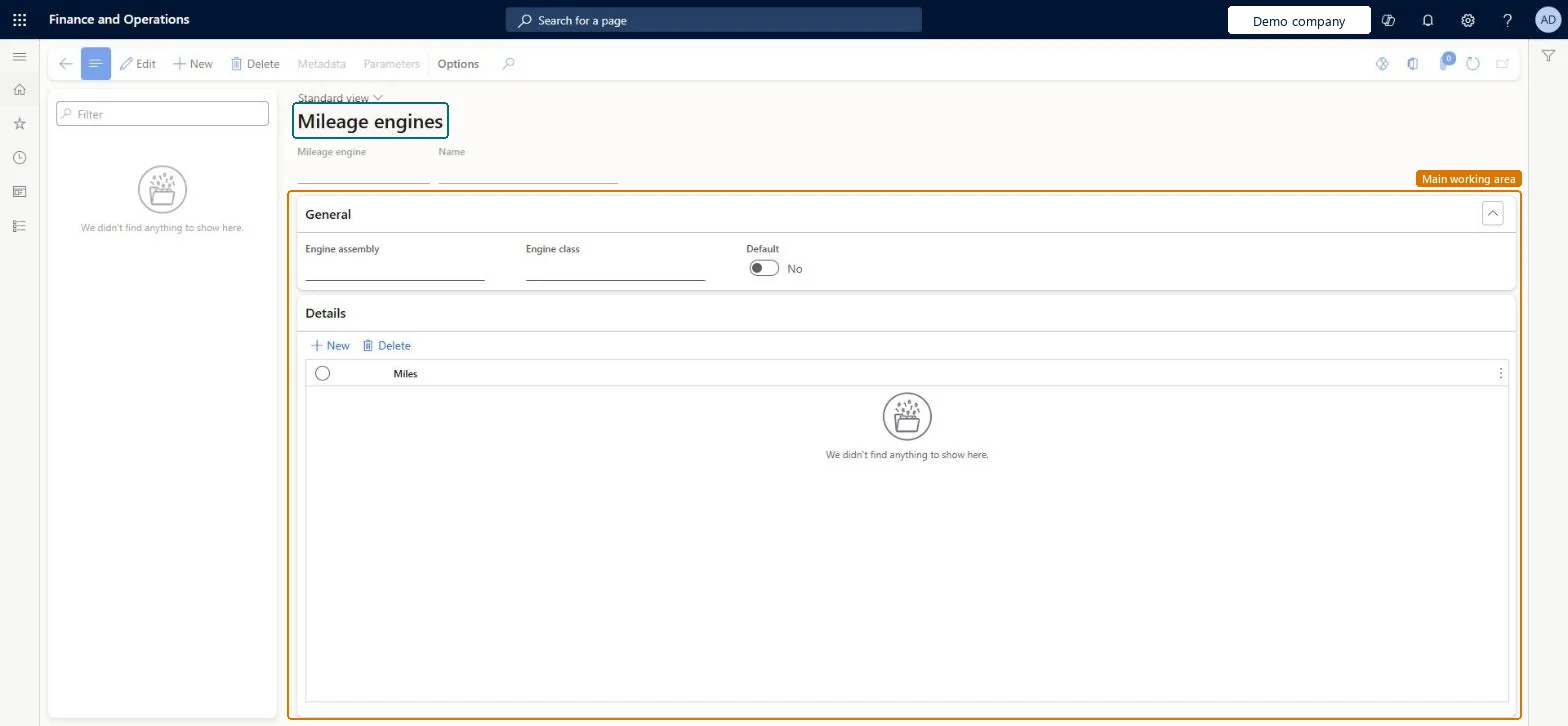
Set up Mileage engine
Use this page to set up the mileage engines that rate engines can use to calculate rates based on the mileage between the source and the destination.
How to use it
Go to Transportation management > Setup > Engines > Mileage engine.
On the Action Pane, select New, and then enter the Mileage engine code and Name.
On the General FastTab, enter the Engine assembly and Engine class, and set the Default option.
On the Details FastTab, select New to add the mileage lines.
On the Action Pane, use Metadata and Parameters to complete the engine setup.
Source: Checked in Dynamics 365
Test checklist
Create the mileage engine and its postal-code based mileage data.
Set MileageEngineCode on a mileage rate engine.
Rate a load between two postal codes in the data and check the distance and rate.
Set up a mileage engine only when carrier rates are priced by distance, and reference it from the rate engine with MileageEngineCodeThe rate engine can use the mileage engine to rate by distance between source and destination; mileage engines take their metadata from their own configuration.
Expecting latitude and longitude: standard engines work on postal codes, so a coordinate-based distance needs a custom engine.
To set it up or change itLogistics manager TMSLogisticsManagerTo use itTransportation coordinator TMSTransportationCoordinatorGive people one of these roles. On this system, 2 roles can open this page.Checked in Dynamics 365
Actions on the page
(Action Pane without tabs): Metadata, ParametersChecked in Dynamics 365
TMSTransportationMileageEngineEntity (Transportation mileage engines): loaded for each company, in Microsoft's default template 405 - Transportation management.Load order: Microsoft's default template 405 - Transportation management loads Transportation mileage engines at execution unit 1, level 30, sequence 10. Lower levels load first, and entities at the same level load in sequence order.Load first: the default templates at lower levels (System setup to General ledger)Microsoft Learn