About the examples: Examples and screenshots in this guide use BEAT, a demo company in a Dynamics 365 test environment. Use your own company's codes and values instead of copying them.
Step by step, with screenshots
Set up Commission calculation1 screen
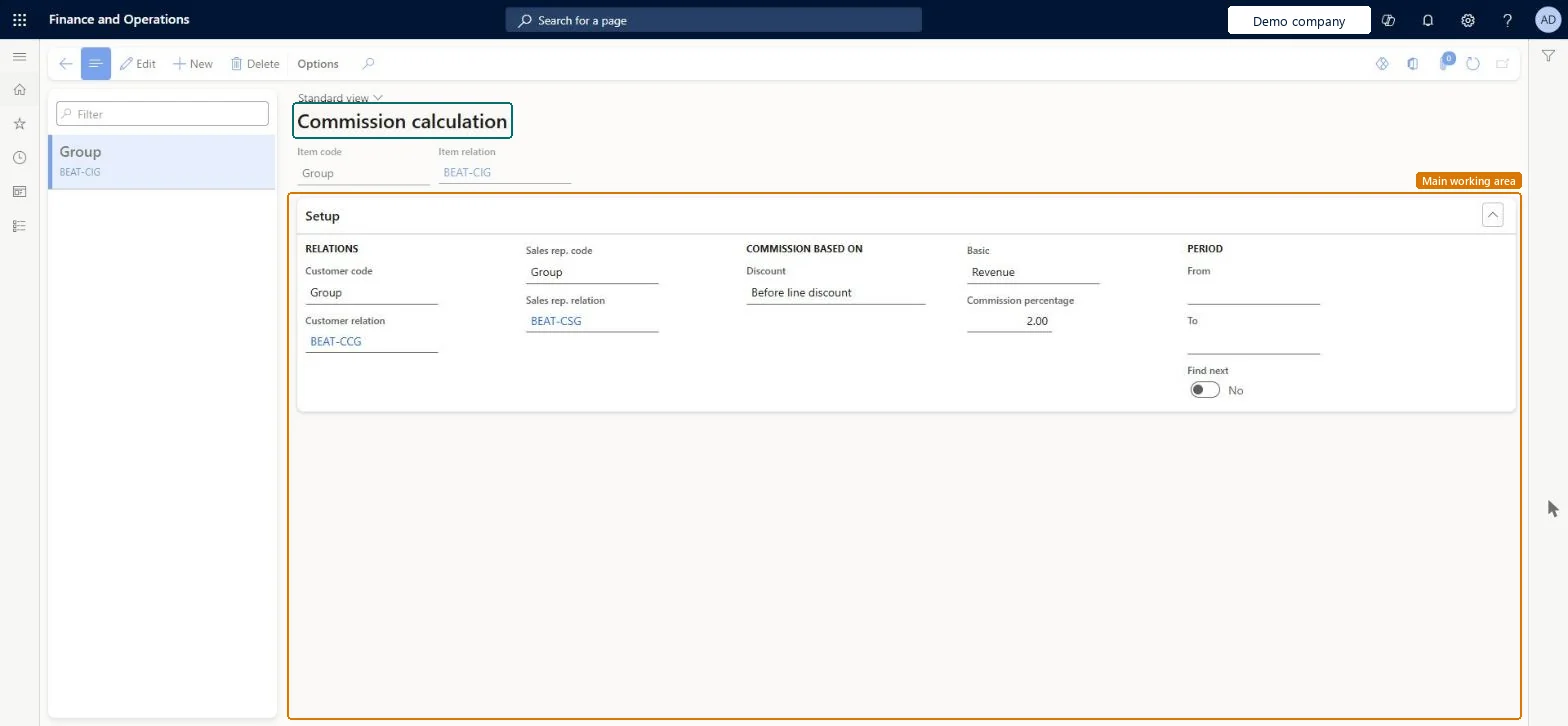
Use this page to set the commission calculation basis, whether discounts are included, and the period when each commission rate is active.
Screen 1
Set a commission rate for a group
Go to Sales and marketing > Commissions > Commission calculation
Make sure the commission item group, customer group and sales group exist
Select New
Set Item code to Group and select the item group
Set Customer code to Group and select the customer group
Set Sales rep. code to Group and select the sales group
Select the basis and enter the commission percentage
Select Save
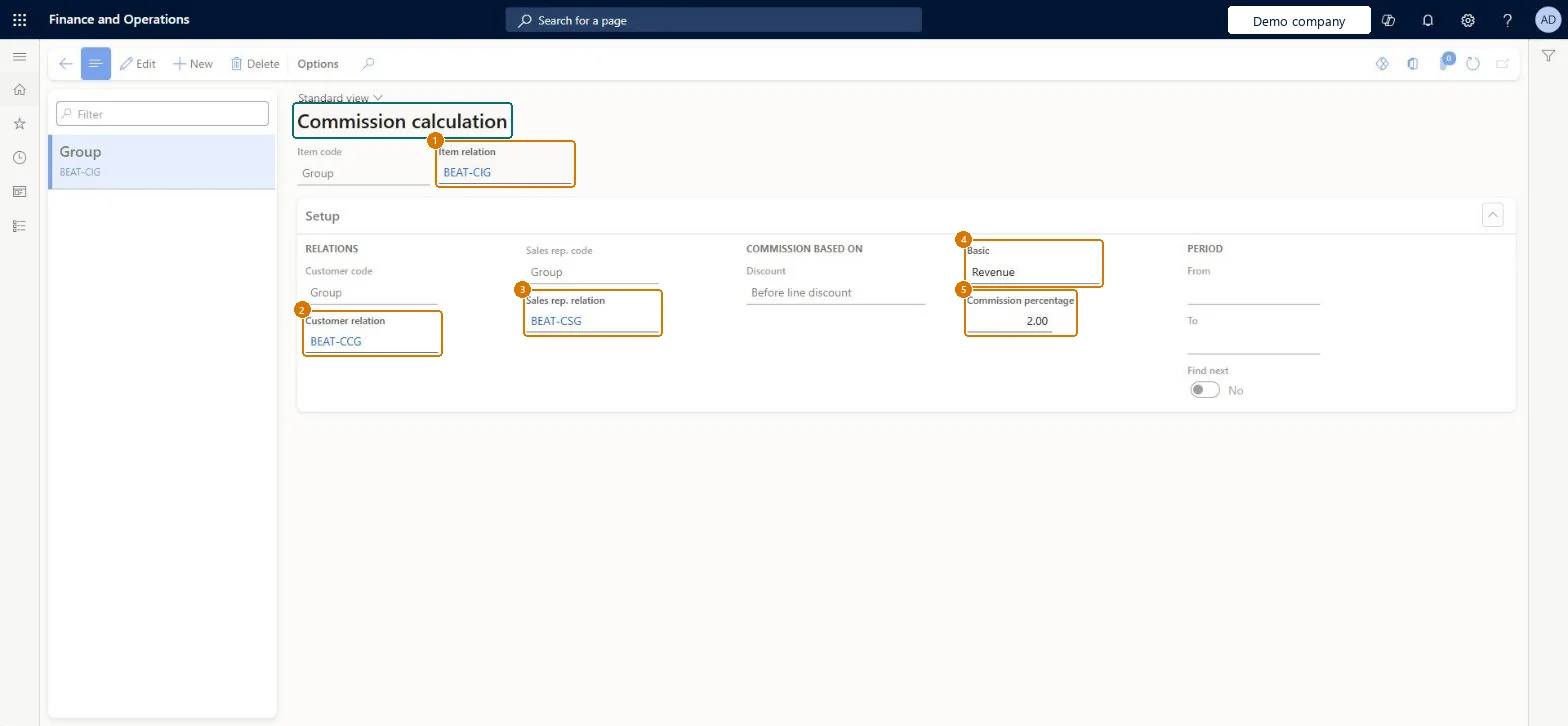
1Item relation
BEAT-CIG
2Customer relation
BEAT-CCG
3Sales rep. relation
BEAT-CSG
4Basic
Revenue
5Commission percentage
2.00
Item code
Group
Customer code
Group
Sales rep. code
Group
Discount
Before line discount
Show the full screen page title tab to open what to set or check
Steps from Microsoft
Go to Sales and marketing > Commissions > Commission calculation.
Select New.
In the Item code field, select Group, and then select the item commission group in the Item relation field.
In the Customer code field, select Group, and then select the customer commission group in the Customer relation field.
In the Sales rep. relation field, select the commission sales group.
Keep or change the discount option and the calculation basis, such as Revenue.
In the Commission percentage field, enter the rate.
The sales representative or group of sales representatives that earns the commission rate.Microsoft Learn
Group
SalesRepCode
Discount
Whether the commission is worked out before or after line discounts are taken off.Microsoft Learn
Before line discount
DiscLevel
Basic
The amount the commission is calculated on, such as revenue.Microsoft Learn
Revenue
CommissionBasis
Common errors and fixes
Message
What to do
No commission transactions are created when a sales order is invoiced.
Check that the customer has a Commission group and Sales group in Sales order defaults, the released product has a Commission group on the Sell FastTab, and a Commission calculation row matches that combination and date. Microsoft Learn
Test checklist
Assign a commission customer group and sales group to a customer (Sales order defaults) and a commission item group to a released product (Sell FastTab).
Create a Commission calculation row for that item group, customer group and sales group with a Commission percentage.
Create and invoice a sales order for that customer and item.
Check that the commission is posted for the sales representatives in the sales group, split by their Commission share.
Group for Item code and Customer code, a Sales rep. relation, Discount Before line discount and Basic Revenue, with a validity period on each rate.Learn's setup keeps Before line discount and Revenue as the basis and uses customer and item commission groups, so one rate covers a whole group of customers and items instead of one row per customer and item.
The rate only applies when the sales order matches the combination. If the customer has no Commission group and Sales group in Sales order defaults, or the released product has no Commission group on the Sell FastTab, no commission is calculated.Test: Commission rate applies to a matching sales order
Feature management and licence
Licence or add-in
On the live system, Sales manager and Accounting supervisor (maintain), and the accounts receivable roles and Collections manager (use) use this page.
Reversible: Rates are applied to sales transactions as they are invoiced. A change affects later invoices only; use the validity period for rate changes.
If you change it later
Commissions are calculated when invoices are posted; invoices that are already posted aren't recalculated. Microsoft Learn
Technical architect
6Technical
Menu item
CommissionCalcChecked in Dynamics 365
Form
CommissionCalcChecked in Dynamics 365
Table
CommissionCalcShown as “Commission rates” in Record infoChecked in Dynamics 365
PrivilegesMaintain setup of commission elements CommissionCalcMaintainView setup of commission elements CommissionCalcViewDutiesInquire into sales commissions master CustInvoiceSalesCommissionsInquireMaintain sales commissions master CustInvoiceSalesCommissionsMaintainInquire into compensation process HcmCompensationInquire17 security rolesCollections manager CollectionLetterCollectionsManagerAccounts receivable clerk CustInvoiceAccountsReceivableClerkAccounts receivable manager CustInvoiceAccountsReceivableManagerCompensation and benefits manager HcmCompensationAndBenefitsManagerHuman resource manager HcmHumanResourceManagerPayroll administrator HcmPayrollAdministratorPayroll manager HcmPayrollManagerAccountant LedgerAccountantAccounting manager LedgerAccountingManagerAccounting supervisor LedgerAccountingSupervisorAccounts payable centralized payments clerk PaymAccountsPayableCentralPaymClerkAccounts payable payments clerk PaymAccountsPayablePaymentsClerkAccounts receivable centralized payments clerk PaymAccountsReceivableCentralPaymClerkAccounts receivable payments clerk PaymAccountsReceivablePaymentsClerkSales manager TradeSalesManagerAccounts payable clerk VendInvoiceAccountsPayableClerkAccounts payable manager VendInvoiceAccountsPayableManagerChecked in Dynamics 365
Roles to set it up and use it
To set it up or change itSales manager TradeSalesManagerAccounting supervisor LedgerAccountingSupervisorTo use itAccounts receivable clerk CustInvoiceAccountsReceivableClerkAccounts receivable manager CustInvoiceAccountsReceivableManagerAccounts receivable centralized payments clerk PaymAccountsReceivableCentralPaymClerkAccounts receivable payments clerk PaymAccountsReceivablePaymentsClerkCollections manager CollectionLetterCollectionsManagerGive people one of these roles. On this system, 17 roles can open this page.Checked in Dynamics 365
Actions on the page
Options: Personalize, Page options, ShareChecked in Dynamics 365
CommissionCalculationEntity (Commission calculation): loaded for each company, in Microsoft's default template 140 - Accounts receivable.Load order: Microsoft's default template 140 - Accounts receivable loads Commission calculation at execution unit 1, level 30, sequence 20. Lower levels load first, and entities at the same level load in sequence order.Load first: the default templates at lower levels (System setup to General ledger)Microsoft Learn
Checked in a working Dynamics 365 system, version 10.0.49: the menu item, form, table and security, the page, the demo records and the values in the screenshots.
To cite this step: SM-COMM-040, Set up Commission calculation. Beyond ERP Atlas Hub, 2026-11-11. https://www.beyonderp.cloud/atlas/step/SM-COMM-040