Setup step on the Fiscal calendars page · General ledger
Set up Fiscal calendars
Used to create and delete fiscal calendars, years, and periods, divide periods, and create closing periods; a calendar can be used by ledgers, fixed asset books, and budget cycles.
- Used by
- Accountant, Accounting manager, Accounting supervisor and 8 more roles
- Business process
- Develop financial period strategy
- Menu item
FiscalCalendars- Main table
FiscalCalendar- Data entity
FiscalCalendarEntity- Setup steps
- 1 on this page
Everyone
1What it is and why
| What it is | The page for fiscal calendars, each of which contains fiscal years made up of periods. |
|---|---|
| What you do here | Used to create and delete fiscal calendars, years, and periods, divide periods, and create closing periods; a calendar can be used by ledgers, fixed asset books, and budget cycles. |
| Example | Create a fiscal calendar that starts on July 1 and ends on June 30 of the following year. |
Functional consultant · Solution architect
2Where it fits
| Business process | Define accounting policies › Develop financial period strategy |
|---|---|
| Menu path | General ledger › Calendars › Fiscal calendars |
| Set up first | — |
| Used next by | Ledger Microsoft Learn ↗Ledger calendars Microsoft Learn ↗Recalculate ledger periods Microsoft Learn ↗Year end close Microsoft Learn ↗ |
| Related pages | Date intervals Microsoft Learn ↗Budget cycle time spans Microsoft Learn ↗ |
| In this process | ← Set up Ledger calendars |
End user · Functional consultant
3How to do it
Step by step, with screenshots
Set up Fiscal calendars1 screen
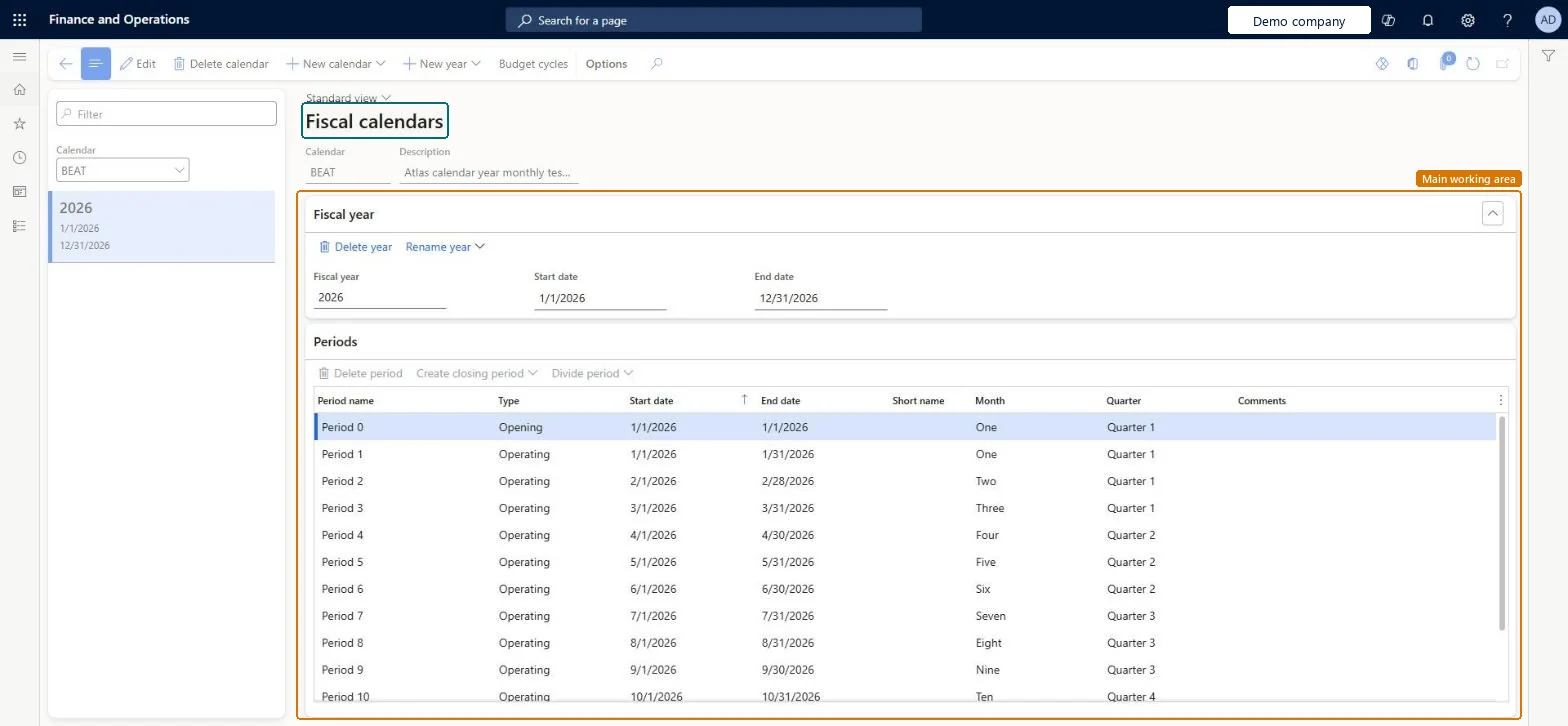
Used to create and delete fiscal calendars, years, and periods, divide periods, and create closing periods; a calendar can be used by ledgers, fixed asset books, and budget cycles.
Screen 1
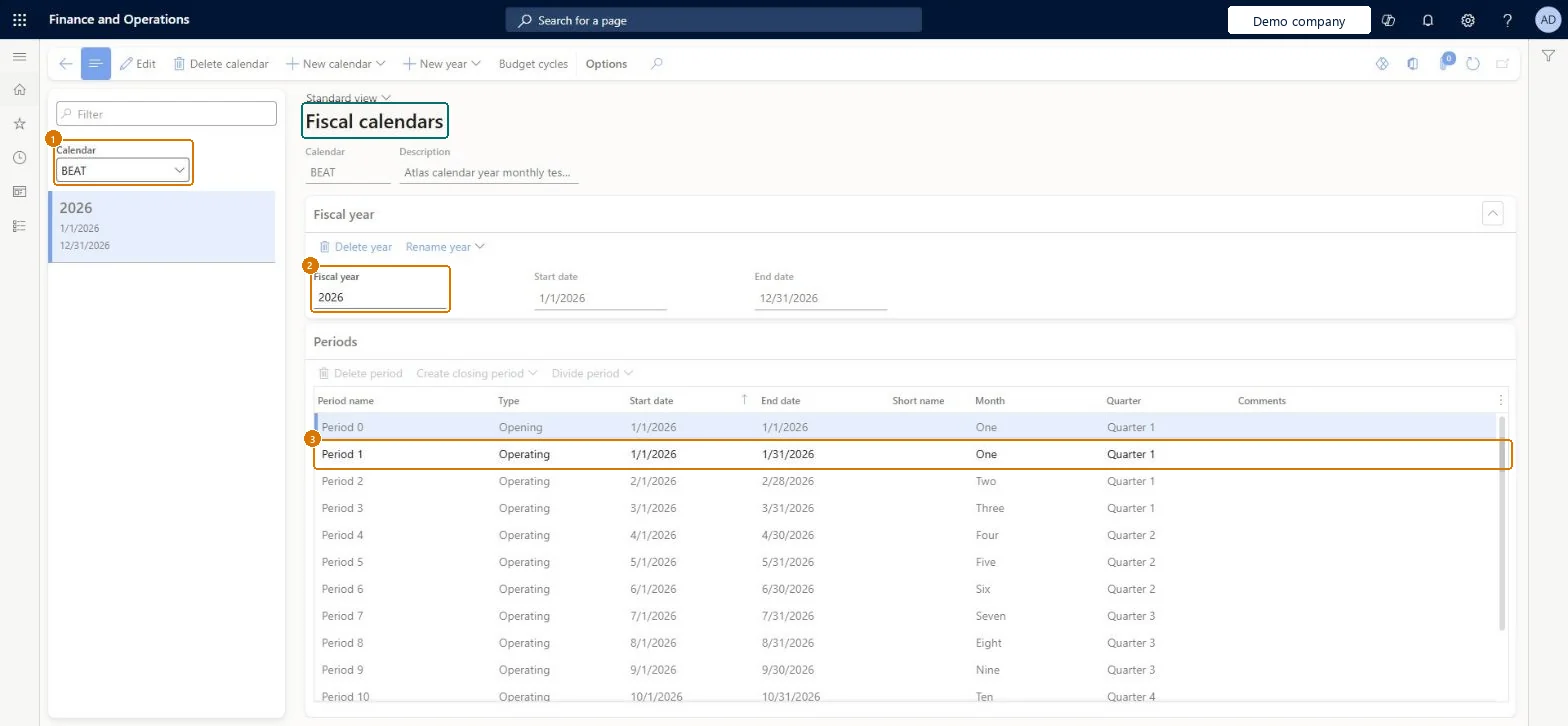
Create the fiscal calendar and year
Go to General ledger > Calendars > Fiscal calendars
- Select New calendar and enter the calendar code
- Select New year to add fiscal year 2026
- Check the monthly periods on the Periods FastTab
1Calendar BEAT 2Fiscal year 2026 Start date 1/1/2026 End date 12/31/2026 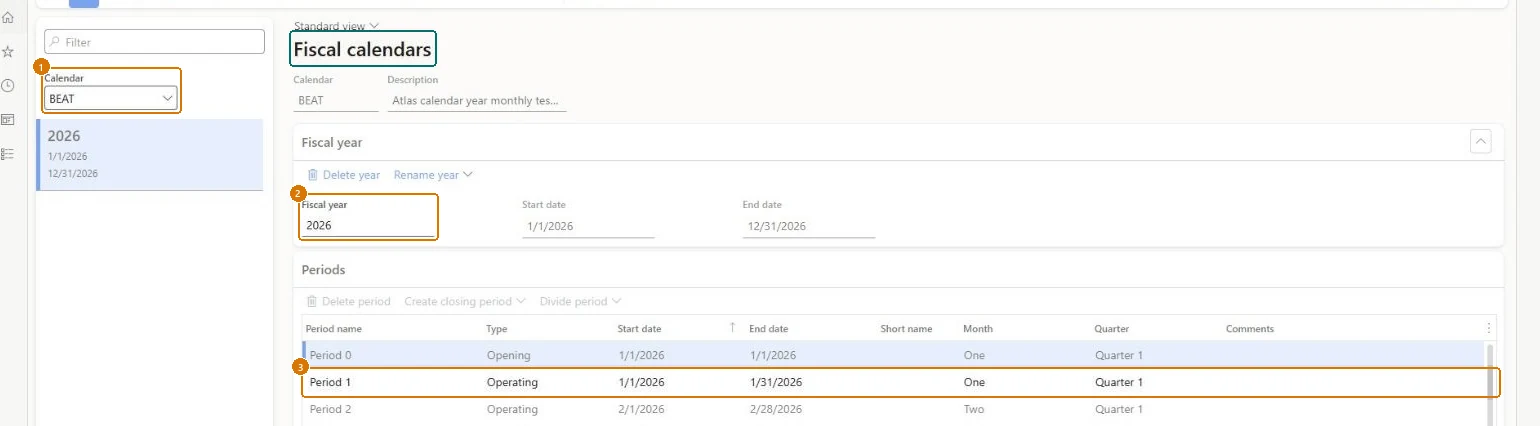
Show the full screen
page title tab to open what to set or check
Microsoft's steps
- Go to General ledger > Calendars > Fiscal calendars.
- Select New calendar.
- In the Calendar field, enter a name for the calendar.
- In the Description field, enter a description that can appear on reports.
- Enter the Start and End dates of the first fiscal year.
- Enter a Fiscal year name for that first year.
- Enter the Length of period and the Unit, which together set how many periods are created.
- Select Create.
Source: Microsoft Learn ↗
Field guide
| Field | What it means | Worked example | Table column |
|---|---|---|---|
| Calendar | The name of the new fiscal calendar.Microsoft Learn ↗ | BEAT | — |
| Description | A description of the calendar that can be printed on reports.Microsoft Learn ↗ | — | Description |
| Fiscal year name | The name of the first fiscal year created in the calendar.Microsoft Learn ↗ | — | — |
| Length of period | How long each period is; together with Unit it decides how many periods the year gets.Microsoft Learn ↗ | — | — |
| Unit | The unit of time for the period length, such as months or days.Microsoft Learn ↗ | — | — |
| Fiscal year | — | 2026 | — |
| Start date | — | 1/1/2026 | — |
| End date | — | 12/31/2026 | — |
Functional consultant
4Setup decisions
| Setup step | Recommended value and why | Decision · common mistake · test |
|---|---|---|
| Set up Fiscal calendars | — | — |
Solution architect
5Design impact
| Shared or per company | Shared: the same records are used by every legal entity. Microsoft data model ↗ |
|---|---|
| Can it be undone | — |
| Feature or country | — |
| If you change it later | Period dates can be changed only while no transactions are posted in the period, and a year's start and end dates can't be changed. After any period change, Recalculate ledger periods must be run in every company that uses the calendar. Microsoft Learn ↗ |
Technical architect
6Technical
| Menu item | FiscalCalendars Checked in Dynamics 365 |
|---|---|
| Form | FiscalCalendars Checked in Dynamics 365 |
| Table | FiscalCalendarShown as “Fiscal calendar” in Record infoKey field: CalendarIdChecked in Dynamics 365 |
| Data entities | FiscalCalendarEntityFiscal calendar integration entity Microsoft data model ↗FiscalYearEntityFiscal calendar Microsoft data model ↗ |
| Who can open it | PrivilegesMaintain fiscal calendars FiscalCalendarsMaintainView fiscal calendars FiscalCalendarsViewDutiesReview budget control process performance BudgetBudgetControlProcessPerfReviewReview budget process performance BudgetBudgetProcessPerfReviewMaintain fiscal calendars duty. FiscalCalendarsMaintainView fiscal calendars duty. FiscalCalendarsViewEnable general ledger process LedgerGeneralLedgerProcessEnableInquire into general ledger reference data LedgerGeneralLedgerReferenceDataInquireEnable general ledger process RentalLedgerGeneralLedgerProcessEnable11 security rolesAuditorAuditPolicyManagerBudget manager BudgetBudgetManagerChief executive officer CompanyChiefExecutiveOfficerChief financial officer CompanyChiefFinancialOfficerAccountant LedgerAccountantAccounting manager LedgerAccountingManagerAccounting supervisor LedgerAccountingSupervisorFinancial controller LedgerFinancialControllerRental manager RentalManagerRental purchasing manager RentalPurchasingManagerRental sales manager RentalSalesManager |
| Actions on the page | Buttons: Delete calendar, New calendar, New year, Budget cyclesChecked in Dynamics 365 |
Developer
7Developer
| Open it directly | https://<your-environment>/?mi=FiscalCalendars |
|---|---|
| Integrate with | FiscalCalendarEntity data entity Microsoft data model ↗ |
| Table definition | FiscalCalendar columns and relations Microsoft data model ↗ |
Everyone
8Sources and checks
- learn.microsoft.com/dynamics365/finance/budgeting/fiscal-calendars-fiscal-years-periods
- learn.microsoft.com/training/modules/create-fiscal-calendars-years-periods-dyn365-finance/8-exercise-1
- learn.microsoft.com/common-data-model/schema/core/operationscommon/tables/finance/ledger/reference/fiscalcalendar
- learn.microsoft.com/dynamics365/finance/general-ledger/change-mdfy-clndr-to-ledger
- learn.microsoft.com/dynamics365/finance/budgeting/fiscal-calendars-fiscal-years-periods
- learn.microsoft.com/training/modules/configure-periodic-processes-dyn365-finance/05-end-year-close
- learn.microsoft.com/training/modules/create-fiscal-calendars-years-periods-dyn365-finance/
- Checked in a working Dynamics 365 system, version 10.0.49: the menu item, form, table and security, the page, the demo records and the values in the screenshots.
GL-CALENDAR-020 — Set up Fiscal calendars. Beyond ERP Atlas Hub, snapshot 2026-10-16, partly verified. https://www.beyonderp.cloud/atlas/step/GL-CALENDAR-020