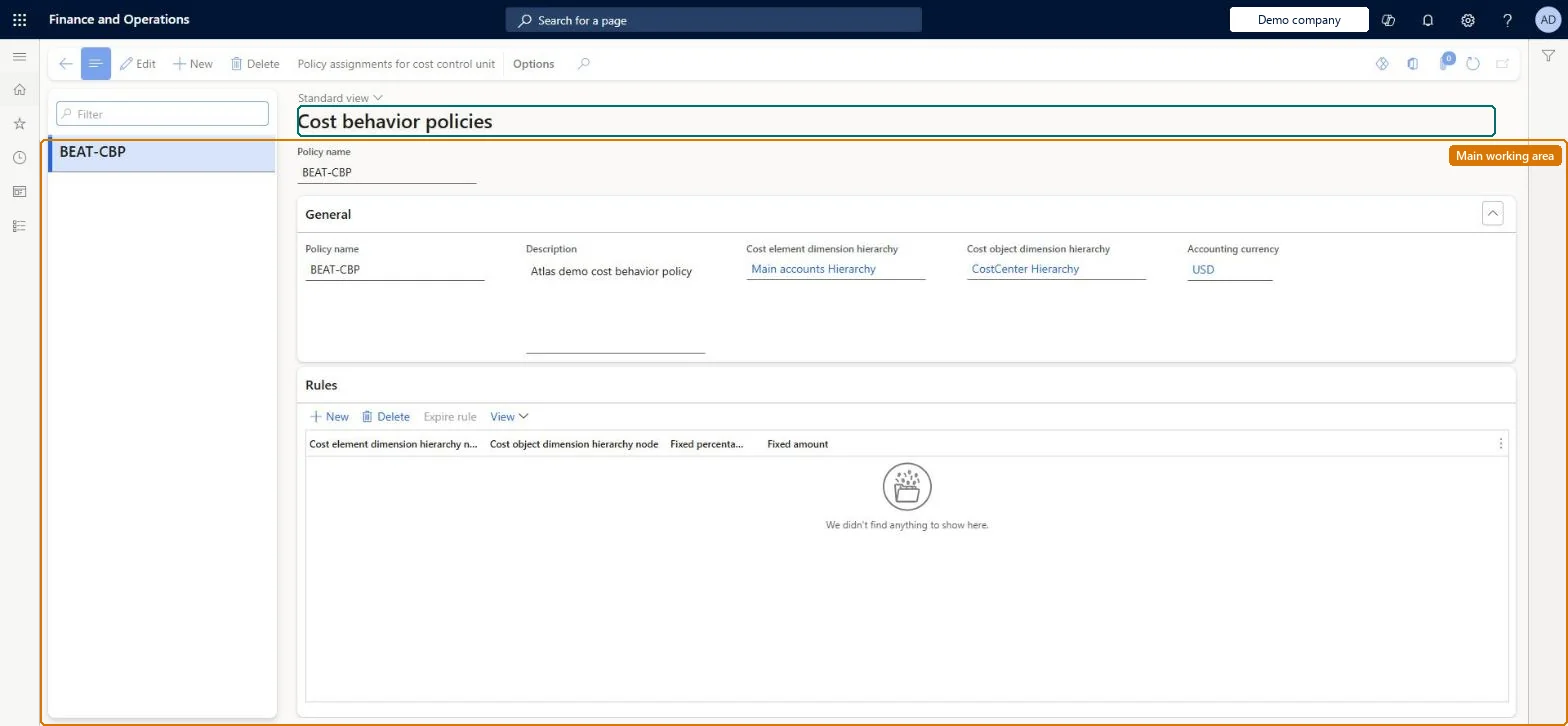
Setup step on the Cost behavior policies page · Cost accounting
Set up Cost behavior policies
Use this page to define how much of each cost is fixed (as a percentage or a fixed amount) and from which date the rules apply. Imported cost entries arrive as Unclassified; the policy rules reclassify them as Fixed cost or Variable cost in step 1 of the overhead calculation.
SETUP GUIDEHow to set it up8 sections. Choose a role to highlight what matters to you.
Everyone
1What it is and why
What it is
A setup page where you create cost behavior policies and their rules, which classify imported cost entries as fixed or variable cost per cost element and cost object hierarchy node, and assign the policy to a cost control unit.
What you do here
Use this page to define how much of each cost is fixed (as a percentage or a fixed amount) and from which date the rules apply. Imported cost entries arrive as Unclassified; the policy rules reclassify them as Fixed cost or Variable cost in step 1 of the overhead calculation.
Example
For example, an electricity bill has a fixed fee of 1,000.00 and the rest depends on consumption, so a rule with Fixed amount 1,000.00 classifies the first 1,000.00 as fixed and the remainder as variable.
The page in Dynamics 365. page title tab to open what to set or check
About the examples: Examples and screenshots in this guide use BEAT, a demo company in a Dynamics 365 test environment. Use your own company's codes and values instead of copying them.
Setup steps on this page
Set up Cost behavior policies
Use this page to define how much of each cost is fixed (as a percentage or a fixed amount) and from which date the rules apply. Imported cost entries arrive as Unclassified; the policy rules reclassify them as Fixed cost or Variable cost in step 1 of the overhead calculation.
Steps from Microsoft
Go to Cost accounting > Policies > Cost behavior policies.
Select New and type a Policy name.
Select the Cost element dimension hierarchy (the cost behavior hierarchy) and the Cost object dimension hierarchy (for example Organization), then select Save.
Select New in the rules list and pick the Cost element dimension hierarchy node (for example Variable cost) and the Cost object dimension hierarchy node.
Set the fixed percentage or fixed amount; by default the variable percentage is 100 percent.
Select Policy assignments for cost control unit, then select New.
Enter the Valid from accounting date and select the Cost control unit.
The cost element hierarchy whose nodes (for example Fixed cost, Variable cost) the rules refer to.Microsoft Learn
CostElementDimensionHierarchy
Cost object dimension hierarchy
The cost object hierarchy whose nodes the rules refer to, for example Organization.Microsoft Learn
CostObjectDimensionHierarchy
Cost element dimension hierarchy node
In a rule, the cost element node or member the rule applies to.Microsoft Learn
Cost object dimension hierarchy node
In a rule, the cost object node or member the rule applies to.Microsoft Learn
Fixed percentage / Fixed amount
How much of the cost is fixed, as a percentage or as an amount; anything not fixed is variable, and the default is 100 percent variable.Microsoft Learn
Valid from / Valid to
The date and time range during which a rule is effective; an expired rule is ignored by later overhead calculations.Microsoft Learn
Cost control unit
On the policy assignment, the cost control unit the policy becomes effective for from the Valid from accounting date.Microsoft Learn
Common errors and fixes
Message
What to do
A changed policy doesn't change the figures in the Cost control workspace
Policies take effect when you run the overhead calculation again. Run it for the period and point the report at the new calculation version. Microsoft Learn
A validation message says a dimension member is missing from a classification hierarchy
Add the member to a node of the hierarchy. A classification hierarchy must hold every member of its dimension. Microsoft Learn
Test checklist
Create a policy with a cost element hierarchy that has Fixed cost and Variable cost nodes and the Organization cost object hierarchy.
Add a rule for the Fixed cost node at 100%, and a rule with a Fixed amount of 1,000.00 for the electricity cost element.
Assign the policy to the cost control unit with a Valid from accounting date.
Run the overhead calculation and open the Cost behavior calculation journal.
Check that a 10,000.00 electricity entry is reversed from Unclassified into 1,000.00 Fixed cost and 9,000.00 Variable cost.
High-level rules on hierarchy nodes (for example Fixed cost node at 100% for the whole Organization), plus specific rules only where needed, such as a fixed amount for an electricity feeRules on hierarchy nodes avoid a rule for every member and keep maintenance low. A Variable cost node isn't required, because any cost that isn't classified as fixed is variable.
Cost accounting has four roles: Cost accounting manager (Activity licence), Cost accountant and Cost accountant clerk (Operations licence), and Cost object controller (Team members licence). Cost accountants and cost accounting managers maintain policies. No Feature management feature needs to be turned on for this page.
Shared: Cost accounting setup isn't kept per legal entity. It is the same from every company, and one cost accounting ledger can collect data from several legal entities. Checked in Dynamics 365
Can it be undone
Reversible: Rules and assignments are date-effective and time-effective. Expire a rule to stop it, and overhead calculations run after the expiry date no longer use it. Past calculation versions are kept.
If you change it later
Rules are date-effective: expiring or replacing a rule affects only overhead calculations run after the expiry date, and updated hierarchies flow into the rules automatically; rerun the overhead calculation for the period after any change. Microsoft Learn
Technical architect
6Technical
Menu item
CAMCostBehaviorRuleChecked in Dynamics 365
Form
CAMCostBehaviorRuleChecked in Dynamics 365
Table
CAMDataCostBehaviorPolicyShown as “COST BEHAVIOR POLICIES” in Record infoChecked in Dynamics 365
Who can open it
3 security roles. Select a role to see its duties and privileges.
To set it up or change itMaintain cost accounting policies CAMCostAccountingPoliciesMaintainMaintain cost accounting rules CAMCostAccountingRulesMaintainTo use itInquire into cost accounting policies CAMCostAccountingPoliciesInquireGive people a role that holds these duties. On this system, 3 roles give access to this page.Checked in Dynamics 365
Actions on the page
(Action Pane without tabs): Policy assignments for cost control unitChecked in Dynamics 365
Load order: A cost behavior policy has no data entity in Data management, so it can't be loaded from a file or a configuration template. Re-create the policy and its rules by hand in each environment after the hierarchies and allocation bases exist, and assign it to the cost control unit.Microsoft Learn
Checked in a working Dynamics 365 system, version 10.0.49: the menu item, form, table and security, the page.
To cite this step: CA-POLICY-010, Set up Cost behavior policies. Beyond ERP Atlas Hub, 2026-11-11. https://www.beyonderp.cloud/atlas/step/CA-POLICY-010