BeyondERP.Newsletter
Menu

Setup step on the Pay specification report page · Time and attendance

Review pay before Transfer to pay

Print the report with the choices that answer one question.

Business process
Pay employees
Menu item
JmgEmployeeTimeSpec
Setup steps
1 on this page
Show what matters for
SETUP GUIDEHow to set it up8 sections. Choose a role to highlight what matters to you.
Everyone

1What it is and why

What it isA report that prints, per worker, the registrations, calculated time and pay items for a period, with or without the pay rates.
What you do hereUse it before Transfer to pay to check each worker's pay items, or when a worker questions their pay.
ExampleFor example, for a worker who clocked in at 06:30 and out at 17:00, it shows pay time 10.00 on pay type 1201 at rate 10 (100.00) and overtime 1.50 on 1301 at rate 5 (7.50), 107.50 in total.
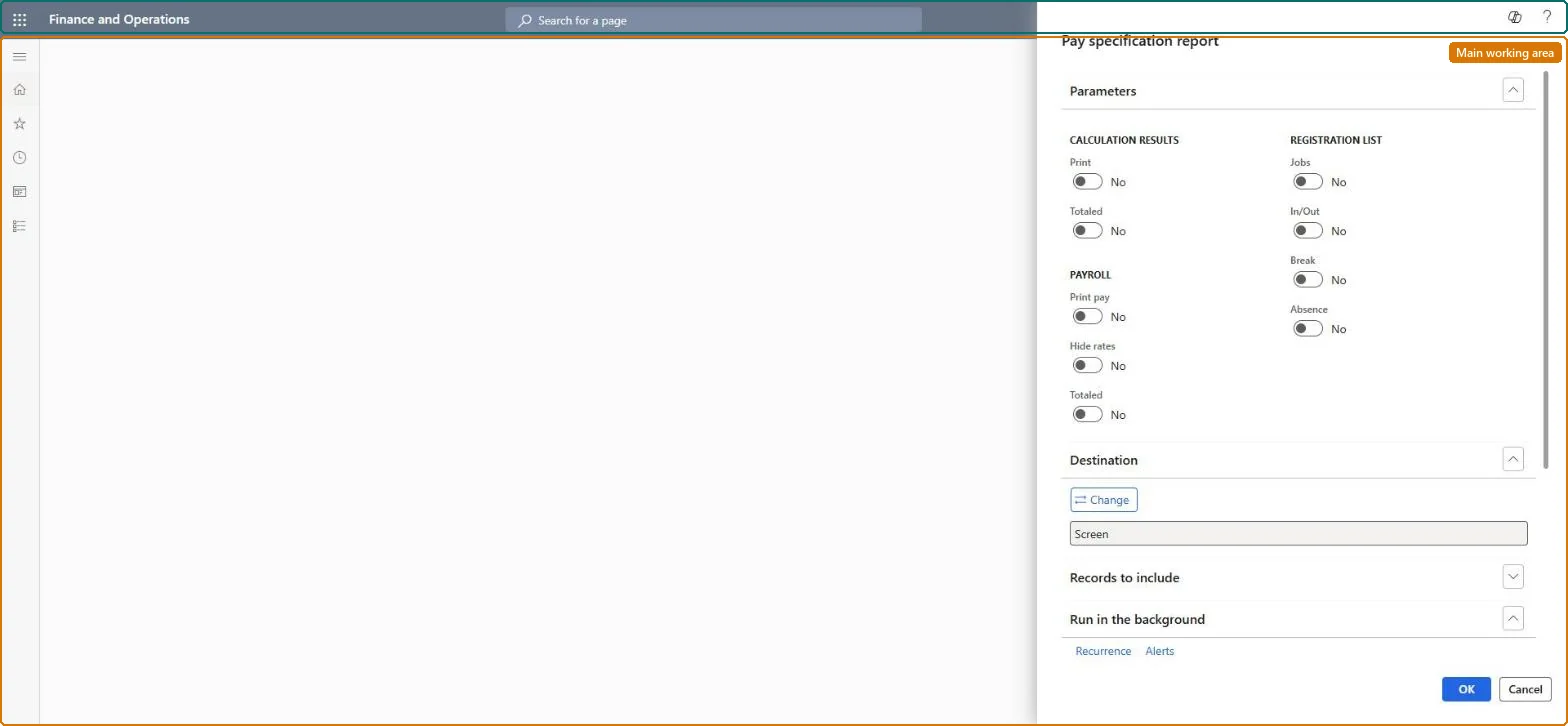
Pay specification report page in Dynamics 365
The page in Dynamics 365. page title tab to open what to set or check
Functional consultant · Solution architect

2Where it fits

Business processManage compensation and benefits › Pay employees
Menu pathTime and attendance › Inquiries and reports › Payroll › Pay specification report
Set up firstApprove Microsoft Learn
Used next byTransfer to pay Microsoft Learn
Related pagesPay items Microsoft Learn
In this process Read and adjust one worker's balance · Check balances after a change
End user · Functional consultant

3How to do it

About the examples: Examples and screenshots in this guide use BEAT, a demo company in a Dynamics 365 test environment. Use your own company's codes and values instead of copying them.

When to run it

When to run itBefore Transfer to pay, to review the pay items generated for each worker, or when a worker questions their pay.
How oftenOnce per pay period, or on demand when a worker's pay is questioned.
What the output showsPer worker: registrations, calculated time and pay items (pay type, pay units and rate, unless hidden), with totals. Pay units that are too high usually come from overtime or flex settings in the time profile or pay agreement.

Source: Microsoft Learn

Setup steps on this page

Review pay before Transfer to pay

Print the report with the choices that answer one question.

Steps from Microsoft

  1. Go to Time and attendance > Inquiries and reports > Payroll > Pay specification report.
  2. Under Calculation results, set Print to include the calculated time and Totaled to show totals.
  3. Under Payroll, set Print pay to include pay items, Hide rates to leave rates out when the report goes to workers, and Totaled for pay totals.
  4. Under Registration list, choose which registrations to list: Jobs, In/Out, Break and Absence.
  5. Limit it to the workers you need, print it, and compare pay units per pay type with what you expect from each worker's time profile.

Source: Microsoft Learn

Fields on the page

FieldWhat it means
Calculation results: Print / TotaledIncludes the calculated time, and totals it.Microsoft Learn
Payroll: Print pay / Hide rates / TotaledIncludes the pay items, leaves the rates out when the report goes to workers, and totals pay.Microsoft Learn
Registration listWhich registrations are listed: Jobs, In/Out, Break and Absence.Microsoft Learn

Common errors and fixes

MessageWhat to do
Overtime shows on the standard time pay typeCalculation parameters merge overtime into standard time by default; change the Overtime profile specification type. Microsoft Learn
Functional consultant

4Setup decisions

Setup stepRecommended value and whyDecision, common mistake and test
Review pay before Transfer to payPrint it per pay period with Print pay, and with Hide rates when it goes to workers.It shows each worker's registrations, time and pay items in one place.Who gets a pay specification?Handing workers a copy with rates when Hide rates should be set.Test: Review pay before Transfer to pay

Feature management and licence

Licence or add-inTime and attendance roles come from the security read in the Technical section. On this system access comes from duties such as Payroll administrator, Payroll manager, Chief executive officer. The Microsoft Learn article for this page names no Feature management feature to turn on.

Microsoft Learn

Solution architect

5Design impact

Shared or per companyPer company: Time and attendance data is kept per legal entity (every Time and attendance entity in Data management is per company), so the job or report works on the registrations of the company it is run in. Microsoft Learn
Can it be undoneReversible: The report or inquiry only reads data; nothing is changed.
If you change it laterThe report changes no data; what it shows is what Transfer to pay exports. Microsoft Learn
Technical architect

6Technical

Menu itemJmgEmployeeTimeSpec Checked in Dynamics 365
FormSysOperationTemplateForm Checked in Dynamics 365
Roles to set it up and use itTo use itPayroll administrator HcmPayrollAdministratorPayroll manager HcmPayrollManagerChief executive officer CompanyChiefExecutiveOfficerGive people one of these roles. On this system, 3 roles can run this page.Checked in Dynamics 365
Developer

7Developer

Open it by URLhttps://<your-environment>/?mi=JmgEmployeeTimeSpec
Data migrationLoad order: The Pay specification report report has no data entity in Data management, so it can't be loaded from a file or a configuration template. It only prints data; set up its batch printing again if it is scheduled.Checked in Dynamics 365
Everyone

8Sources

To cite this step: TA-RPT-060, Review pay before Transfer to pay. Beyond ERP Atlas Hub, 2026-11-11. https://www.beyonderp.cloud/atlas/step/TA-RPT-060