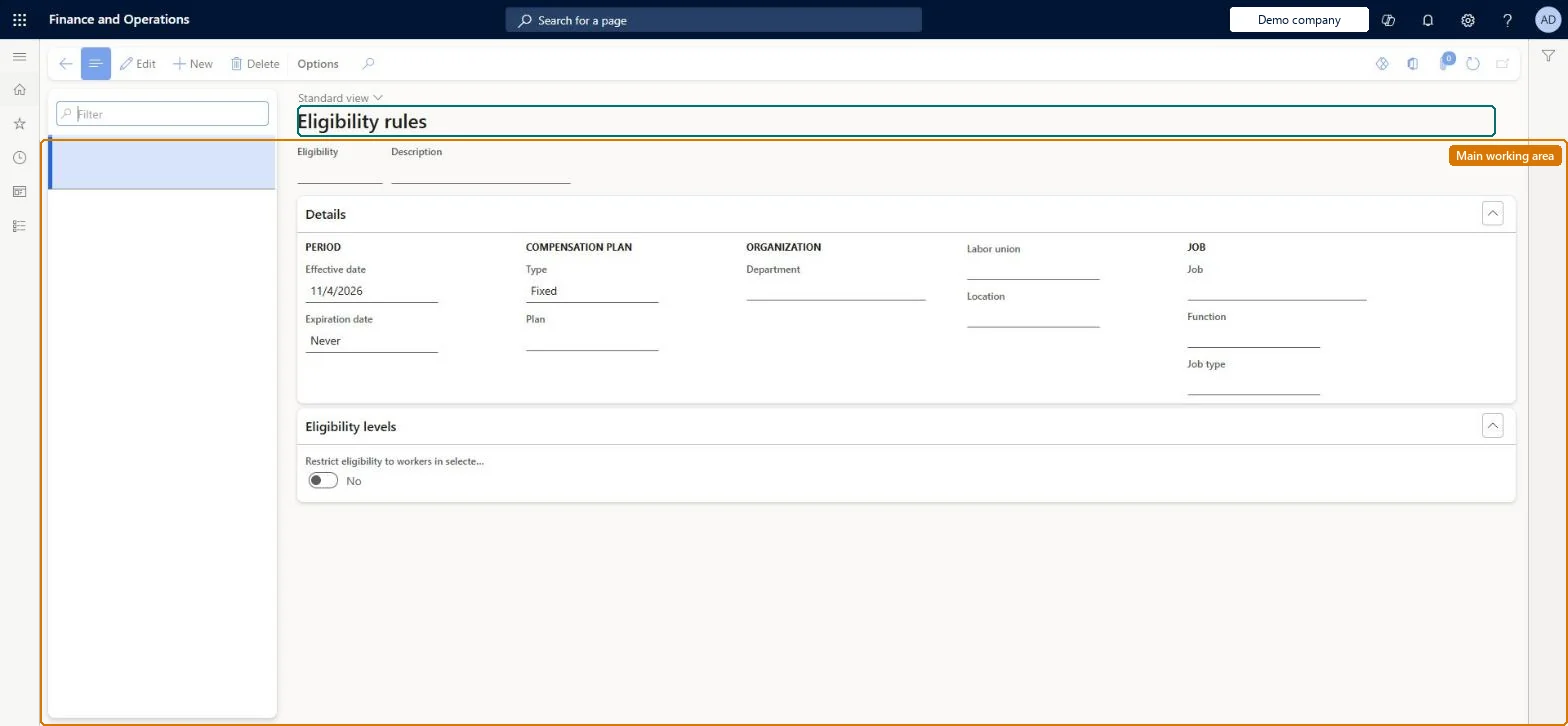
Setup step on the Eligibility rules page · Human resources
Set up Eligibility rules
Use this page to define criteria such as department, labor union, compensation region, job, function, job type or compensation level that employees must all meet to be enrolled in a plan.
Compensation and benefits manager, Human resource manager, Payroll administrator and 1 more role
Business process
Develop people strategy
Menu item
HRMCompEligibility
Main table
HRMCompEligibility
Data entity
HcmCompensationEligibilityRuleEntity
Setup steps
1 on this page
Show what matters for
SETUP GUIDEHow to set it up8 sections. Choose a role to highlight what matters to you.
Everyone
1What it is and why
What it is
A setup page where you create rules that decide which employees are eligible for a fixed or variable compensation plan.
What you do here
Use this page to define criteria such as department, labor union, compensation region, job, function, job type or compensation level that employees must all meet to be enrolled in a plan.
Example
For example, BEAT's rule SAL-SALES for plan SAL-2026 requires department Sales, job type Salaried and level G3 to G5; of 40 sales employees, the 28 salaried ones at those levels are offered the plan.
The page in Dynamics 365. page title tab to open what to set or check
About the examples: Examples and screenshots in this guide use BEAT, a demo company in a Dynamics 365 test environment. Use your own company's codes and values instead of copying them.
Setup steps on this page
Set up Eligibility rules
Use this page to define criteria such as department, labor union, compensation region, job, function, job type or compensation level that employees must all meet to be enrolled in a plan.
Steps from Microsoft
Go to Human resources > Compensation > Eligibility > Eligibility rules.
Select New.
Enter the Eligibility and Description.
Enter the Effective date and select the plan Type.
In the Plan field, select the compensation plan.
Select the criteria an employee must meet, such as Department or Job.
Limits eligibility to positions in a compensation region.Microsoft Learn
NORTH
Compensation level
Limits eligibility by the level set on the employee's job.Microsoft Learn
G3, G4, G5
Common errors and fixes
Message
What to do
The plan doesn't appear in the Compensation plan field when an employee is enrolled
No eligibility rule exists for the plan, or the employee doesn't meet every criterion on it. Create the rule on Eligibility rules and check the job, position, department and labor union values of the employee. Microsoft Learn
Every employee is offered the plan
The rule has no criteria; with no criteria all employees are eligible. Add the department, job or other criteria. Microsoft Learn
Test checklist
Create an eligibility rule for a fixed plan limited to one department.
Open an employee in that department with an active position, select Compensation > Fixed plan, and check the plan is offered.
Repeat for an employee in another department and check the plan isn't offered.
Remove the rule and check no employee is offered the plan.
At least one eligibility rule for every fixed and variable plan, using only the criteria that must all be met (department, labor union, compensation region, job, function, job type or level).If a plan has no eligibility rule, no employee is eligible and the plan doesn't appear when you set up compensation. Employees must meet all conditions on the rule.
Compensation and benefits managers set up and run compensation; Human resource managers and payroll roles can view it. No Feature management feature is needed for this page.
Per company: eligibility rules belong to the legal entity you are signed in to. Data management lists the HcmCompensationEligibilityRuleEntity entity as not shared, so each company keeps its own. Checked in Dynamics 365
Can it be undone
Reversible: Rules can be changed at any time; they control which plans are offered when compensation is set up or enrolled.
If you change it later
If an employee does not meet the rule, or a plan has no rule, the plan does not appear when you create that employee's compensation record. Microsoft Learn
Technical architect
6Technical
Menu item
HRMCompEligibilityChecked in Dynamics 365
Form
HRMCompEligibilityChecked in Dynamics 365
Table
HRMCompEligibilityShown as “COMPENSATION PLAN ELIGIBILITY RULES” in Record infoKey field: EligibilityIdChecked in Dynamics 365
Data entities
HcmCompensationEligibilityRuleEntityCompensation plan eligibility rules Checked in Dynamics 365HcmCompensationEligibilityLevelEntityCompensation eligibility levels (The compensation levels of a rule.) Checked in Dynamics 365
Who can open it
PrivilegesMaintain eligibility rules HRMCompEligibilityMaintainView eligibility rules HRMCompEligibilityViewDutiesInquire into compensation process HcmCompensationInquireEnable compensation process HcmCompensationProcessEnable4 security rolesCompensation and benefits manager HcmCompensationAndBenefitsManagerHuman resource manager HcmHumanResourceManagerPayroll administrator HcmPayrollAdministratorPayroll manager HcmPayrollManagerChecked in Dynamics 365
Roles to set it up and use it
To set it up or change itCompensation and benefits manager HcmCompensationAndBenefitsManagerTo use itHuman resource manager HcmHumanResourceManagerPayroll administrator HcmPayrollAdministratorPayroll manager HcmPayrollManagerGive people one of these roles. On this system, 4 roles can open this page.Checked in Dynamics 365
Developer
7Developer
Open it by URL
https://<your-environment>/?mi=HRMCompEligibility
Integrate with
HcmCompensationEligibilityRuleEntity data entity Checked in Dynamics 365
Data migration
HcmCompensationEligibilityRuleEntity Compensation plan eligibility rules. Loaded for each company.HcmCompensationEligibilityLevelEntity Compensation eligibility levels: the levels of a rule.Load order: Load with the Compensation management template: after the fixed and variable plans; rules, then eligibility levels, then employee fixed compensation and variable enrollments.Load first: HcmCompFixedPlanTableEntity, HcmCompVarPlanTableV2Entity, HcmCompensationLevelEntity, HcmCompensationRegionEntityMicrosoft Learn