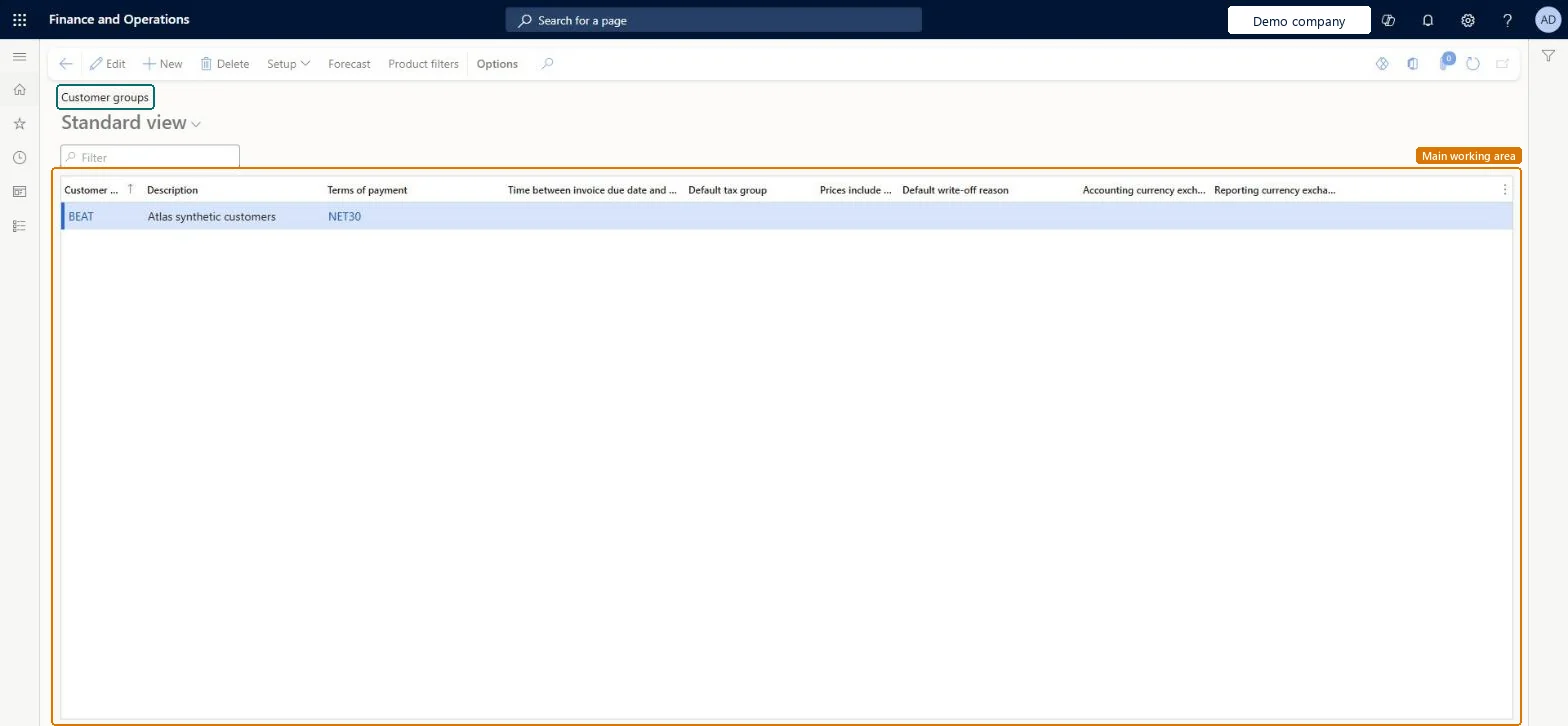
Setup step on the Customer groups page · Accounts receivable
Set up Customer groups
Create and maintain the groups of customers that share key parameters such as terms of payment, settle periods, inventory posting accounts, sales tax group and default accounts.
Accounts receivable clerk, Accounts receivable manager, Auditor and 5 more roles
Business process
Define customer classifications in Dynamics 365 Supply Chain Management
Menu item
CustGroup
Main table
CustGroup
Data entity
CustCustomerGroupEntity
Setup steps
1 on this page
Show what matters for
SETUP GUIDEHow to set it up8 sections. Choose a role to highlight what matters to you.
Everyone
1What it is and why
What it is
A setup page for groups of customers that share key parameters.
What you do here
Use it to create and maintain customer groups that share settings such as terms of payment, settle periods, inventory posting ledger accounts, sales tax group and default account setup.
Example
For example, a company can use customer groups to set up automatic posting to General Ledger accounts for the revenue its customers generate.
The page in Dynamics 365. page title tab to open what to set or check
About the examples: Examples and screenshots in this guide use BEAT, a demo company in a Dynamics 365 test environment. Use your own company's codes and values instead of copying them.
Step by step, with screenshots
Set up Customer groups1 screen
Create and maintain the groups of customers that share key parameters such as terms of payment, settle periods, inventory posting accounts, sales tax group and default accounts.
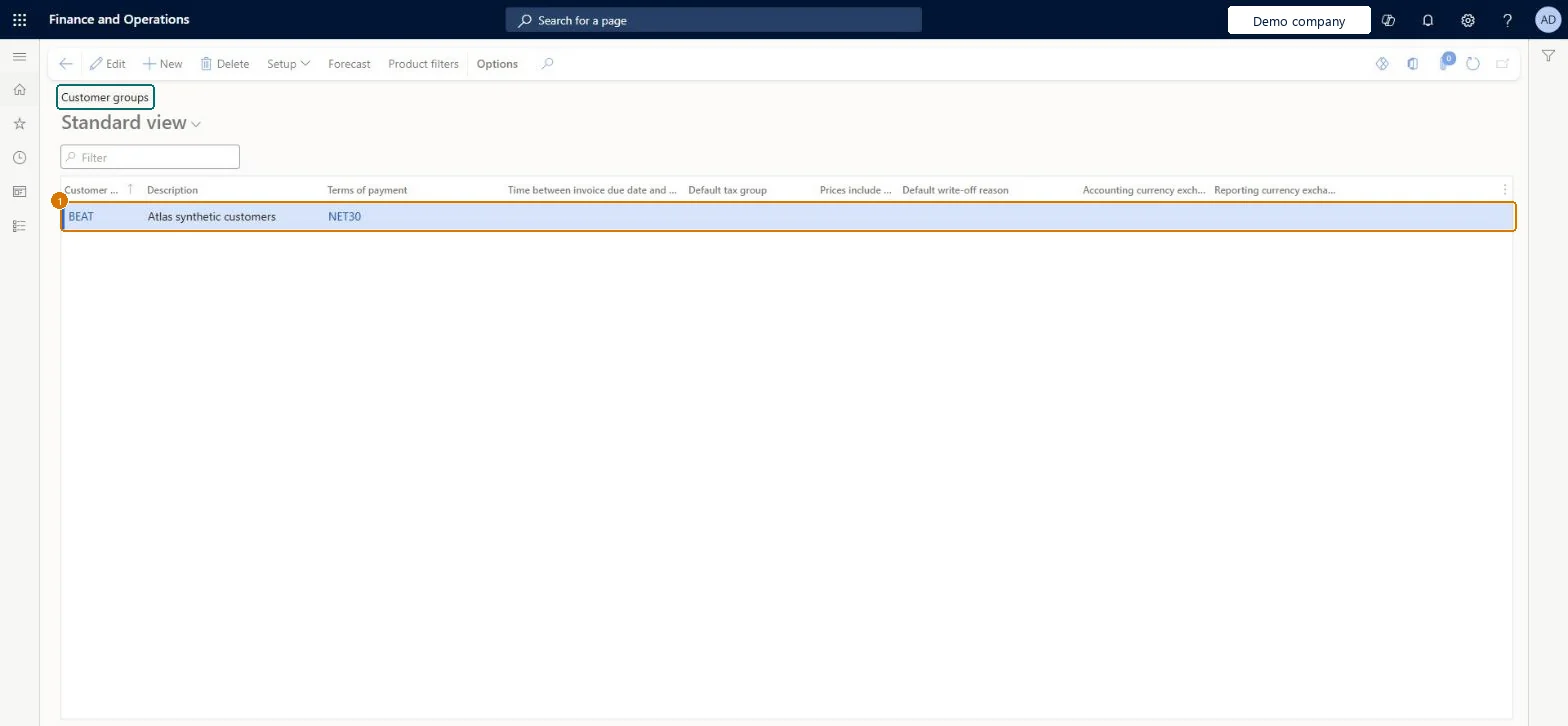
Screen 1
Create the customer group
Go to Accounts receivable > Setup > Customer groups
Select New
Enter the group code, description and terms of payment
1Customer group
BEAT
Description
Customers
Terms of payment
NET30
Show the full screen page title tab to open what to set or check
How to use it
Go to Accounts receivable > Setup > Customer groups.
Select New to add a customer group, or select a group and select Edit.
Fill in the Customer group, Description and Terms of payment.
Fill in other columns you need, such as Default tax group or Default write-off reason.
Select Setup, Forecast or Product filters for the selected group if you need them.
Groups that separate customers needing different terms, posting or tax defaults (for example domestic, export, intercompany)Learn describes customer groups as customers that share key parameters such as terms of payment, settle periods, sales tax group and default account setup, and posting profiles can be set per group.
Moving customers between groups after posting: the Customer to ledger reconciliation report then shows differences between customer and ledger balances.
Hard to reverse: The group can be changed, but reconciliation reports use the current group, so history doesn't follow the move.
If you change it later
A number sequence set on a customer group is used first for new customer IDs; the one on Accounts receivable parameters is used only when the group has none. Microsoft Learn
Technical architect
6Technical
Menu item
CustGroupChecked in Dynamics 365
Form
CustGroupChecked in Dynamics 365
Table
CustGroupShown as “Customer groups” in Record infoKey field: CustGroupChecked in Dynamics 365
PrivilegesMaintain customer groups CustGroupMaintainView customer groups CustGroupViewDutiesEnable customer process CustCustomerProcessEnableInquire into customer reference data CustCustomerReferenceDataInquire8 security rolesAuditor AuditPolicyManagerCollections agent CollectionLetterCollectionsAgentCollections manager CollectionLetterCollectionsManagerChief financial officer CompanyChiefFinancialOfficerAccounts receivable clerk CustInvoiceAccountsReceivableClerkAccounts receivable manager CustInvoiceAccountsReceivableManagerAccounting manager LedgerAccountingManagerSales manager TradeSalesManagerChecked in Dynamics 365
Roles to set it up and use it
To set it up or change itAccounts receivable manager CustInvoiceAccountsReceivableManagerCollections manager CollectionLetterCollectionsManagerSales manager TradeSalesManagerTo use itAccounts receivable clerk CustInvoiceAccountsReceivableClerkAccounting manager LedgerAccountingManagerCollections agent CollectionLetterCollectionsAgentAuditor AuditPolicyManagerChief financial officer CompanyChiefFinancialOfficerGive people one of these roles. On this system, 8 roles can open this page.Checked in Dynamics 365
Actions on the page
Buttons: Setup, Forecast, Product filtersChecked in Dynamics 365
CustCustomerGroupEntity (Customer groups): loaded for each company, in Microsoft's default template 140 - Accounts receivable.Load order: Microsoft's default template 140 - Accounts receivable loads Customer groups at execution unit 1, level 50, sequence 10. Lower levels load first, and entities at the same level load in sequence order.Load first: Customer write-off reason codes, the default templates at lower levels (System setup to dependency bands 30 to 90)Microsoft Learn
Checked in a working Dynamics 365 system, version 10.0.49: the menu item, form, table and security, the page, the demo records and the values in the screenshots.
To cite this step: AR-SETUP-110, Set up Customer groups. Beyond ERP Atlas Hub, 2026-11-11. https://www.beyonderp.cloud/atlas/step/AR-SETUP-110