Accounts payable clerk, Accounts payable manager, Collections agent and 14 more roles
Business process
Defining payment policies in Dynamics 365 Finance
Menu item
PaymCalendar
Main table
PaymCalendar
Data entity
PaymentCalendarEntity
Setup steps
1 on this page
Show what matters for
SETUP GUIDEHow to set it up8 sections. Choose a role to highlight what matters to you.
Everyone
1What it is and why
What it is
A setup page for payment calendars, which define the standard business week and exceptions (holidays or extra working days) by country/region, state/province or city.
What you do here
It is used so that due dates and interest start dates are moved off non-working days to the next or earlier working day.
Example
You create a calendar for each country/region you do business with, specifying the standard business week and holiday exceptions.
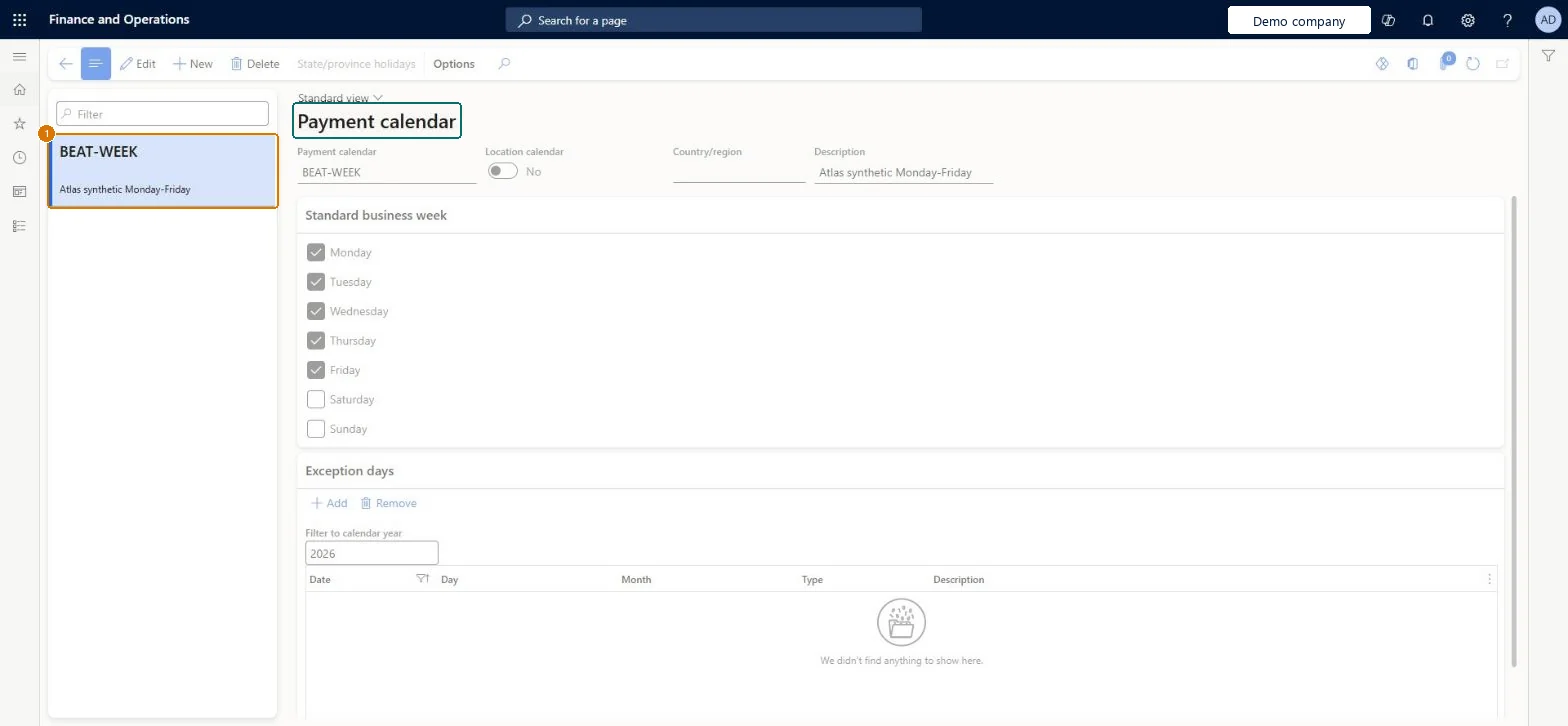
The page in Dynamics 365. page title tab to open what to set or check
About the examples: Examples and screenshots in this guide use BEAT, a demo company in a Dynamics 365 test environment. Use your own company's codes and values instead of copying them.
Step by step, with screenshots
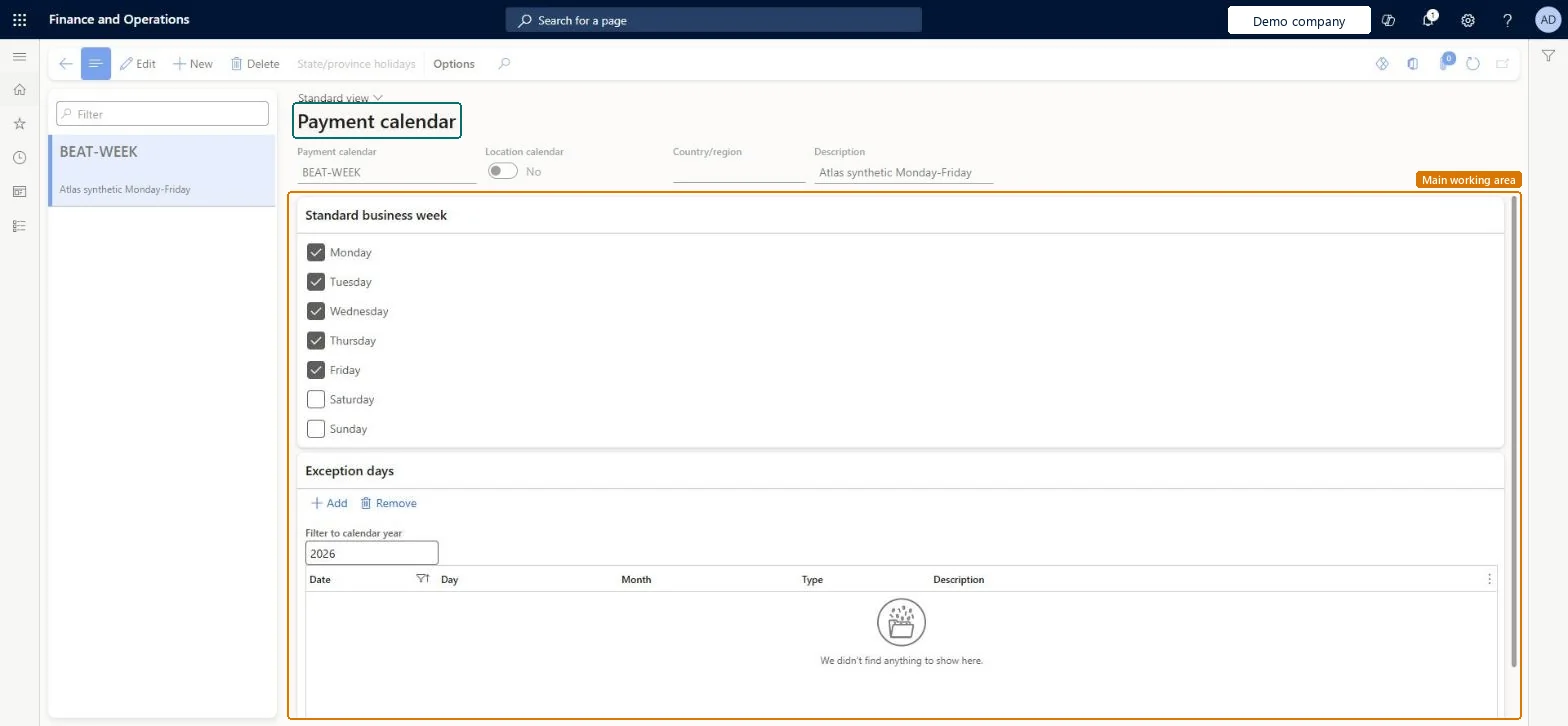
Set up Payment calendar1 screen
Maintains calendars of national, state/province and city holidays that are treated as non-working days when payment due dates are calculated.
Screen 1
Create the payment calendar
Go to Accounts payable > Payment setup > Payment calendar
Select New and enter the Payment calendar and Description
In Standard business week, tick Monday to Friday
Leave Saturday and Sunday unticked
1Payment calendar
BEAT-WEEK
Description
Monday-Friday
Location calendar
No
Monday to Friday
Ticked
Saturday and Sunday
Not ticked
Show the full screen page title tab to open what to set or check
How to use it
Go to Accounts payable > Payment setup > Payment calendar.
Select New, then enter the Payment calendar and the Description.
Choose the Country/region, or turn on Location calendar if it applies.
In Standard business week, select the days that are working days.
In Exception days, select Add to add a date, or Remove to remove one, and use Filter to calendar year to change the year shown.
Select State/province holidays to open the holidays for the calendar.
One calendar per country/region you do business with, defining the standard business week and holiday or extra working day exceptions, with state/province and city holidays added where neededDue dates and interest start dates are moved off non-working days using these calendars; state and city exceptions can only add holidays.
Building calendars without a rule on Payment calendar configuration: due dates can't be adjusted unless a rule is set up there.
PrivilegesMaintain payment calendars PaymentCalendarMaintainView payment calendars PaymentCalendarViewDutiesEnable invoice and cash process CustInvoiceInvoiceAndCashProcessEnableInquire into customer payments status PaymCustomerPaymentsStatusInquireInquire into vendor payment status PaymVendorPaymentStatusInquireEnable invoice and cash process RentalCustInvoiceInvAndCashProcEnableEnable invoice and payment process VendInvoiceInvoicePaymentProcessEnable17 security rolesCollections agent CollectionLetterCollectionsAgentCollections manager CollectionLetterCollectionsManagerChief financial officer CompanyChiefFinancialOfficerAccounts receivable clerk CustInvoiceAccountsReceivableClerkAccounts receivable manager CustInvoiceAccountsReceivableManagerAccountant LedgerAccountantAccounting manager LedgerAccountingManagerAccounting supervisor LedgerAccountingSupervisorFinancial controller LedgerFinancialControllerAccounts payable centralized payments clerk PaymAccountsPayableCentralPaymClerkAccounts payable payments clerk PaymAccountsPayablePaymentsClerkAccounts receivable centralized payments clerk PaymAccountsReceivableCentralPaymClerkAccounts receivable payments clerk PaymAccountsReceivablePaymentsClerkRental coordinator agent RentalCoordinatorAgentRental manager RentalManagerAccounts payable clerk VendInvoiceAccountsPayableClerkAccounts payable manager VendInvoiceAccountsPayableManagerChecked in Dynamics 365
Roles to set it up and use it
To set it up or change itAccounts payable manager VendInvoiceAccountsPayableManagerAccounting supervisor LedgerAccountingSupervisorRental manager RentalManagerRental coordinator agent RentalCoordinatorAgentAccounting manager LedgerAccountingManagerTo use itAccounts payable clerk VendInvoiceAccountsPayableClerkChief financial officer CompanyChiefFinancialOfficerFinancial controller LedgerFinancialControllerAccountant LedgerAccountantAccounts payable payments clerk PaymAccountsPayablePaymentsClerkGive people one of these roles. On this system, 17 roles can open this page.Checked in Dynamics 365
Actions on the page
Buttons: State/province holidaysChecked in Dynamics 365
PaymentCalendarEntity (Payment calendar): shared by all companies, in Microsoft's default template 120 - Accounts payable.Load order: Microsoft's default template 120 - Accounts payable loads Payment calendar at execution unit 1, level 30, sequence 10. Lower levels load first, and entities at the same level load in sequence order.Load first: the default templates at lower levels (System setup to General ledger)Microsoft Learn
Checked in a working Dynamics 365 system, version 10.0.49: the menu item, form, table and security, the page, the demo records and the values in the screenshots.
To cite this step: AP-PAYSETUP-030, Set up Payment calendar. Beyond ERP Atlas Hub, 2026-11-11. https://www.beyonderp.cloud/atlas/step/AP-PAYSETUP-030