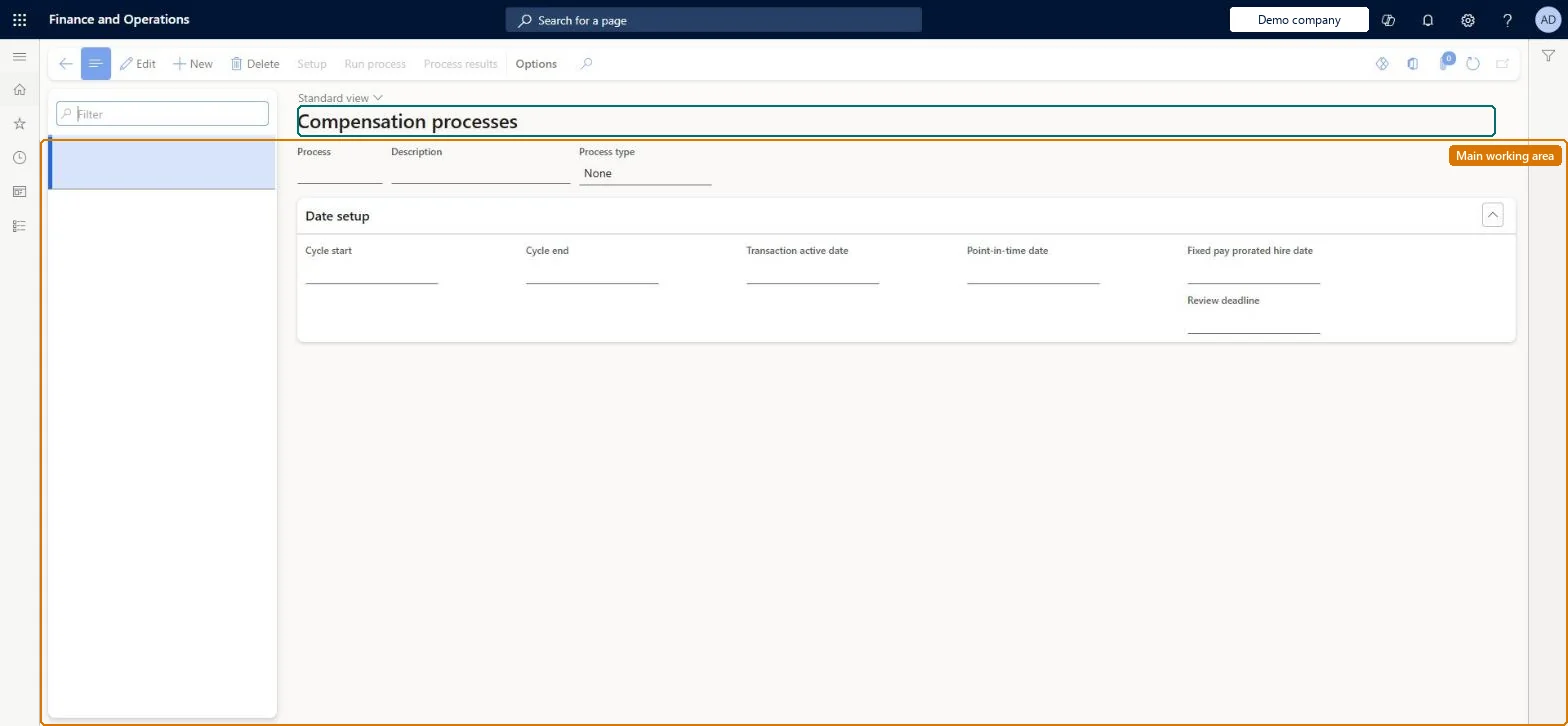
A page where you set up compensation processes (process events) that calculate new compensation amounts and awards for employees in fixed and variable compensation plans.
Compensation and benefits manager, Human resource manager
Business process
Manage compensation changes
Menu item
HRMCompProcess
Main table
HRMCompProcess
Data entity
HcmCompensationProcessEventsEntity
Setup steps
1 on this page
Show what matters for
PAGE GUIDEWhat the page does and how to use it8 sections. Choose a role to highlight what matters to you.
Everyone
1What it is and why
What it is
A page where you set up compensation processes (process events) that calculate new compensation amounts and awards for employees in fixed and variable compensation plans.
What you do here
Use this page to set the cycle dates and effective date, choose the plans and compensation actions to include, and run the process, which can be repeated for what-if analysis.
Example
For example, BEAT creates the Annual process MERIT2026 with cycle 1 January to 31 December 2025, transaction active date 1 March 2026 and a fixed pay pro rated hire date of 1 April 2025; an employee hired on 1 July 2025 receives about half of the calculated merit increase, one hired in March the full increase.
The page in Dynamics 365. page title tab to open what to set or check
About the examples: Examples and screenshots in this guide use BEAT, a demo company in a Dynamics 365 test environment. Use your own company's codes and values instead of copying them.
Setup steps on this page
Set up and run the compensation process
Define the cycle, effective date, plans and actions of each compensation run and run it as often as needed before loading.
Steps from Microsoft
Go to Human resources > Compensation > Process > Compensation processes.
Select New.
Enter the Process, Description and Process type.
Enter the Cycle start, Cycle end, Transaction active date and Review deadline, then select Save.
Select Setup, add the compensation plans, and add the compensation actions for each plan.
Select Run process, set Show processing results to Yes, and select OK.
Used by variable plans that base awards on the compensation rate at that date.Microsoft Learn
12/31/2025 (for a bonus plan using Point in time)
PointInTimeDate
Fixed pay pro rated hire date
For fixed plans with a Percent hire rule, employees hired before this date get the full increase.Microsoft Learn
4/1/2025
Review deadline
Informational date by which results should be reviewed.Microsoft Learn
2/15/2026
LoadDate
Use previous result
Chains actions so an action starts from the previous action's result instead of base pay.Microsoft Learn
Yes on the Merit action after Equity
Common errors and fixes
Message
What to do
An employee is missing from the process results
The process includes employees who were actively employed and enrolled in the selected plans as of the Cycle end date. Check the employee's enrollment and position assignment on that date. Microsoft Learn
A Promotion or Other level change action adds nothing for most employees
Employees without a recommended increase don't get these actions. Select Enable recommendation for the action and enter recommendations in Employee results. Microsoft Learn
Ratings, allocations or leverage don't change the calculated amounts
Pay for performance is applied only for plans where Enable pay for performance is selected on the process setup. Select it for the plan and run the process again. Microsoft Learn
Test checklist
Create a process with Cycle start, Cycle end, Transaction active date and Review deadline.
In Setup, add a plan with Equity and Merit actions, setting Use previous result on Merit.
Run process with Show processing results set to Yes.
Open Process results and check a new event was created; run again and check a second event appears.
One process per cycle and population (for example Annual for merit), with Cycle end on the last day evaluated, Transaction active date a few months later, and actions in the order Equity, Merit, General with Use previous result where they should build on each other.The cycle end date decides which employees were active and enrolled; the transaction active date is when the new rates take effect; each run creates a new compensation event, so trial runs change no pay.
Compensation and benefits managers set up and run compensation; Human resource managers and payroll roles can view it. No Feature management feature is needed for this page.
Per company: compensation processes belong to the legal entity you are signed in to. Data management lists the HcmCompensationProcessEventsEntity entity as not shared, so each company keeps its own. Checked in Dynamics 365
Can it be undone
Reversible: A process can be run many times for what-if analysis; each run creates a new compensation event. Nothing changes on employee records until approved events are loaded. Microsoft Learn
If you change it later
Each run creates a new compensation event, so you can make trial runs and adjustments before loading results. Microsoft Learn
Technical architect
6Technical
Menu item
HRMCompProcessChecked in Dynamics 365
Form
HRMCompProcessChecked in Dynamics 365
Table
HRMCompProcessShown as “COMPENSATION PROCESS TABLE” in Record infoKey field: ProcessIdChecked in Dynamics 365
Data entities
HcmCompensationProcessEventsEntityCompensation process table Checked in Dynamics 365HRMCompProcessLineEntityCompensation process lines (The plans added to a process on the Setup page.) HRMCompProcessLineActionEntityCompensation process lines actions (The actions added to each plan of a process.)
Who can open it
PrivilegesMaintain compensation process HRMCompProcessMaintainView compensation process HRMCompProcessViewDutiesInquire into compensation transactions HcmCompensationTransactionInquireMaintain compensation transactions HcmCompensationTransactionMaintain2 security rolesCompensation and benefits manager HcmCompensationAndBenefitsManagerHuman resource manager HcmHumanResourceManagerChecked in Dynamics 365
Roles to set it up and use it
To set it up or change itCompensation and benefits manager HcmCompensationAndBenefitsManagerTo use itHuman resource manager HcmHumanResourceManagerGive people one of these roles. On this system, 2 roles can open this page.Checked in Dynamics 365
Actions on the page
(Action Pane without tabs): Setup, Run process, Process resultsChecked in Dynamics 365
Developer
7Developer
Open it by URL
https://<your-environment>/?mi=HRMCompProcess
Integrate with
HcmCompensationProcessEventsEntity data entity Checked in Dynamics 365
Data migration
HcmCompensationProcessEventsEntity Compensation process table: the process header. Loaded for each company.HRMCompProcessLineEntity Compensation process lines: the plans of a process.HRMCompProcessLineActionEntity Compensation process lines actions: the actions per plan.Load order: Load with the Compensation management template: the process table, then its lines and line actions, after the plans, fixed compensation actions and merit targets they name. Processes are usually created in the new system instead of loaded.Load first: HcmCompFixedPlanTableEntity, HcmFixedCompensationActionEntity, HcmCompensationMeritIncreaseTargetEntityMicrosoft Learn