Fixed assetsInquiries and reportsTransaction reports
output:AssetDisposal
Business process
Analyze fixed assets
Menu item
output:AssetDisposal
Setup steps
1 on this page
Show what matters for
PAGE GUIDEWhat the page does and how to use it8 sections. Choose a role to highlight what matters to you.
Everyone
1What it is and why
What it is
A report that shows fixed assets that were disposed of, with disposal date, net book value, sales value and profit or loss.
What you do here
Use this report to review the fixed assets that have been disposed of, with the disposal date, net book value, sales value and profit or loss.
Example
For example, after scrapping an asset with a net book value of 9,000.00, the accountant runs the report and checks that it shows the disposal date, net book value 9,000.00 and a loss of 9,000.00.
The page in Dynamics 365. page title tab to open what to set or check
About the examples: Examples and screenshots in this guide use BEAT, a demo company in a Dynamics 365 test environment. Use your own company's codes and values instead of copying them.
When to run it
When to run it
At period end, or after assets have been sold or scrapped.
How often
Monthly or at each period close.
What the output shows
Disposed assets with disposal date, net book value, sales value and profit or loss. A sales value of zero usually means the asset was scrapped rather than sold.
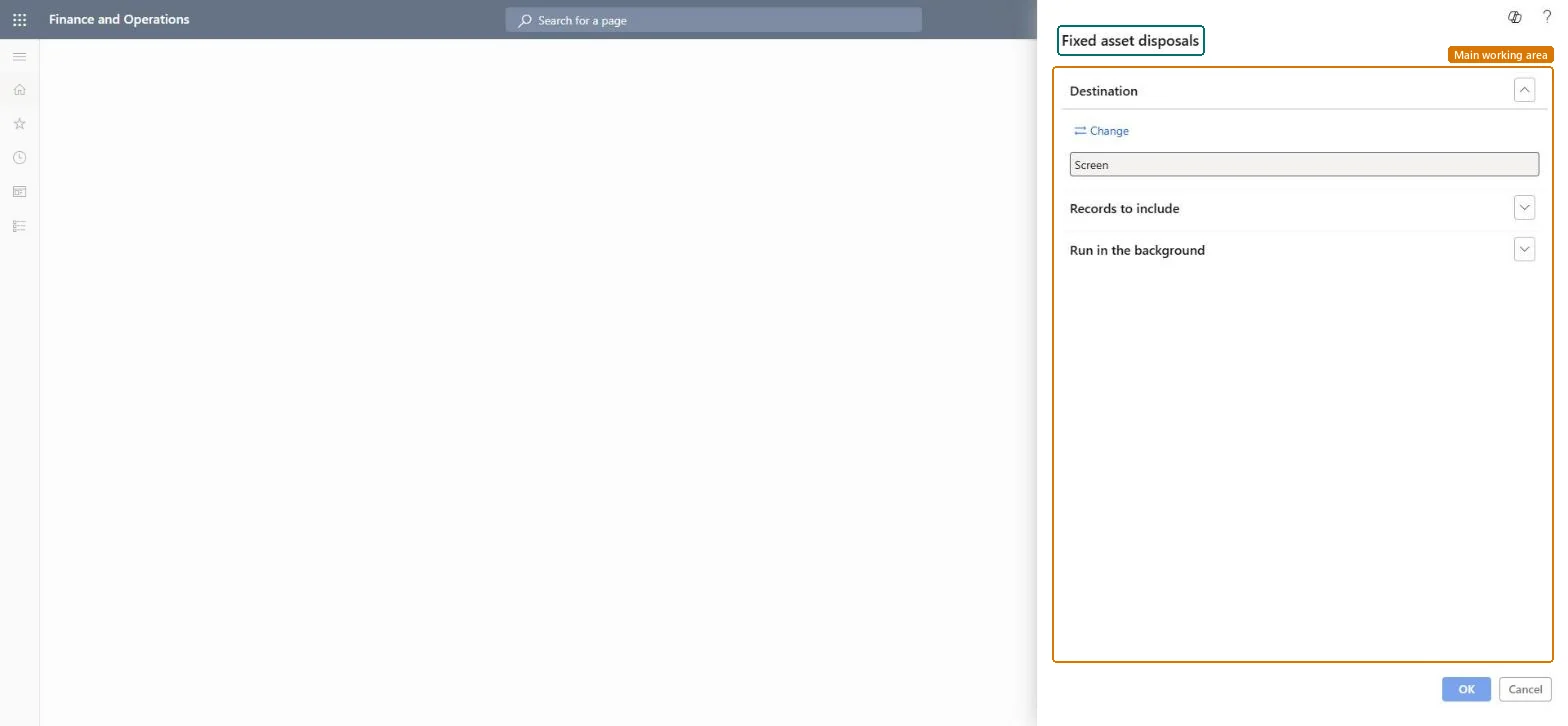
Where the report goes: Screen by default, or a file, printer or email.Checked in Dynamics 365
Screen
Records to include
Filters the disposals, such as a date range and book.Checked in Dynamics 365
Common errors and fixes
Message
What to do
The report is empty
Check the filters under Records to include and that the assets have posted transactions in the books you selected. Checked in Dynamics 365
Disposal posting fails validation of the posting profile
With Post disposal transactions in detail = Yes, the disposal profile needs Acquisition this year and Acquisition prior years; with No it needs Acquisition value. You can't define both kinds at once. Microsoft Learn
Filter on the period and the ledger book, and check the profit or loss against the gain and loss account.The report shows disposal date, net book value, sales value and profit or loss; disposal sale and scrap set the net book value to zero.
Fixed assets is part of Dynamics 365 Finance. Fixed asset accountants run the report. On this system the roles that open the page include Accounting supervisor, Accountant, Accounting manager, Auditor. No Feature management feature needs to be turned on for this page.
Checked in Dynamics 365
Solution architect
5Design impact
Shared or per company
Per company: the report reads the fixed assets and books of the current legal entity. Microsoft Learn
Can it be undone
Nothing to undo: The disposals report only reads data; it changes nothing. Microsoft Learn
If you change it later
The report only reads posted fixed asset data; it changes nothing. Its figures change when transactions are posted, reversed or deleted on the books it covers. Microsoft Learn
Technical architect
6Technical
Menu item
output:AssetDisposalChecked in Dynamics 365
Form
SysOperationTemplateFormChecked in Dynamics 365
Roles to set it up and use it
To use itAccounting supervisor LedgerAccountingSupervisorAccountant LedgerAccountantAccounting manager LedgerAccountingManagerAuditor AuditPolicyManagerChief financial officer CompanyChiefFinancialOfficerGive people one of these roles. On this system, 16 roles can run this page.Checked in Dynamics 365
Load order: Fixed asset disposals has no data entity in Data management, so it can't be loaded from a file or a configuration template. The report stores nothing of its own: it reads the posted fixed asset data, so migrate the assets, books and transactions and run it again in the new environment.Microsoft Learn
Fixed asset disposals report (Dynamics AX 2012 documentation, an earlier version) (archived Dynamics AX 2012 article for the same report; the menu item name is the same)
Checked in a working Dynamics 365 system, version 10.0.49: the menu item, form, table and security, the page.