Job page · Accounts receivable
Reimbursement
A periodic process that creates reimbursement transactions for customers that have credit balances.
- Used by
- —
- Business process
- —
- Menu item
Action:CustOverPaym- Main table
- —
- Data entity
- —
- Setup steps
- —
Show what matters for
Everyone
1What it is and why
| What it is | A periodic process that creates reimbursement transactions for customers that have credit balances. |
|---|---|
| What you do here | It moves each customer's credit balance to the customer's vendor account as a vendor invoice (creating a one-time vendor if needed), which is then paid through Accounts payable. |
| Example | A customer overpaid and has a credit balance; run Reimbursement, review it on the Reimbursement report, and pay the created vendor invoice in Accounts payable. |
Functional consultant · Solution architect
2Where it fits
| Business process | — |
|---|---|
| Menu path | Accounts receivable › Periodic tasks › Reimbursement |
| Set up first | Accounts receivable parameters: Minimum reimbursement Microsoft Learn ↗All customers: Vendor account Microsoft Learn ↗ |
| Used next by | Reimbursement report Microsoft Learn ↗Vendor payments Microsoft Learn ↗ |
| Related pages | — |
End user · Functional consultant
3How to do it
Microsoft's steps
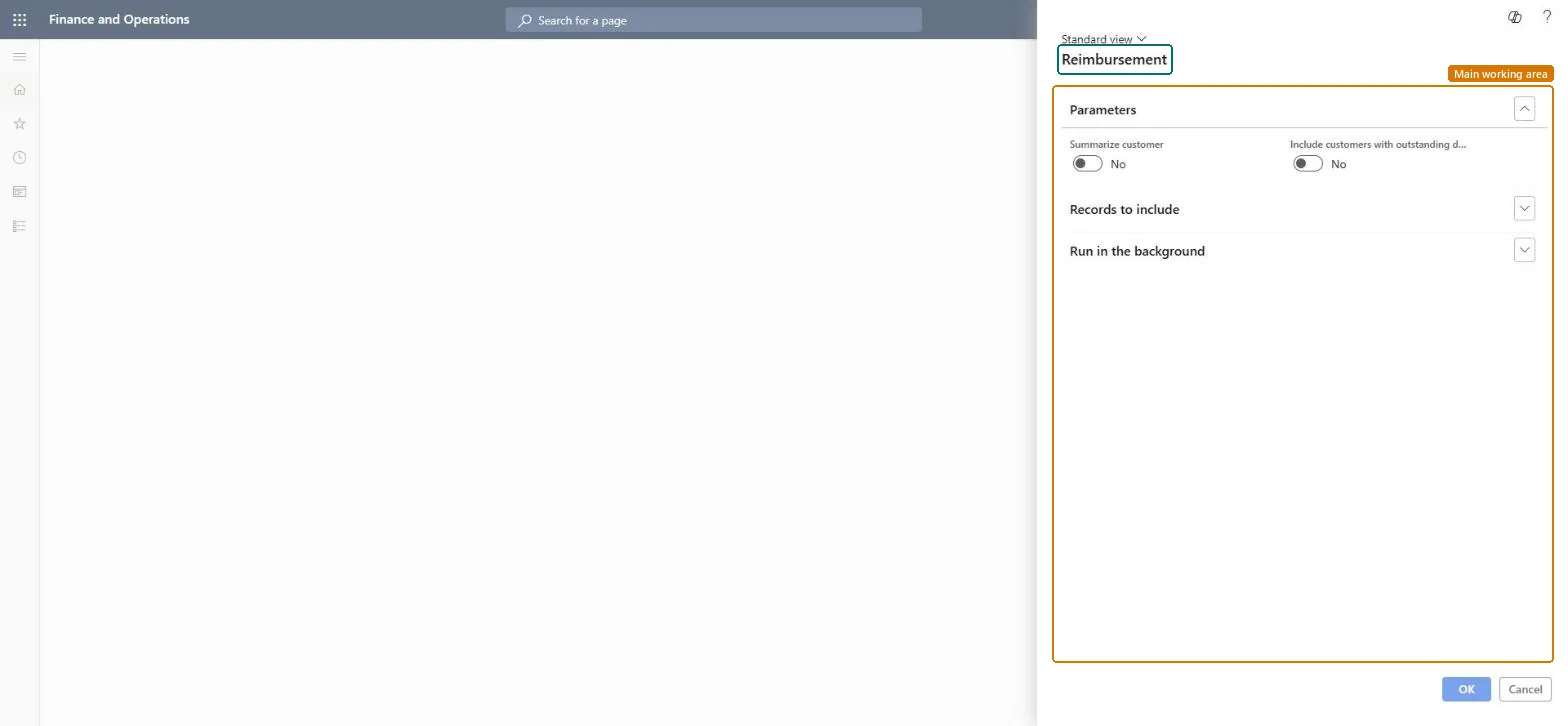
- Go to Accounts receivable > Periodic tasks > Reimbursement.
- Set Summarize customer to Yes to group all transactions, or No to group only those with similar ledger dimensions.
- Select Include customers with outstanding debit transactions if needed.
- On the Records to include FastTab, select Filter to limit the run to specific customers.
- Run the process.
- Review the result in the Reimbursement report.
- In Accounts payable, pay the vendor invoices that the process created.
Source: Microsoft Learn ↗
Field guide
| Field | What it means | Worked example | Table column |
|---|---|---|---|
| Summarize customer | Yes groups all transactions; No groups only transactions with similar ledger dimensions.Microsoft Learn ↗ | — | — |
| Include customers with outstanding debit transactions | Also selects customers who have unsettled debit amounts.Microsoft Learn ↗ | — | — |
Functional consultant
4Setup decisions
| Setup step | Recommended value and why | Decision · common mistake · test |
|---|---|---|
| — No setup is made on this page. | ||
Solution architect
5Design impact
| Shared or per company | — |
|---|---|
| Can it be undone | — |
| Feature or country | — |
| If you change it later | The credit balance moves to the customer's vendor account as a vendor invoice; if the customer has no vendor account, a one-time vendor is created. Microsoft Learn ↗ |
Technical architect
6Technical
| Menu item | Action:CustOverPaym Checked in Dynamics 365 |
|---|---|
| Form | CustOverPaym Checked in Dynamics 365 |
| Table | — |
| Data entities | — |
| Who can open it | — |
| Actions on the page | — |
Developer
7Developer
| Open it directly | https://<your-environment>/?mi=Action:CustOverPaym |
|---|---|
| Integrate with | — |
| Table definition | — |
Everyone
8Sources and checks
- learn.microsoft.com/dynamics365/finance/accounts-receivable/reimburse-customers
- learn.microsoft.com/dynamics365/finance/accounts-receivable/reimburse-customers
- Checked in a working Dynamics 365 system, version 10.0.49: the menu item, form, table and security, the page.