BeyondERP.Newsletter
Menu

Setup step on the Product filters page · Warehouse management

Set up Product filters

Use this page to define the filter codes that categorise items for handling, purchasing and selling.

Used by
Field Service Integration User, Production supervisor, Process engineer and 3 more roles
Business process
Manage warehouse operations
Menu item
WHSFilters
Main table
WHSFilters
Data entity
WHSFirstProductFilterCodeEntity
Setup steps
1 on this page
Show what matters for
SETUP GUIDEHow to set it up8 sections. Choose a role to highlight what matters to you.
Everyone

1What it is and why

What it isA setup page where you define product filters, each with a filter code, a filter title and a description.
What you do hereUse this page to define the filter codes that categorise items for handling, purchasing and selling.
ExampleFor example, items can be grouped together or kept apart when the way they are handled depends on weight or handling restrictions.
Product filters page in Dynamics 365
The page in Dynamics 365. page title tab to open what to set or check
Functional consultant · Solution architect

2Where it fits

Business processManage warehouse operations
Menu pathWarehouse management › Setup › Product filters › Product filters
Used next byProduct filter groups Microsoft Learn
In this process Set up Quality check template · Set up License plates
End user · Functional consultant

3How to do it

About the examples: Examples and screenshots in this guide use BEAT, a demo company in a Dynamics 365 test environment. Use your own company's codes and values instead of copying them.

Setup steps on this page

Set up Product filters

Use this page to define the filter codes that categorise items for handling, purchasing and selling.

Steps from Microsoft

  1. Go to Warehouse management > Setup > Product filters > Product filters.
  2. On the Action Pane, select New to add a product filter to the grid.
  3. In the Filter title field, select a value.
  4. In the Filter code field, enter a value.
  5. In the Description field, enter a name for the code.

Source: Microsoft Learn

Test checklist

  1. Create a filter code for Code 1.
  2. On the item group, select the Filter required check box for Code 1.
  3. Edit a WMS released product in that item group and set Code 1.
  4. Check the code is available on the Warehouse FastTab.

Source: Microsoft Learn

Functional consultant

4Setup decisions

Setup stepRecommended value and whyDecision, common mistake and test
Set up Product filtersGive each Filter title (Code 1 to Code 10) one meaning, such as hazardous classification, and define its filter codesEach Code value represents one characteristic, and filter codes put items into categories for handling, purchasing and selling.Setting filters on items that don't use warehouse management processes; filter codes work only for WMS items.
Solution architect

5Design impact

Shared or per companyPer company: each legal entity has its own records. Microsoft data model
Can it be undoneReversible: Filter codes can be added and described at any time.
Technical architect

6Technical

Menu itemWHSFilters Checked in Dynamics 365
FormWHSFilters Checked in Dynamics 365
TableWHSFiltersShown as “PRODUCT FILTERS” in Record infoKey field: FilterNumChecked in Dynamics 365
Data entitiesWHSFirstProductFilterCodeEntityFirst product filter codes Microsoft data model WHSFourthProductFilterCodeEntityFourth product filter codes Microsoft data model WHSSecondProductFilterCodeEntitySecond product filter codes Microsoft data model WHSThirdProductFilterCodeEntityThird product filter codes Microsoft data model
Who can open itPrivilegesMaintain filters WHSFiltersMaintainView filters WHSFiltersViewDutiesInquire into warehouse operation master WMSWarehouseOperationMasterInquireMaintain warehouse operation master WMSWarehouseOperationMasterMaintain
6 security rolesField Service Integration User FieldServiceIntegrationUserProduction supervisor ProdProductionSupervisorProcess engineer RouteProcessEngineerProcess engineering manager RouteProcessEngineeringManagerWarehouse planner WHSWarehousePlannerWarehouse manager WMSWarehouseManager
Checked in Dynamics 365
Roles to set it up and use itTo set it up or change itWarehouse manager WMSWarehouseManagerProcess engineer RouteProcessEngineerTo use itWarehouse planner WHSWarehousePlannerProduction supervisor ProdProductionSupervisorProcess engineering manager RouteProcessEngineeringManagerField Service Integration User FieldServiceIntegrationUserGive people one of these roles. On this system, 6 roles can open this page.Checked in Dynamics 365
Developer

7Developer

Open it by URLhttps://<your-environment>/?mi=WHSFilters
Integrate withWHSFirstProductFilterCodeEntity data entity Microsoft data model
Data migrationWHSFirstProductFilterCodeEntity (First product filter codes): loaded for each company, in Microsoft's default template 400 - Warehouse management.WHSFourthProductFilterCodeEntity (Fourth product filter codes): loaded for each company, in Microsoft's default template 400 - Warehouse management.WHSSecondProductFilterCodeEntity (Second product filter codes): loaded for each company, in Microsoft's default template 400 - Warehouse management.Load order: Microsoft's default template 400 - Warehouse management loads First product filter codes at execution unit 1, level 30, sequence 10. Lower levels load first, and entities at the same level load in sequence order.Load first: the default templates at lower levels (System setup to General ledger)Microsoft Learn
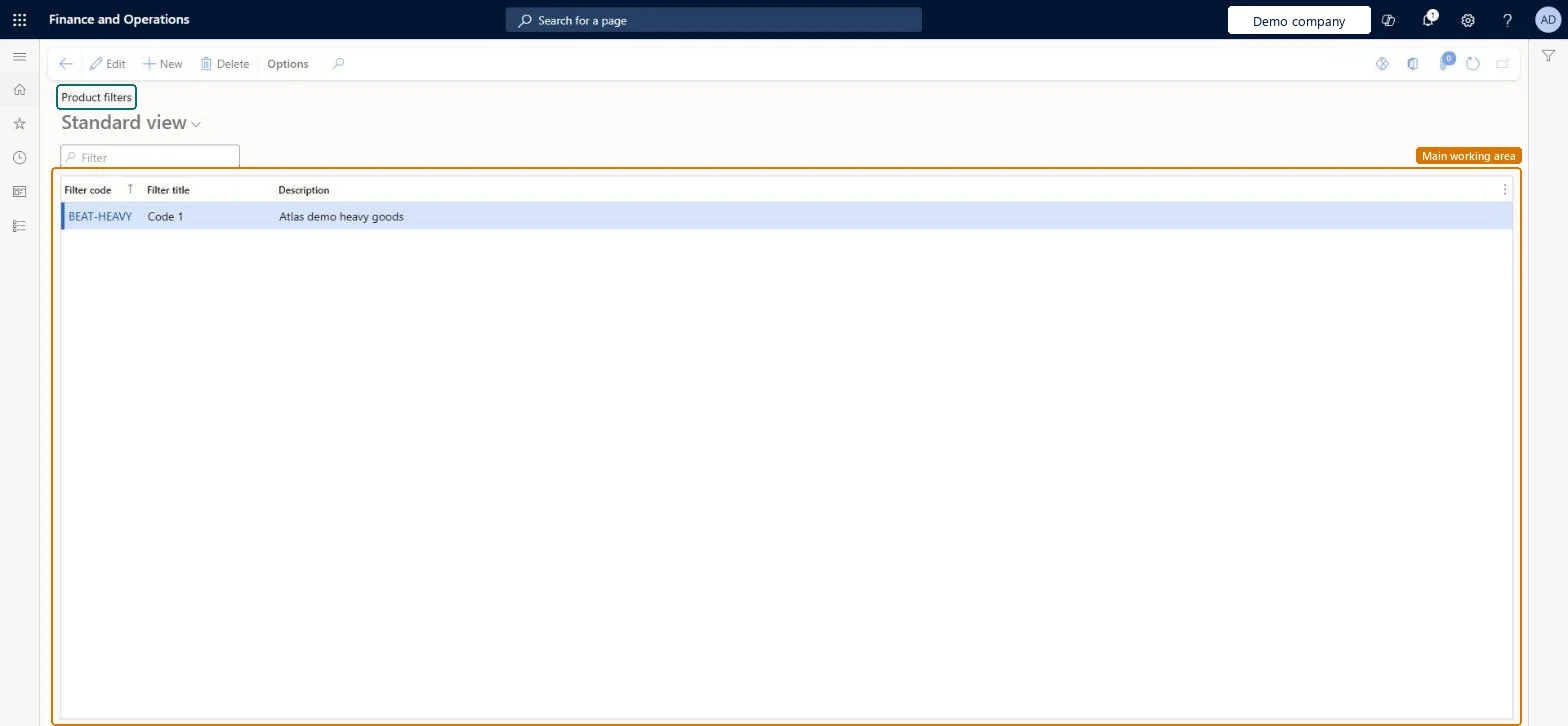
Table definitionWHSFilters columns and relations Microsoft data model
Everyone

8Sources

To cite this step: WM-SETUP-130, Set up Product filters. Beyond ERP Atlas Hub, 2026-11-11. https://www.beyonderp.cloud/atlas/step/WM-SETUP-130