PAGE GUIDEWhat the page does and how to use it8 sections. Choose a role to highlight what matters to you.
Everyone
1What it is and why
What it is
A setup page where you define route plans, which contain route segments that give the stops visited on a route and the carriers used for each segment.
What you do here
Use this page to set up routes that have multiple stops, including the origin and destination hub, carrier and mode of each segment, and route schedules for routes that you use regularly.
Example
For example, for each segment you can define spot rates for charges such as travelling to the segment, picking up the goods and dropping off the goods.
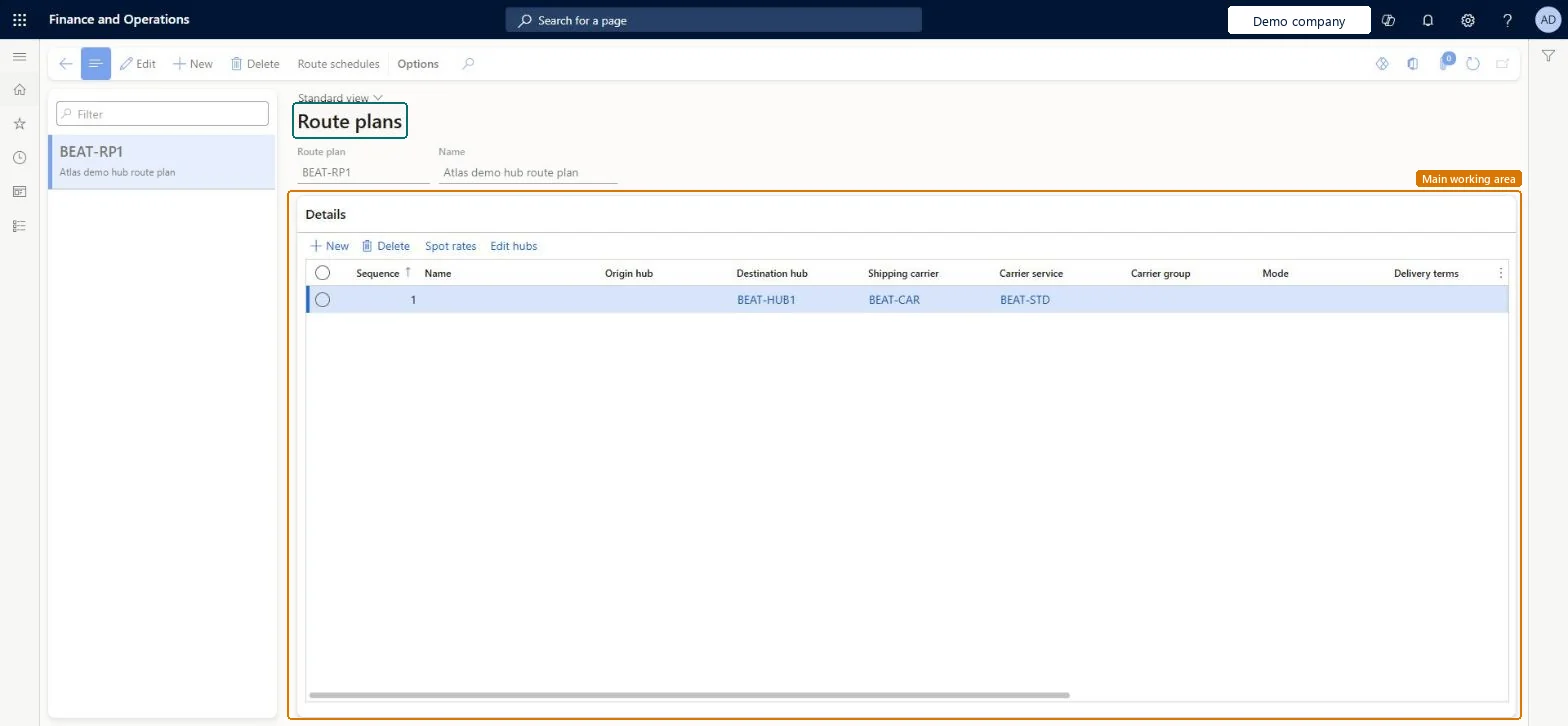
The page in Dynamics 365. page title tab to open what to set or check
About the examples: Examples and screenshots in this guide use BEAT, a demo company in a Dynamics 365 test environment. Use your own company's codes and values instead of copying them.
Setup steps on this page
Set up Route plans
Use this page to set up routes that have multiple stops, including the origin and destination hub, carrier and mode of each segment, and route schedules for routes that you use regularly.
How to use it
Go to Transportation management > Setup > Routing > Route plans.
Select New, and then enter a Route plan and a Name.
In the Details section, select New to add a segment, and enter the Sequence, Name, Origin hub and Destination hub.
For the segment, select the Shipping carrier, Carrier service or Carrier group, the Mode and the Delivery terms.
With a segment selected, use Spot rates and Edit hubs on the Details toolbar as required.
For a scheduled route, select Route schedules on the Action Pane.
Source: Checked in Dynamics 365
Test checklist
Create hubs for each stop, then a route plan with segments that set origin hub, destination hub and carrier.
Link the route plan to a route guide.
For a scheduled route, add a route schedule and create routes on the Route schedule page.
On the Load building workbench, propose a load for the scheduled route and check that only sales orders whose delivery postal code matches a hub and whose delivery date is in range are included.
Use route plans for routes with multiple stops: set up every stop as a hub first, add one segment per leg with its carrier, and add a route schedule only for routes you run regularlyStops on a route plan must be defined as hubs, each segment carries its own carrier and spot rates, and scheduled routes are meant for routes you use regularly.
PrivilegesMaintain route configurations TMSRouteConfigMaintainView route configurations TMSRouteConfigViewDutiesInquire into carrier master and network planning information TMSCarrierMasterInquireMaintain carrier and network planning master TMSCarrierMasterMaintain2 security rolesLogistics manager TMSLogisticsManagerTransportation coordinator TMSTransportationCoordinatorChecked in Dynamics 365
Roles to set it up and use it
To set it up or change itLogistics manager TMSLogisticsManagerTo use itTransportation coordinator TMSTransportationCoordinatorGive people one of these roles. On this system, 2 roles can open this page.Checked in Dynamics 365
Actions on the page
(Action Pane without tabs): Route schedulesChecked in Dynamics 365
TMSTransportationRoutePlanEntity (Transportation route plans): loaded for each company, in Microsoft's default template 405 - Transportation management.Load order: Microsoft's default template 405 - Transportation management loads Transportation route plans at execution unit 1, level 30, sequence 10. Lower levels load first, and entities at the same level load in sequence order.Load first: the default templates at lower levels (System setup to General ledger)Microsoft Learn