BeyondERP.Newsletter
Menu

Setup page · Asset management

Lifecycle models

A setup page where you group maintenance request lifecycle states into lifecycle models, which define the flow for different types of maintenance requests.

Used by
Maintenance clerk, Maintenance manager
Business process
Develop maintenance strategy
Menu item
EntAssetRequestLifecycleModel
Main table
EntAssetRequestLifecycleState
Data entity
EntAssetMaintenanceRequestLifecycleModelEntity
Setup steps
1 on this page
Show what matters for
PAGE GUIDEWhat the page does and how to use it8 sections. Choose a role to highlight what matters to you.
Everyone

1What it is and why

What it isA setup page where you group maintenance request lifecycle states into lifecycle models, which define the flow for different types of maintenance requests.
What you do hereUse this page to create maintenance request lifecycle models, choose which lifecycle states each model includes, and set the order in which users see them.
ExampleFor example, a standard model includes the states Created, Active, and Ended in the order that requests usually move through them.
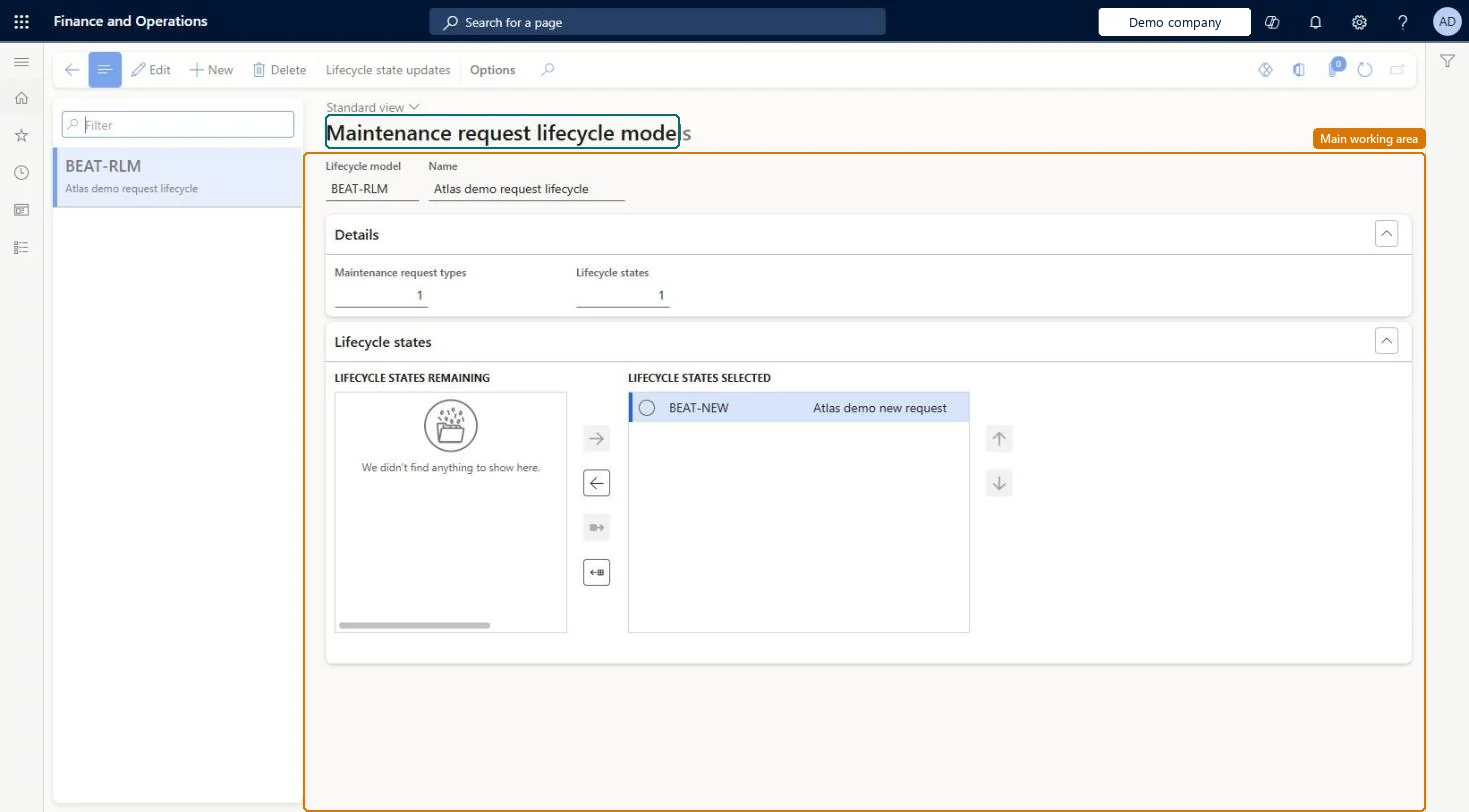
Lifecycle models page in Dynamics 365
The page in Dynamics 365. page title tab to open what to set or check
Functional consultant · Solution architect

2Where it fits

Business processDefine asset strategy › Develop maintenance strategy
Menu pathAsset management › Setup › Maintenance requests › Lifecycle models
Set up firstLifecycle states (maintenance requests) Microsoft Learn
Used next byMaintenance request types Microsoft Learn
End user · Functional consultant

3How to do it

About the examples: Examples and screenshots in this guide use BEAT, a demo company in a Dynamics 365 test environment. Use your own company's codes and values instead of copying them.

Setup steps on this page

Set up Maintenance request lifecycle models

Use this page to create maintenance request lifecycle models, choose which lifecycle states each model includes, and set the order in which users see them.

Steps from Microsoft

  1. Go to Asset management > Setup > Maintenance requests > Lifecycle models.
  2. On the Action Pane, add a lifecycle model.
  3. In the Lifecycle model field, enter an ID, and in the Name field, enter a name.
  4. On the Lifecycle states FastTab, move the lifecycle states to include into the Lifecycle states selected column.
  5. Use the up and down buttons to put the lifecycle states in the order that requests usually follow.

Source: Microsoft Learn

Fields on the page

FieldWhat it means
Lifecycle states selectedLifecycle states in the model, in the order shown to users when they change a request's state.Microsoft Learn
Lifecycle state for asset receivedFor depot repair: asset lifecycle state that assets get when they are received.Microsoft Learn
Lifecycle state for asset deliveredFor depot repair: lifecycle state that assets get when they are returned.Microsoft Learn

Test checklist

  1. Create a model with Created, Active and Ended in that order.
  2. Assign it to a maintenance request type.
  3. Create a request of that type and change its lifecycle state.
  4. Check the states are offered in the model's order.

Source: Microsoft Learn

Functional consultant

4Setup decisions

Setup stepRecommended value and whyDecision, common mistake and test
Set up Maintenance request lifecycle modelsAt least one standard model, with selected states ordered the way requests normally progress from start to finishLearn says at least one standard model should be created, and users see states in the order of Lifecycle states selected when they change a request's state.Leaving the states in the order they were added, so users see a confusing list when updating requests.

Feature management and licence

Licence or add-inConfiguration key Asset management > Inbound/outbound (needed for the depot repair fields Lifecycle state for asset received and Lifecycle state for asset delivered; enable in maintenance mode)

Microsoft Learn

Solution architect

5Design impact

Can it be undoneReversible: The model can be edited any time; check the Maintenance request types count, because every type that uses it changes. Microsoft Learn
If you change it laterThe order of states in the model is the order in which users see them when they change a maintenance request's lifecycle state. Microsoft Learn
Technical architect

6Technical

Menu itemEntAssetRequestLifecycleModel Checked in Dynamics 365
FormEntAssetRequestLifecycleModel Checked in Dynamics 365
TableEntAssetRequestLifecycleStateShown as “MAINTENANCE REQUEST LIFECYCLE MODELS” in Record infoKey field: RequestLifecycleModelIdChecked in Dynamics 365
Data entitiesEntAssetMaintenanceRequestLifecycleModelEntityAsset management maintenance request lifecycle models Checked in Dynamics 365
Who can open itPrivilegesMaintain maintenance management setup EntAssetSetupMaintainView maintenance management setup EntAssetSetupViewDutiesMaintain Asset Management setup EntAssetSetupMaintainView Enterprise Asset Management setup EntAssetSetupView
2 security rolesMaintenance clerk EntAssetMaintenanceClerkMaintenance manager EntAssetMaintenanceManager
Checked in Dynamics 365
Roles to set it up and use itTo set it up or change itMaintenance manager EntAssetMaintenanceManagerTo use itMaintenance clerk EntAssetMaintenanceClerkGive people one of these roles. On this system, 2 roles can open this page.Checked in Dynamics 365
Actions on the page(Action Pane without tabs): Lifecycle state updatesChecked in Dynamics 365
Developer

7Developer

Open it by URLhttps://<your-environment>/?mi=EntAssetRequestLifecycleModel
Integrate withEntAssetMaintenanceRequestLifecycleModelEntity data entity Checked in Dynamics 365
Everyone

8Sources