Microsoft’s planned Dynamics 365 Finance journal redesign touches finance processes that already depend on journals today: cost allocation, accruals, intercompany accounting, imported journals, Excel-based preparation, workflow approval, validation and posting.
Microsoft’s Roadmap ID 571847 says the planned financial-journal capabilities depend on Optimized financial dimensions and the Ledger posting rules framework. Preview is currently estimated for March 2027, with rollout starting in December 2027. Those dates are roadmap estimates, not production commitments.
What is planned, and what exists today
Microsoft’s 23 September 2026 Dynamics 365 announcement says the financial-journal experience is being re-engineered for higher transaction volumes and cross-legal-entity complexity.
The roadmap describes planned capabilities including scalable journal creation and import, customer and ledger account types, in-context import-error review, pre-posting visibility for intercompany and intracompany accounting, accruals and allocations, related-document traceability, and advanced tax calculation integration.
Those capabilities are planned. The following business processes are current, documented Dynamics 365 Finance scenarios.
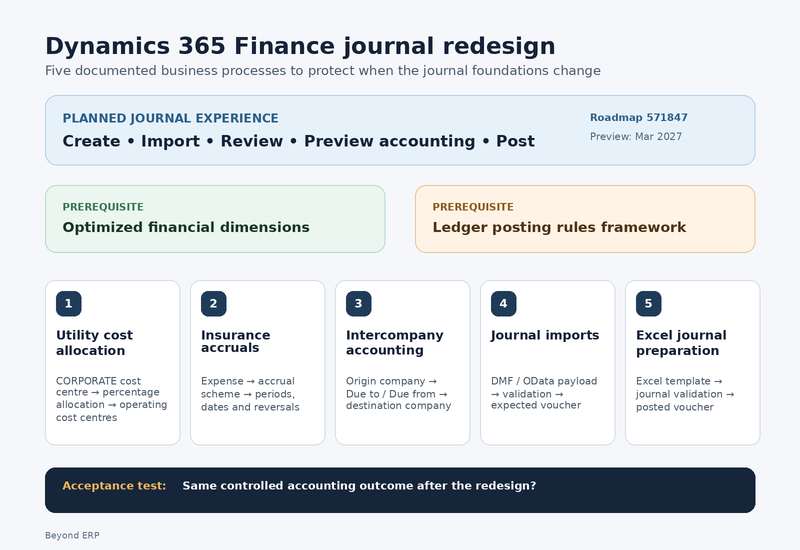
Business use case 1: allocate a corporate utility bill to cost centres
Microsoft’s allocation terms documentation uses a concrete example.
A company has a CORPORATE cost centre numbered 000. Utility invoices are posted to that corporate cost centre. The business wants the utility expense distributed by percentage across individual cost centres while keeping the existing department and business-unit dimensions.
Dynamics 365 Finance supports this through allocation terms on the utility expense main account. The source can be restricted to cost centre 000, destination cost centres can be defined individually, and other dimensions can be retained. When a voucher matches the source criteria, Finance can automatically create the allocation voucher.
That gives us a specific accounting outcome to protect: a centrally booked operating cost must reach the correct reporting cost centres.
What to test
For this use case, compare:
- source utility expense account and CORPORATE cost centre;
- allocation percentages;
- retained department and business-unit values;
- destination cost centres;
- balancing entries;
- resulting voucher; and
- reporting output by cost centre.
The success criterion is accounting equivalence, not merely successful posting.
Business use case 2: spread an insurance cost through ledger accruals
Microsoft’s ledger accrual task guide uses insurance expense as its example.
A finance user creates or opens a general journal, enters the insurance expense, applies an accrual scheme, selects a start date, reviews the generated transactions and posts them.
That represents a familiar finance requirement: recognise an expense across the periods to which it relates.
The roadmap says the planned journal experience will provide pre-posting visibility for accruals, and it also states that future-period accruals will no longer post automatically.
What to test
A controller needs evidence that:
- the total expense is unchanged;
- the number of generated periods is correct;
- posting dates are correct;
- the main account and dimensions are correct on every generated line;
- tax treatment is unchanged where applicable;
- reversal behaviour is understood; and
- the close process does not rely on automation behaviour that Microsoft is changing.
Business use case 3: intercompany journals and centralized payments
Microsoft’s intercompany accounting documentation explicitly lists daily journals, vendor invoice journals, ledger allocations and centralized payments as intercompany scenarios.
The setup requires Due to and Due from accounts for the legal entities involved. Microsoft recommends unique intercompany main accounts per company to simplify reconciliation and elimination. The setup also distinguishes the originating legal entity from the destination legal entity, and reciprocal setup may be required when either company can originate the transaction.
A shared-services or treasury team may operate centrally, but the accounting still has to land correctly in multiple legal entities.
What to test
When Microsoft introduces pre-posting visibility for intercompany accounting, test:
- originating versus destination legal entity;
- reciprocal company setup;
- Due to and Due from accounts;
- fixed counterparty/trading-partner dimensions;
- destination journal name;
- supporting amounts such as realized gains/losses where relevant;
- resulting vouchers in both companies; and
- reconciliation and elimination output.
Business use case 4: import journals from another system
Microsoft’s general-journal import guidance documents journal imports for data migration and integration scenarios.
For DMF, Microsoft recommends the General journal entity in most scenarios because it combines header and lines. For OData and the Excel add-in, the Ledger journal header and Ledger journal line entities are available separately.
An organisation may have upstream systems that generate journals outside Finance. Whether the source is a migration load or an ongoing integration, the imported journal still needs to pass Finance validation and create the expected accounting.
What to measure before preview
Capture a baseline for representative imported journals:
- row count;
- processing time;
- failure rate;
- common validation errors;
- financial dimension transformations;
- duplicate prevention;
- journal name defaults;
- workflow behaviour;
- posting result; and
- final voucher count.
Then rerun the same payloads when the new experience becomes available.
Business use case 5: finance users prepare journals in Excel
Microsoft’s Excel journal guidance explains how users enter and publish journal lines from Excel.
The available templates cover scenarios including ledger journals, invoice journals, vendor and customer payment journals, fixed-asset journals and project expense journals. Microsoft states that when lines are published, they are validated against the rules configured for the financial journals before users edit or post the vouchers in Finance.
Financial dimensions can also be added to Excel templates.
What to test
The Excel regression surface should include:
- required dimensions;
- allowed dimension combinations;
- account/offset-account combinations;
- intercompany support where applicable;
- validation messages;
- user correction flow; and
- the final voucher after posting.
What these five use cases tell us about the two prerequisites
Optimized financial dimensions
Dimensions determine where cost and revenue are reported and who owns the result.
They are central to the utility allocation example, imported journals, Excel journals, intercompany accounting and accrual entries.
Microsoft’s financial dimensions documentation says that, from Finance 10.0.49, the optional Financial dimension service is deprecated and future investment aligns with Optimized Financial dimensions.
The practical action is to identify every journal process that parses, derives, defaults, validates or transports dimensions.
Ledger posting rules framework
Microsoft names the Ledger posting rules framework as the other prerequisite for the planned journal capabilities.
The public material cited here does not yet document a complete migration sequence.
The useful preparation work is to catalogue where today’s accounting result depends on posting logic, balancing, restrictions, validations or custom extensions and make those results testable.
Regression tests by finance process
A stronger test pack should be organised by finance process.
| Business process | Current evidence to capture | Future acceptance test |
|---|---|---|
| Corporate utility allocation | Source cost centre, percentages, retained dimensions, destination cost centres, voucher | Same distribution and reporting result |
| Insurance accrual | Total amount, scheme, periods, dates, dimensions, reversals | Same economic recognition with understood future-period behaviour |
| Intercompany / centralized payment | Origin/destination company, Due to/Due from, counterparty dimension, vouchers | Same legal-entity and reconciliation result |
| Imported journals | Payload size, transforms, validation errors, posting result | Same accounting result with acceptable processing performance |
| Excel journal preparation | Template, dimensions, validation rules, correction flow | Same validation and posted voucher |
This turns the journal redesign into five observable business outcomes that can be tested.
What Microsoft has not yet documented
The planned journal experience is not generally available today.
Microsoft has named Optimized financial dimensions and the Ledger posting rules framework as prerequisites, but the cited public material does not yet provide a complete migration sequence for either one.
Keep that uncertainty explicit.
Use the time before preview to make the current business outcomes measurable. When Microsoft publishes more prerequisite guidance and the preview becomes available, compare the new behaviour against those baselines.
Conclusion
Existing finance processes already depend on dimensions, posting rules and journal controls:
- allocating a centrally booked utility bill;
- spreading an insurance cost across periods;
- balancing intercompany journals;
- importing journals from another system; and
- validating finance-owned Excel journals.
Those processes are concrete, documented and testable.
For the March 2027 preview, the acceptance question is straightforward:
That is what should be proven before production adoption.
Sources
- AI at Work roadmap: Improve financial journal processing and control
- Microsoft Dynamics 365 Blog: Build the future of agentic ERP
- Microsoft Learn: Allocation terms
- Microsoft Learn: Create ledger accrual transactions
- Microsoft Learn: Intercompany accounting setup
- Microsoft Learn: Import general journals in Dynamics 365 projects
- Microsoft Learn: Publish journal lines and documents from Excel
- Microsoft Learn: Financial dimensions and tags
- Microsoft Learn: General journal processing
Evidence
Microsoft is re-engineering the Dynamics 365 Finance journal experience for higher transaction volumes and cross-legal-entity complexity, including visibility before posting.
Microsoft Dynamics 365 Blog: Build the future of agentic ERP with new Microsoft Dynamics 365 capabilities · 2026-09-23
Roadmap ID 571847 is in development, estimates preview in March 2027 and rollout from December 2027, and names two prerequisites.
AI at Work roadmap: Improve financial journal processing and control · 2026-09-18
From 11 September 2026 with Finance 10.0.49, Microsoft deprecates the Financial dimension service and directs future investment towards Optimized Financial dimensions.
Microsoft Learn: Financial dimensions and tags · 2026-05-27
Current journal processing includes journal names, workflow approval, controls, account structures, global general journals and Simulate posting.
Microsoft Learn: General journal processing · 2026-05-12
Microsoft documents a utility-expense example where costs posted to a CORPORATE cost centre are allocated by percentage to individual cost centres.
Microsoft Learn: Allocation terms · 2024-05-08
Microsoft's ledger accrual task guide uses insurance expense as the example for generating periodic accrual transactions from a general journal.
Microsoft Learn: Create ledger accrual transactions · 2025-09-08
Microsoft documents intercompany journal scenarios including daily journals, vendor invoice journals, ledger allocations and centralized payments, with Due to/Due from setup.
Microsoft Learn: Intercompany accounting setup · 2026-04-03
Microsoft documents general-journal imports for migration and integration, with DMF and OData entity options.
Microsoft Learn: Import general journals in Dynamics 365 projects · 2024-02-20
Microsoft documents publishing financial-journal lines from Excel, with validation against configured journal rules before vouchers are edited or posted in Finance.
Microsoft Learn: Publish journal lines and documents from Excel · 2026-07-30