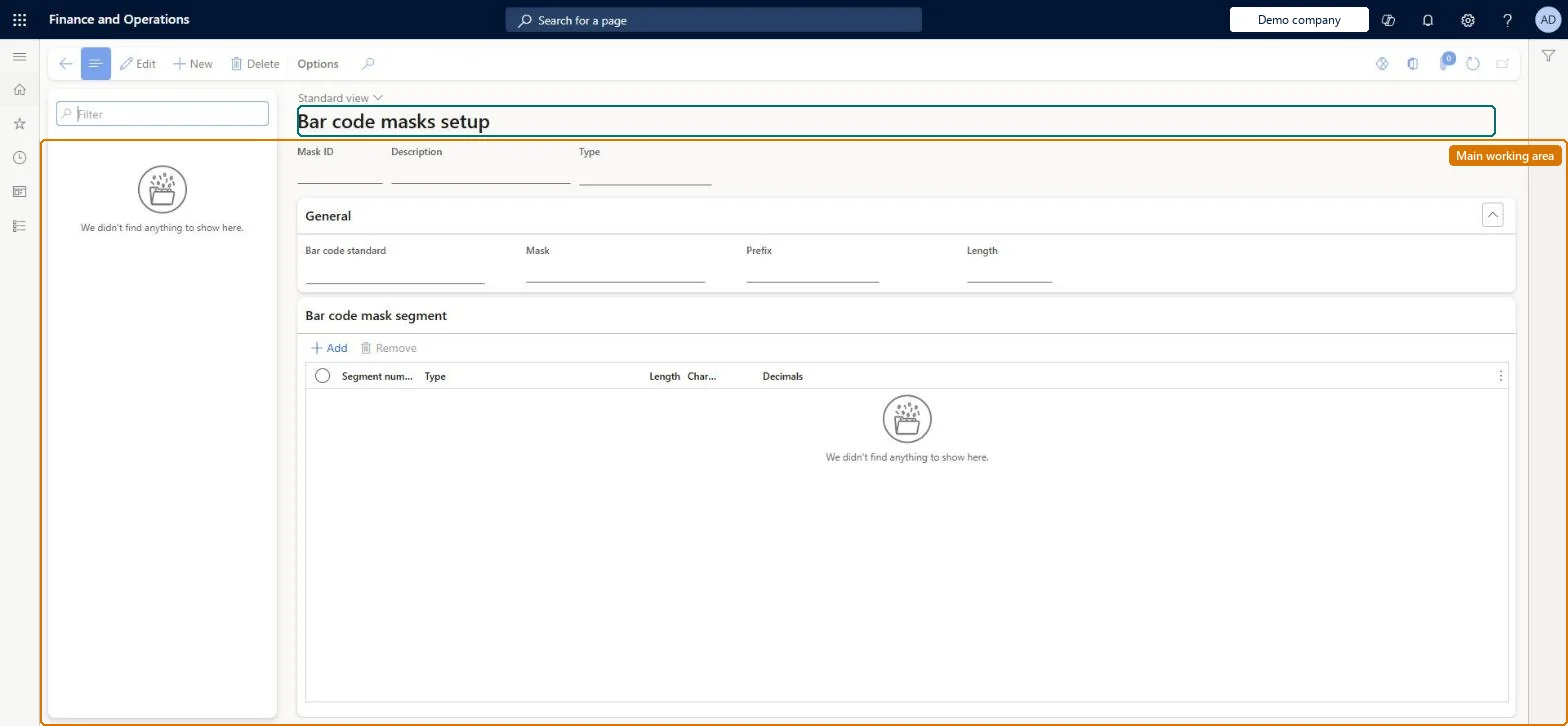
A setup page where you define barcode masks: a mask ID, type, barcode standard, optional prefix and an ordered set of mask segments that give the format of barcodes to be generated or recognised.
Retail and CommerceInventory managementBar codes and labels
RetailBarcodeMaskSetup
Used by
Retail operations manager, Retail service, Information technology manager
Business process
Manage sales channels
Menu item
RetailBarcodeMaskSetup
Main table
RetailBarcodeMaskTable
Data entity
RetailBarcodeMaskEntity
Setup steps
1 on this page
Show what matters for
PAGE GUIDEWhat the page does and how to use it8 sections. Choose a role to highlight what matters to you.
Everyone
1What it is and why
What it is
A setup page where you define barcode masks: a mask ID, type, barcode standard, optional prefix and an ordered set of mask segments that give the format of barcodes to be generated or recognised.
What you do here
Use this page to build the masks that Commerce uses to generate barcodes for products and other entities and to identify barcodes scanned at the POS.
Example
For example, create a Product mask of type Product with the Code 39 standard, prefix 22 and a 10-character product segment matching the length of your product IDs.
The page in Dynamics 365. page title tab to open what to set or check
About the examples: Examples and screenshots in this guide use BEAT, a demo company in a Dynamics 365 test environment. Use your own company's codes and values instead of copying them.
Setup steps on this page
Set up Bar code mask setup
Use this page to build the masks that Commerce uses to generate barcodes for products and other entities and to identify barcodes scanned at the POS.
Steps from Microsoft
Go to Retail and Commerce > Inventory management > Bar codes and labels > Bar code mask setup.
Select New.
Enter Mask ID and Description, and select a Type.
In the General section, select the Barcode standard and enter a prefix if required.
In the Barcode mask segment section, add the segments and their lengths.
Product segment length equal to the product ID length used in stores; number sequence segments no longer than the mask segments, and shorter for check-digit types (EAN13, EAN8, UPCA, UPCE)Learn says the segment length should match the store product ID length, and from 10.0.32 the prefix is added after the number sequence, so sequence segments must fit inside the mask.
A number sequence as long as the mask on an EAN13 mask leaves no room for the check digit, so generated barcodes don't fit the mask.Test: Number sequence fits the mask
Solution architect
5Design impact
Can it be undone
Reversible: A mask can be changed, but it drives both barcode generation and POS scan recognition, so keep segment lengths in step with any number sequence that generates barcodes. Microsoft Learn
If you change it later
Segment lengths must be kept in step with any number sequence that generates barcodes from the mask: the sequence segments may not exceed the mask segments, and must be shorter where the barcode type has a check digit. Microsoft Learn
Technical architect
6Technical
Menu item
RetailBarcodeMaskSetupChecked in Dynamics 365
Form
RetailBarcodeMaskSetupChecked in Dynamics 365
Table
RetailBarcodeMaskTableShown as “BAR CODE MASK” in Record infoChecked in Dynamics 365
To set it up or change itRetail service RetailServiceRetail operations manager RetailOperationsManagerInformation technology manager SysServerITManagerGive people one of these roles. On this system, 3 roles can open this page.Checked in Dynamics 365
RetailBarcodeMaskEntity (Bar code mask): loaded for each company, in Microsoft's default template 500 - Retail.Load order: Microsoft's default template 500 - Retail loads Bar code mask at execution unit 1, level 30, sequence 20. Lower levels load first, and entities at the same level load in sequence order.Load first: the default templates at lower levels (System setup to General ledger)Microsoft Learn