BeyondERP.Newsletter
Menu

Report page · Project management and accounting

Project on-account (2 periods)

A report that shows the on-account amounts invoiced per project for two ledger date ranges side by side.

Business process
Analyze project performance
Menu item
output:ProjListProjOnAccountProj2ColumnPeriod
Setup steps
1 on this page
Show what matters for
PAGE GUIDEWhat the page does and how to use it8 sections. Choose a role to highlight what matters to you.
Everyone

1What it is and why

What it isA report that shows the on-account amounts invoiced per project for two ledger date ranges side by side.
What you do hereUse it to compare on-account billing per project between two periods, for example quarter against quarter.
ExampleBEAT compares Q3 with Q4 2026: PRJ-0057 invoiced 25,000.00 on-account in Q3 and 30,000.00 in Q4, in line with its billing schedule.
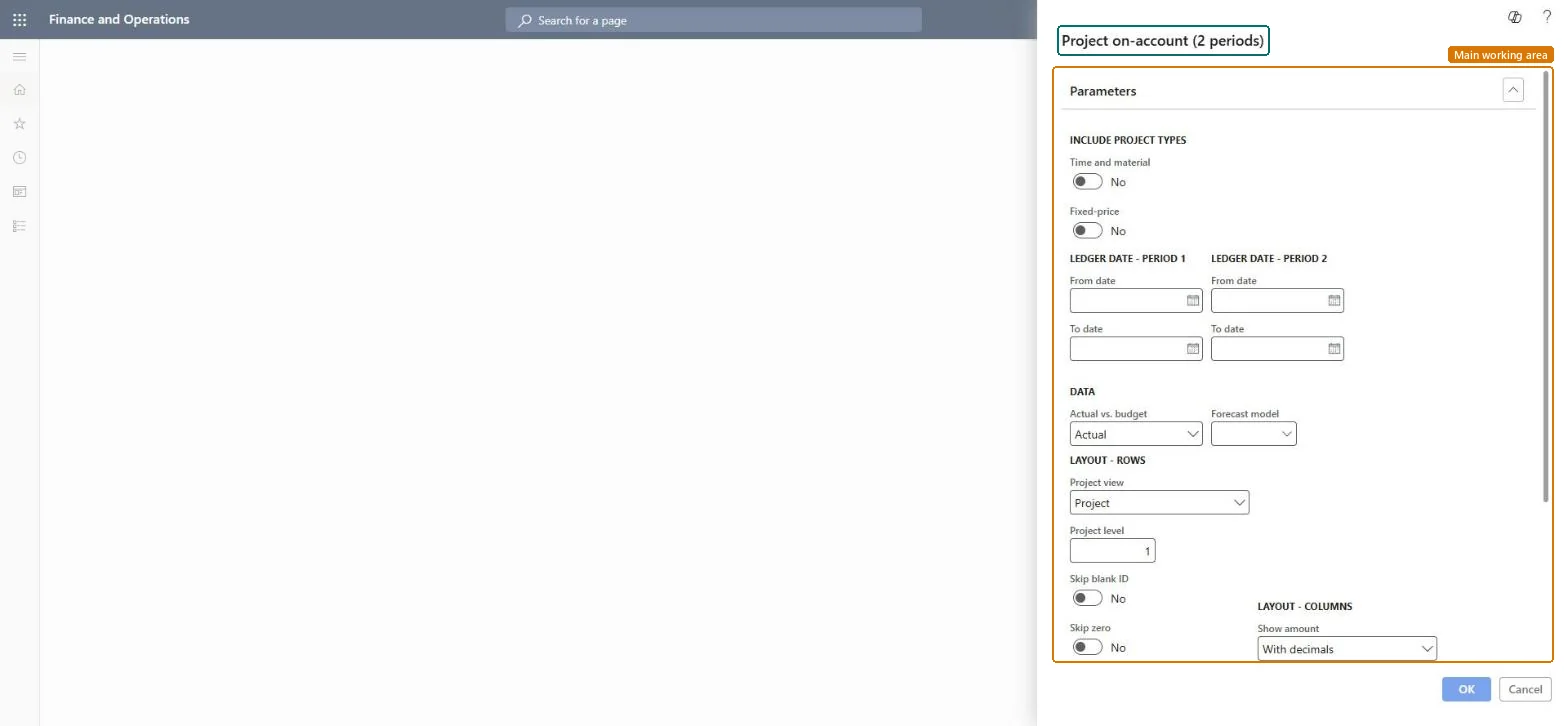
Project on-account (2 periods) page in Dynamics 365
The page in Dynamics 365. page title tab to open what to set or check
Functional consultant · Solution architect

2Where it fits

Business processAnalyze project performance
Menu pathProject management and accounting › Inquiries and reports › On account reports › Project on-account (2 periods)
Set up firstProject on-account Microsoft Learn
Used next byProject on-account (actual vs. budget) Microsoft Learn
Related pagesProject on-account Microsoft Learn Project on-account (actual vs. budget) Microsoft Learn On-account transactions inquiry Microsoft Learn
End user · Functional consultant

3How to do it

About the examples: Examples and screenshots in this guide use BEAT, a demo company in a Dynamics 365 test environment. Use your own company's codes and values instead of copying them.

When to run it

When to run itAfter a period is closed, when you compare on-account invoicing per project with another period.
How oftenOn demand, at period close or for quarterly billing reviews.
What the output showsOne row per project with on-account amounts for Period 1 and Period 2. Unlike Project on-account, it shows two ledger ranges side by side; a gap usually means a milestone was billed in the other period.

Source: Microsoft Learn

Setup steps on this page

Set the selection for Project on-account (2 periods)

Get on-account billing per project that can be checked against the ledger or the plan.

Steps from Microsoft

  1. Go to Project management and accounting > Inquiries and reports > On account reports > Project on-account (2 periods).
  2. Under Include project types, turn on Time and material or Fixed-price for the projects to compare.
  3. Enter the From date and To date for Ledger date - Period 1 and for Ledger date - Period 2.
  4. Under Data, set Actual vs. budget and a Forecast model if you compare budget values in both periods.
  5. Under Layout - rows, choose the Project view and Project level, run the report, and compare the two on-account columns per project.

Source: Microsoft Learn

Fields on the page

FieldWhat it means
Include project typesChoose which project types the report covers.Microsoft Learn
Actual vs. budgetChoose whether the report shows actual values or budgeted values.Microsoft Learn
Forecast modelChoose the forecast model that supplies the budget figures; with project budget control, use the project's budget forecast model.Microsoft Learn
Project viewChoose how the first column of the report is grouped, for example by project group or customer.Microsoft Learn
Project levelSet how many levels of subprojects the report shows.Microsoft Learn
Skip blank IDLeave out transactions that have no ID for the grouping the report uses.Microsoft Learn
Skip zeroLeave out rows where the amounts are zero.Microsoft Learn
Show amountChoose how amounts are shown, such as with decimals, without decimals, or in thousands or millions.Microsoft Learn

Common errors and fixes

MessageWhat to do
Both columns show the same amount for a project.Period 1 and Period 2 overlap; set ranges that don't share dates. Microsoft Learn
Functional consultant

4Setup decisions

Setup stepRecommended value and whyDecision, common mistake and test
Set the selection for Project on-account (2 periods)Enter two closed periods of equal length under Ledger date - Period 1 and Period 2.Each column is a plain total of its range; unequal or overlapping ranges make the comparison meaningless.How do you choose the two periods?Reading a gap between the columns as lost revenue: on-account billing follows the billing schedule, so a milestone billed in the other period explains most gaps.Test: Project on-account (2 periods) shows a billed milestone

Feature management and licence

Licence or add-inOn the live system, Project manager, Project supervisor, Chief executive officer and Chief financial officer can run this page.

Checked in Dynamics 365

Solution architect

5Design impact

Shared or per companyPer legal entity: the report reads only the project data of the company you are signed in to, so run it in each company you close. Checked in Dynamics 365
Can it be undoneReversible: the report changes no data: This comparison report only reads posted on-account data; it changes nothing. Microsoft Learn
If you change it laterThe report reads posted on-account invoices and, for budgets, forecast lines. Whether an on-account invoice hit WIP Invoiced - on account or Invoiced revenue - on account depends on the project cost and revenue profile at posting; a profile change affects only later invoices. Microsoft Learn
Technical architect

6Technical

Menu itemoutput:ProjListProjOnAccountProj2ColumnPeriod Checked in Dynamics 365
FormSysOperationTemplateForm Checked in Dynamics 365
Roles to set it up and use itTo use itProject manager ProjProjectManagerProject supervisor ProjProjectSupervisorChief executive officer CompanyChiefExecutiveOfficerChief financial officer CompanyChiefFinancialOfficerGive people one of these roles. On this system, 4 roles can run this page.Checked in Dynamics 365
Developer

7Developer

Open it by URLhttps://<your-environment>/?mi=output:ProjListProjOnAccountProj2ColumnPeriod
Data migrationLoad order: Project on-account (2 periods) has no data entity in Data management: it is an SSRS report (design ProjOnAccProj2Prd) that reads posted project data. There is nothing to migrate for the report itself; load the project data it reads, for example opening balances through Journals > Beginning balance, then run the report in the new system and compare its totals with the old one.Microsoft Learn
Everyone

8Sources