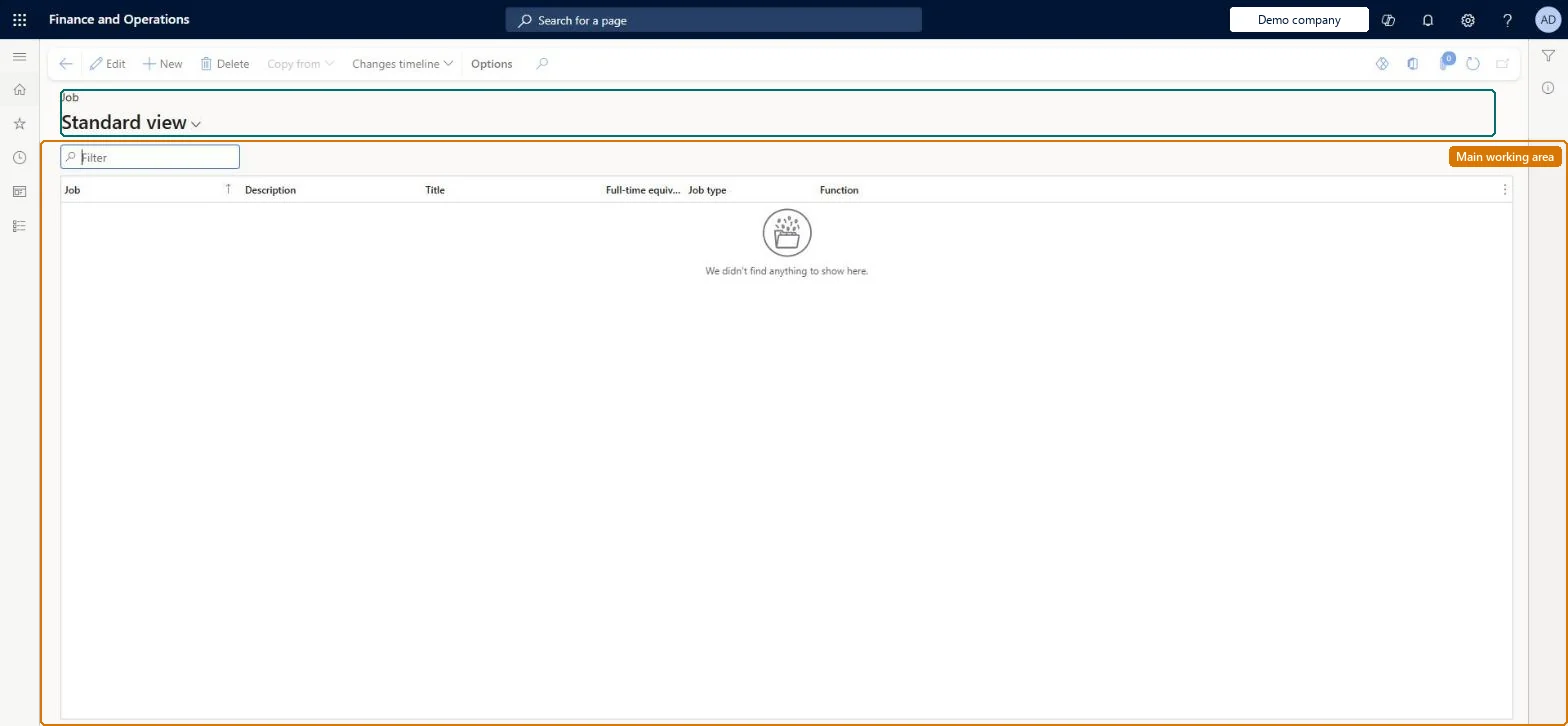
A page where you create and maintain jobs, which hold the title, classification, compensation level, skills and other details that positions based on the job inherit.
Chief executive officer, Chief financial officer, Compensation and benefits manager and 6 more roles
Business process
Develop people strategy
Menu item
HcmJobList
Main table
HcmJob
Data entity
HcmJobEntity
Show what matters for
PAGE GUIDEWhat the page does and how to use it7 sections. Choose a role to highlight what matters to you.
Everyone
1What it is and why
What it is
A page where you create and maintain jobs, which hold the title, classification, compensation level, skills and other details that positions based on the job inherit.
What you do here
Use this page to define jobs so that their details become default values for the positions assigned to them.
Example
For example, a Sales manager job can carry the title, job function and compensation level used by all sales manager positions.
The page in Dynamics 365. page title tab to open what to set or check
About the examples: Examples and screenshots in this guide use BEAT, a demo company in a Dynamics 365 test environment. Use your own company's codes and values instead of copying them.
Steps from Microsoft
Go to Payroll > Positions > Jobs.
Select New.
In the Job and Description fields, enter values and select a standard title.
Under Maximum number of positions, select Maximum positions and enter the number.
In the Job classification section, select a job function and a job type.
In the Compensation section, select a compensation level.
The value is out of its valid range – it must be between 0.00 and 0.00
The Level field on the job's Compensation tab is blank. Edit the job, select a Level, then enter the fixed compensation pay rate again. Microsoft Learn
Test checklist
Create a job with a title, job type (with Exempt status set), job function, job family and compensation level.
Create a position for the job and check that Title, Description, Full-time equivalent and Job family default from the job.
Assign a worker and add fixed compensation; check the pay rate is accepted within the level range.
For a non-exempt job type, check that regular-rate overtime earning codes apply to workers in its positions.
Hard to reverse: Job title, type and function are date-effective. If you add them after the job is created, viewing the job as of its creation date does not show them, so set up titles, job types and job functions before you create jobs. Positions take their title from the job. Microsoft Learn
If you change it later
Job title, type and function are date-effective, so details added later do not show when the job is viewed as of its creation date. Microsoft Learn
Technical architect
5Technical
Menu item
HcmJobListChecked in Dynamics 365
Form
HcmJobChecked in Dynamics 365
Table
HcmJobShown as “JOBS” in Record infoKey field: JobIdChecked in Dynamics 365
PrivilegesMaintain jobs using a list page in human resources HcmJobListMaintainView jobs using a list page in human resources HcmJobListViewDutiesInquire into jobs and positions HcmJobPositionInquireMaintain job and position master HcmJobPositionMaintainReview organizational information HcmOrganizationalReview9 security rolesChief executive officer CompanyChiefExecutiveOfficerChief financial officer CompanyChiefFinancialOfficerCompensation and benefits manager HcmCompensationAndBenefitsManagerHuman resource assistant HcmHumanResourceAssistantHuman resource manager HcmHumanResourceManagerPayroll administrator HcmPayrollAdministratorPayroll manager HcmPayrollManagerRecruiter HcmRecruiterTraining manager HcmTrainingManagerChecked in Dynamics 365
Roles to set it up and use it
To set it up or change itCompensation and benefits manager HcmCompensationAndBenefitsManagerRecruiter HcmRecruiterHuman resource assistant HcmHumanResourceAssistantTo use itPayroll administrator HcmPayrollAdministratorPayroll manager HcmPayrollManagerHuman resource manager HcmHumanResourceManagerTraining manager HcmTrainingManagerChief executive officer CompanyChiefExecutiveOfficerGive people one of these roles. On this system, 9 roles can open this page.Checked in Dynamics 365
Actions on the page
(Action Pane without tabs): Copy from, Changes timelineChecked in Dynamics 365