Setup page · Accounts receivable
Payment calendar configuration
A setup page for payment calendar rules, which select which payment calendar to use instead of the calendar from the interest code.
- Used by
- Accounts receivable clerk, Accounts receivable manager, Collections agent and 10 more roles
- Business process
- Define customer payment processes in Dynamics 365 Finance
- Menu item
PaymCalendarRuleCustomer- Main table
PaymCalendarRule- Data entity
PaymentCalendarRuleEntity- Setup steps
- 1 on this page
Show what matters for
Everyone
1What it is and why
| What it is | A setup page for payment calendar rules, which select which payment calendar to use instead of the calendar from the interest code. |
|---|---|
| What you do here | Use it to create prioritized rules of type Specific, Customer/vendor location or Company location, and to indicate which payment calendars the rules can use. |
| Example | A Specific rule applies a chosen payment calendar to all customers and vendors whose method of payment is CHECK, regardless of terms of payment. |
Functional consultant · Solution architect
2Where it fits
| Business process | Develop sales policies › Define accounts receivable strategy › Define customer payment processes in Dynamics 365 Finance |
|---|---|
| Menu path | Accounts receivable › Payments setup › Payment calendar configuration |
| Set up first | Payment calendar Microsoft Learn ↗ |
| Used next by | — |
| Related pages | Payment calendar Microsoft Learn ↗ |
End user · Functional consultant
3How to do it
Step by step, with screenshots
Set up Payment calendar configuration1 screen
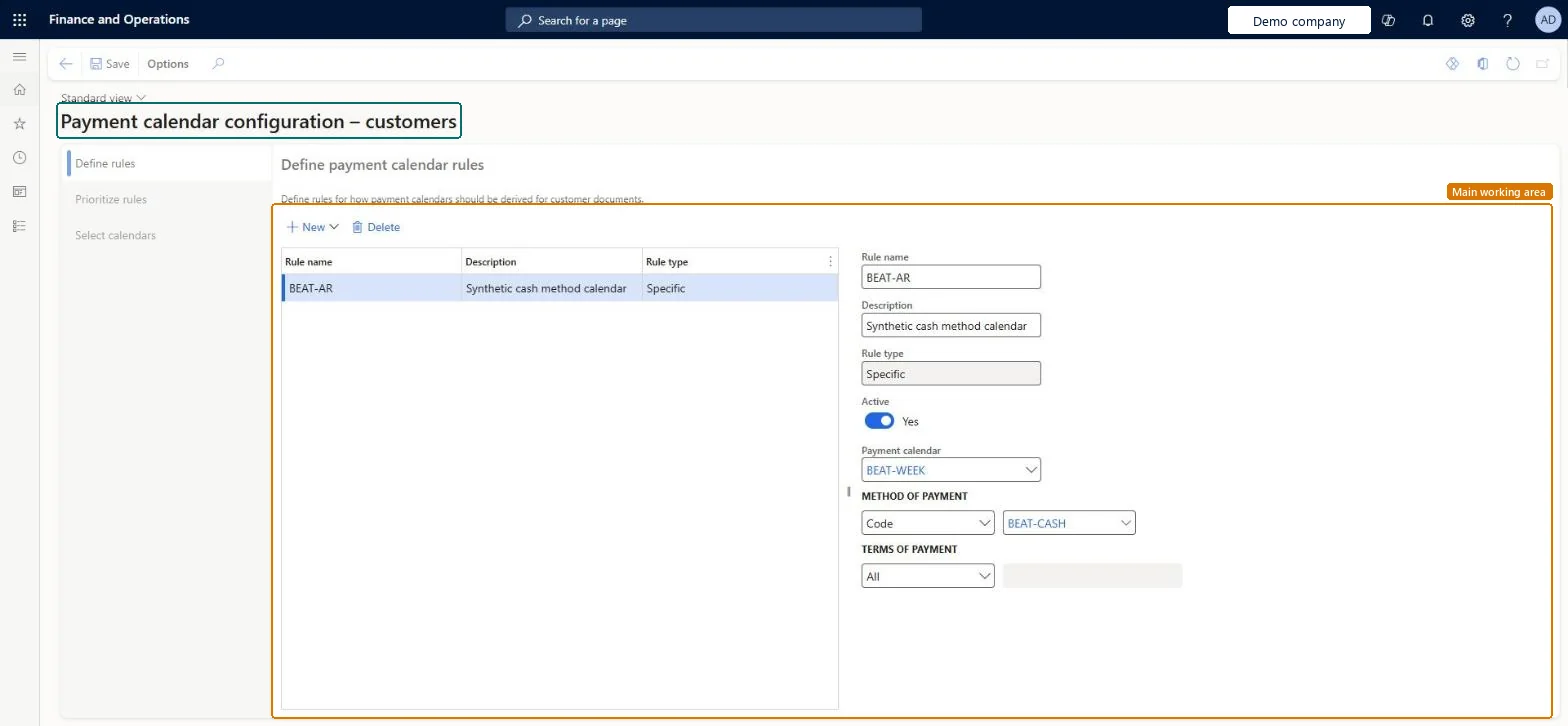
Defines prioritised rules that select which payment calendar applies to a customer based on method and terms of payment, customer address or company location when due dates are adjusted for non-working days.
Screen 1
Create the payment calendar rule
Go to Accounts receivable > Payments setup > Payment calendar configuration, Define rules tab
- On the Define rules tab, select New
- Enter the rule name and description, and set Active to Yes
- Choose the payment calendar, the method of payment code and the terms of payment
- Select Save
1Rule name BEAT-AR Description Synthetic cash method calendar Rule type Specific Active Yes Payment calendar BEAT-WEEK Method of payment Code: BEAT-CASH Terms of payment All 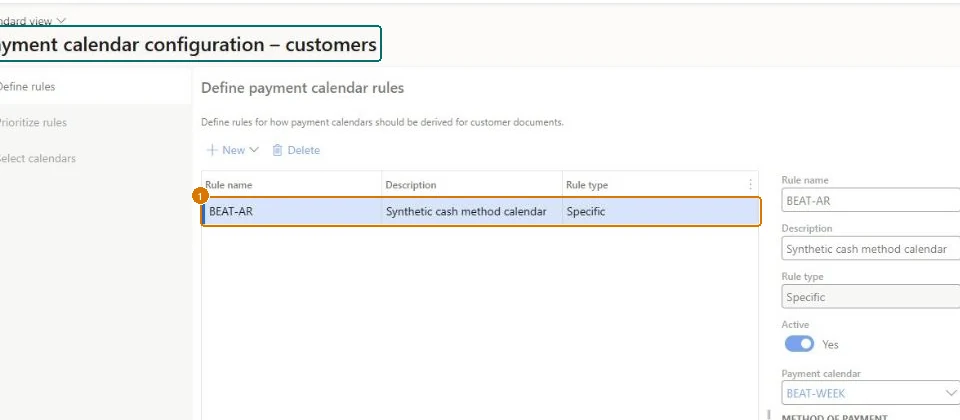
Show the full screen
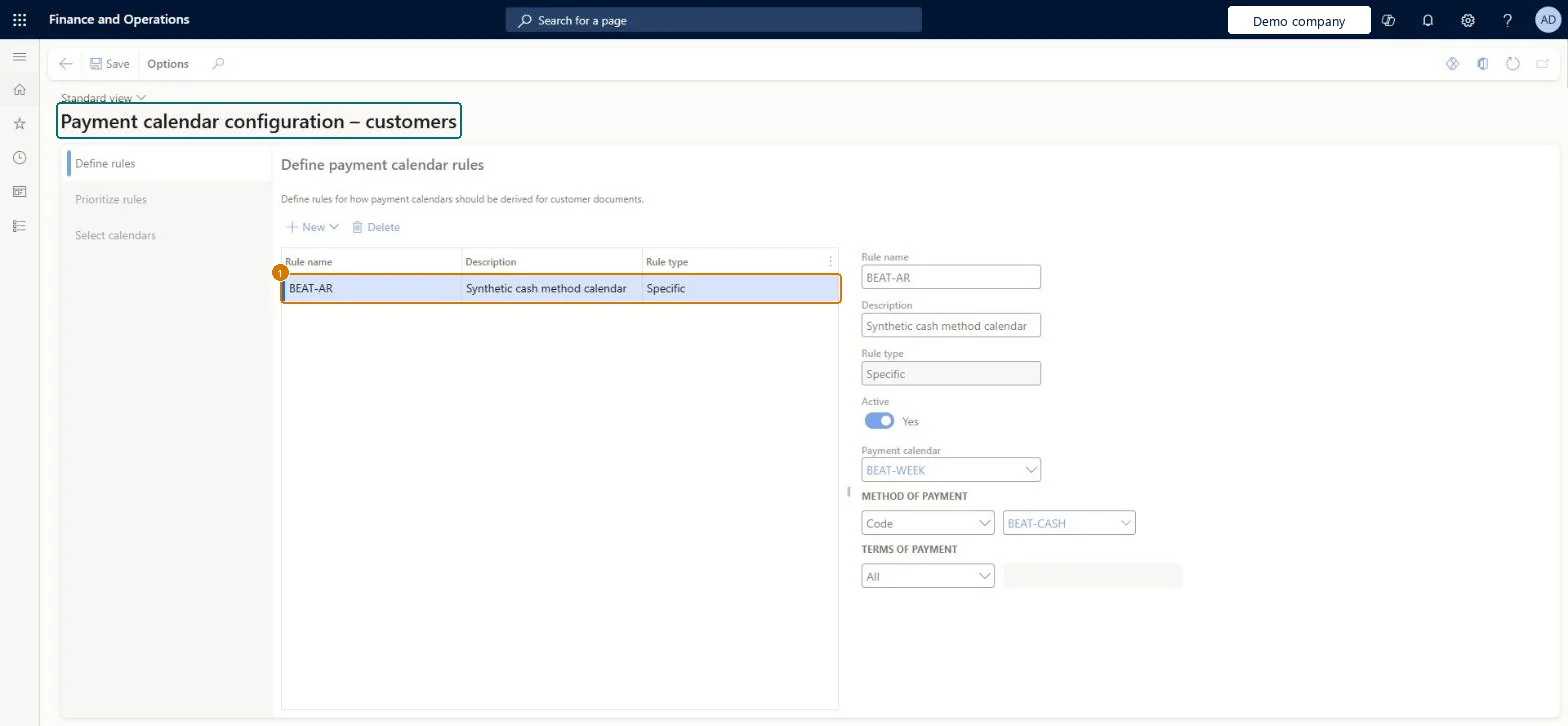
page title tab to open what to set or check
Microsoft's steps
- Go to Accounts receivable > Payments setup > Payment calendar configuration.
- Create a rule and enter a name, a description and a type.
- Choose the type: Specific, Customer/vendor location or Company location.
- Enter the values the rule uses to decide when its calendar applies.
- Select Prioritize rules.
- Use Move up and Move down to set the order in which rules are checked.
Source: Microsoft Learn ↗
Field guide
| Field | What it means | Worked example | Table column |
|---|---|---|---|
| Specific | A rule type that picks a payment calendar for the selected method of payment and terms of payment.Microsoft Learn ↗ | — | — |
| Customer/vendor location | A rule type that picks the calendar from up to three customer or vendor addresses, in the order you set.Microsoft Learn ↗ | — | — |
| Company location | A rule type that picks the calendar from the current company's location.Microsoft Learn ↗ | — | — |
| Rule name | — | BEAT-AR | Name |
| Description | — | Synthetic cash method calendar | Description |
| Rule type | — | Specific | RuleType |
| Active | — | Yes | IsActive |
| Payment calendar | — | BEAT-WEEK | — |
| Method of payment | — | Code: BEAT-CASH | — |
| Terms of payment | — | All | — |
Functional consultant
4Setup decisions
| Setup step | Recommended value and why | Decision · common mistake · test |
|---|---|---|
| Set up Payment calendar configuration | — | — |
Solution architect
5Design impact
| Shared or per company | Per company: each legal entity has its own records. Microsoft data model ↗ |
|---|---|
| Can it be undone | — |
| Feature or country | — |
| If you change it later | When several rules match, the calendar from the rule with the highest priority is used, so reordering rules changes which calendar applies. Microsoft Learn ↗ |
Technical architect
6Technical
| Menu item | PaymCalendarRuleCustomer Checked in Dynamics 365 |
|---|---|
| Form | PaymCalendarRules Checked in Dynamics 365 |
| Table | PaymCalendarRuleShown as “Payment calendar rule” in Record infoChecked in Dynamics 365 |
| Data entities | PaymentCalendarRuleEntityPayment calendar rule Microsoft data model ↗ |
| Who can open it | PrivilegesView customer payment calendar rules PaymentCalendarRuleCustomerViewMaintain customer payment calendar rules PaymentCalendarRuleMaintainCustomerDutiesEnable invoice and cash process CustInvoiceInvoiceAndCashProcessEnableInquire into customer payments status PaymCustomerPaymentsStatusInquireEnable invoice and cash process RentalCustInvoiceInvAndCashProcEnable13 security rolesCollections agentCollectionLetterCollectionsAgentCollections manager CollectionLetterCollectionsManagerChief financial officer CompanyChiefFinancialOfficerAccounts receivable clerk CustInvoiceAccountsReceivableClerkAccounts receivable manager CustInvoiceAccountsReceivableManagerAccountant LedgerAccountantAccounting manager LedgerAccountingManagerAccounting supervisor LedgerAccountingSupervisorFinancial controller LedgerFinancialControllerAccounts receivable centralized payments clerk PaymAccountsReceivableCentralPaymClerkAccounts receivable payments clerk PaymAccountsReceivablePaymentsClerkRental coordinator agent RentalCoordinatorAgentRental manager RentalManager |
| Actions on the page | — |
Developer
7Developer
| Open it directly | https://<your-environment>/?mi=PaymCalendarRuleCustomer |
|---|---|
| Integrate with | PaymentCalendarRuleEntity data entity Microsoft data model ↗ |
| Table definition | PaymCalendarRule columns and relations Microsoft data model ↗ |
Everyone
8Sources and checks
- learn.microsoft.com/training/modules/configure-accounts-receivable-dyn365-finance/payment-calendar-rules
- learn.microsoft.com/training/modules/configure-accounts-receivable-dyn365-finance/payment-calendar-rules
- learn.microsoft.com/common-data-model/schema/core/operationscommon/tables/finance/bank/reference/paymcalendarrule
- Checked in a working Dynamics 365 system, version 10.0.49: the menu item, form, table and security, the page, the demo records and the values in the screenshots.